E-commerce Website Development
Ecommerce website development is mostly about the parts shoppers never see: payments that confirm properly, stock that stays correct, shipping that is priced right, and orders your team can process without a spreadsheet on the side.
We build online stores on WooCommerce or as custom applications, with UPI, cards, net banking, wallets and cash on delivery through Indian payment gateways, plus international payments where your business qualifies. The store, the code and the merchant accounts are yours. It is one of the website development services from AlgoDevelop, an independent software studio.
On this page
- What ecommerce website development includes
- WooCommerce development or a custom ecommerce website?
- Payment gateway integration for Indian and international buyers
- Shipping, COD and GST: the details that take real work
- Product pages that load fast and show up in search
- Selling software, licences and downloads
- How ecommerce website development runs
- What we will not promise you
- Ecommerce website development – frequently asked questions
What ecommerce website development includes
A store is a small business system with a shop window on the front. Before anyone designs a product page, these questions need answers, because each one changes the build:
| Part | Questions to settle first |
|---|---|
| Catalogue | How many products? Sizes, colours or other variants? A bulk import from a spreadsheet or an old store? |
| Checkout | Guest checkout or accounts? Coupons? A minimum order value? A pin code check before payment? |
| Payments | UPI, cards, net banking, wallets, cash on delivery? International cards? Partial refunds? |
| Shipping | Flat rate, by weight, by zone, or free above a set amount? Labels and tracking through a courier’s API? |
| Tax | Which GST rate applies to each product? Are prices shown with tax included? Do invoices need your GSTIN? |
| Messages | Order emails, SMS or WhatsApp updates? Reminders for abandoned carts? |
| Back office | Who packs orders and handles returns? Does stock need to sync with a shop counter or another system? |
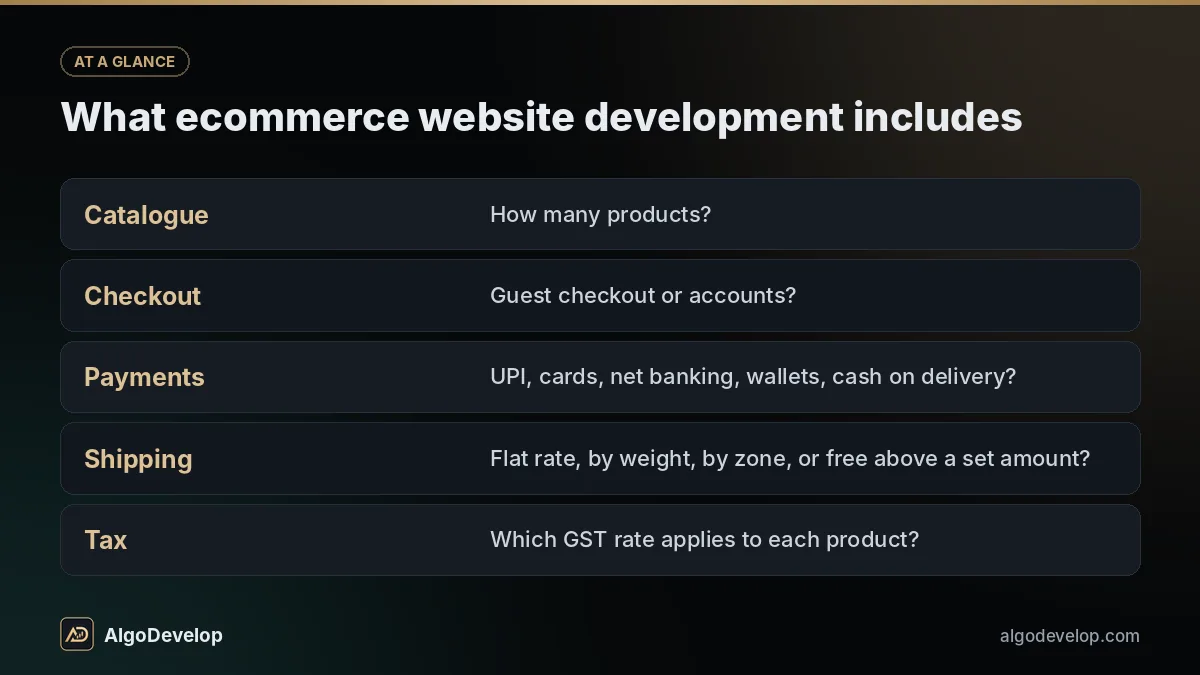
None of these is hard on its own. Together they are the real scope of ecommerce website development, and they explain why two stores that look alike can need very different amounts of work.
WooCommerce development or a custom ecommerce website?
WooCommerce
A free, open-source plugin that turns WordPress into a store, with a mature order screen, many extensions and payment plugins from the main Indian gateways. Your team manages products and content in one admin.
Custom ecommerce website
An application built in Next.js, Node.js or Python, with its own database. It suits unusual pricing, many sellers on one site, heavy traffic or deep links into your own systems. It costs more to build, and new features need a developer.
Online store development on WooCommerce is the right call for most shops: quicker to build, cheaper to run and easy to hand over. Everything on our WordPress website development page applies to it, from a lean theme to staging first. Go custom when the store is the product and its rules will not fit a standard cart; that work sits close to web application development. If a hosted platform such as Shopify, run by someone else for a monthly fee, suits you better, we will say so.
Payment gateway integration for Indian and international buyers
We integrate the gateways Indian shoppers expect, and international ones for buyers abroad:
- Razorpay
- PhonePe
- Paytm
- CCAvenue
- Cashfree
- Stripe
- PayPal
- UPI
- Cards
- Net banking
- Wallets
- Cash on delivery
The merchant account is always yours: you sign up in your business name, complete the gateway’s KYC, and payments settle to your own bank account. We never handle your money. Stripe and PayPal suit buyers abroad, but whether your business can open an account with them depends on their current rules, so check before you plan around them.
Payment gateway integration looks simple from outside: a button and a thank-you page. The parts that go wrong sit underneath:
- Server-side confirmation. An order is marked paid only when the gateway confirms it server to server, through a verified webhook. A browser landing on a thank-you page proves nothing, and a closed tab must not leave a paid order stuck as pending.
- Failed and abandoned payments. Stock held by an unpaid order is released, and the shopper can try again without creating a duplicate order.
- Refunds. Full and partial refunds go back through the gateway from the order screen.
- Test mode first. We try every payment method with test keys before live keys go in. Razorpay’s documentation describes this flow, and the other Indian gateways work along similar lines.
Shipping, COD and GST: the details that take real work
Store templates rarely get these Indian details right out of the box:
Planning an online store?
Tell us what you sell, roughly how many products you have, and how you want to take payment. We reply on WhatsApp with the questions that matter, then a fixed quote.
Get a store quote on WhatsApp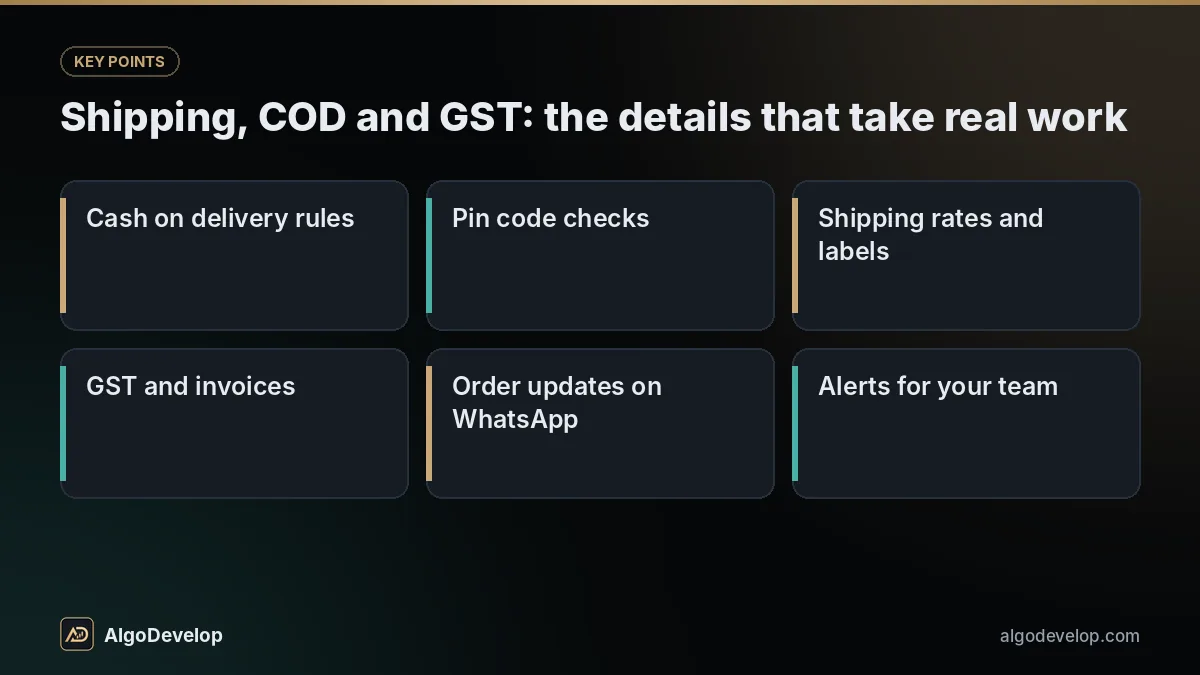
Product pages that load fast and show up in search
Most shoppers reach a product page from search or an ad, usually on a phone. In ecommerce website development, that page does more selling than the home page, so it gets the most care:
- Images sized for the screen and served as WebP, with zoom where detail matters.
- Product structured data, so search engines can read the price and stock status.
- Category filters that respond quickly without spawning thousands of thin, duplicate URLs.
- A product feed for Google Merchant Centre, if you want free listings and Shopping ads.
- A checkout short enough to finish with one thumb: no forced account, and only the fields your courier needs.
Star ratings and reviews must come from real buyers. We wire the review system up; we never fill it in. Later, the same catalogue can feed an Android and iOS shopping app through its API.
Selling software, licences and downloads
Digital products bring their own problems: the file or key must arrive the moment payment clears, and one licence must not end up on fifty computers. We run key delivery and licence checks for our own software.
This site sells 16 ready-made Windows apps, including the signal copiers on our copy trading page, each with a free two-day trial. To download one, a visitor leaves an email and a WhatsApp number, and the trial key appears on the page at once. Keys are checked by a licence server we wrote as a WordPress plugin, with an activation API and an admin panel, and a trial covers one PC and one account.
If you sell software, courses, templates or e-books, the same pieces apply: payment, instant delivery, download limits, device-tied licence keys and an account page for past purchases. Building the software itself falls under desktop application development.
How ecommerce website development runs
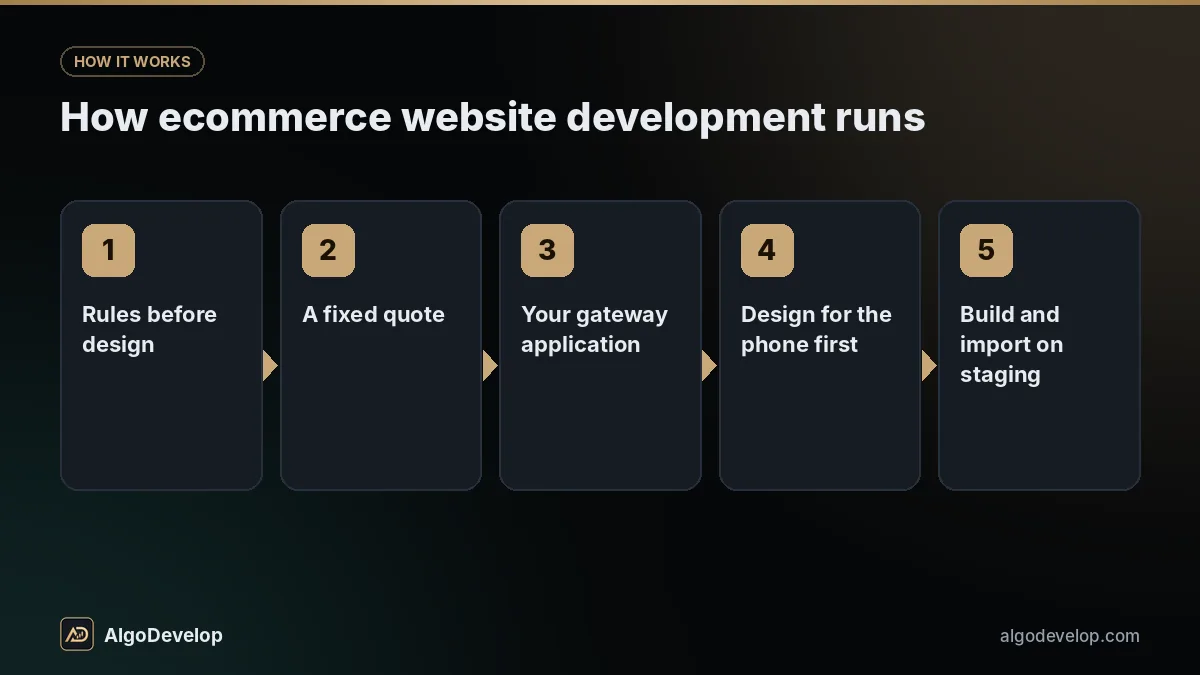
- Rules before design. We settle the questions in the table above with you, plus your returns policy.
- A fixed quote. You get a price and a typical timeline, with the exclusions written down. Our pricing page sets out why we work to fixed prices rather than hourly bills.
- Your gateway application. You apply to the payment gateway in your business name while we design, because KYC and the gateway’s checks take time of their own.
- Design for the phone first. Product, category, cart and checkout pages are approved on a small screen before anything else.
- Build and import on staging. We build the store on a private copy, and products come in from your spreadsheet or old store.
- Test every order path. Paid, failed, cancelled, refunded, part-refunded, COD, out-of-stock and coupon orders, all in test mode.
- Go live and watch. Live keys go in, and we watch the first real orders with you.
- Handover. Your team learns to add products, process orders and issue refunds, with a short written guide.
Because of that testing, a store usually takes longer than a business site of the same size. The quote confirms the timeline.
What we will not promise you
Sales come first on this list. Ecommerce website development can remove reasons not to buy: slow pages, a confusing checkout, a payment that fails halfway. It cannot create demand, fix your pricing or replace marketing, so we do not promise a sales figure.
Gateway approval is not ours to promise either; the gateway decides, and it decides how fast. COD will never be free of returned parcels, only have fewer of them. We will not add fake reviews or ratings, or copy another store’s photos and descriptions. And GST, consumer law and your refund policy are your responsibility: we build what your accountant and lawyer specify, but we do not give tax or legal advice.
Ecommerce website development – frequently asked questions
Should I choose WooCommerce or a custom ecommerce website?
WooCommerce suits most stores: it is quicker to build, cheaper to run and easy for your team to manage. A custom build makes sense when your pricing, selling model or integrations do not fit a standard cart. We recommend one after the scoping chat and explain why.
Which payment gateways can you integrate?
Razorpay, PhonePe, Paytm, CCAvenue and Cashfree for Indian payments, covering UPI, cards, net banking and wallets. For buyers abroad, Stripe and PayPal, where your business can open an account. Cash on delivery is built into WooCommerce and can run alongside any of them, limited by order value or pin code if you wish.
Who opens the payment gateway account?
You do, in your business name, and you complete the gateway’s KYC. Payments settle directly to your bank account, and the gateway charges its own fees. We set up and test the integration, and you can enter the live keys yourself at launch.
Can you set up GST on prices and invoices?
Yes. We set tax classes per product, show prices with or without GST as you prefer, and produce invoices that carry your GSTIN. Your chartered accountant should confirm the rates and the invoice format first.
How many products can a WooCommerce store handle?
Thousands, on decent hosting with a lean theme. Very large catalogues, heavy traffic or complex filters need more careful hosting and database work. That is also the point where a custom ecommerce website is worth discussing.
How long does an online store take to build?
A typical WooCommerce store usually takes several weeks, longer than a business site of the same size, because every payment and order path is tested. It depends on the number of products, the integrations and how quickly your gateway approves the account. The quote confirms the timeline before work starts.
Can you move my existing store to WooCommerce?
Usually, yes. Products, categories, customers and past orders can be moved, depending on what your current platform exports, and every old product URL gets a redirect. The moved store is tested on staging before the switch.
Do you build stores for sellers outside India?
Yes. We are an ecommerce website development company in India, and we build stores for sellers abroad too, using Stripe or PayPal where your business can hold an account. Ask on WhatsApp, on Telegram or through the contact page.