Zerodha Automation
Zerodha automation puts your own rules in charge of your own Kite account. We build it to your requirement. Then it runs on the source you actually use: Telegram, WhatsApp, Discord, TradingView or a strategy of your own.
You run the software on your own PC or VPS, with your own Kite Connect keys. AlgoDevelop is a software developer, not a SEBI-registered intermediary. So we give no signals or advice, we place no trades for you, and we never manage your funds.
On this page
- What Zerodha automation actually means
- Ready-made Zerodha automation: the two Indian copiers
- Built to your requirement
- Where the signals come from
- Kite Connect plans: what you pay Zerodha
- The login that expires every single day
- Your static IP and SEBI’s algo rules
- Options, and the tradingsymbol that changes weekly
- MIS, CNC, NRML and squaring off on your terms
- The limits, and why they belong in code
- Where you stand
- Starting without risking anything
- Frequently asked questions
What Zerodha automation actually means
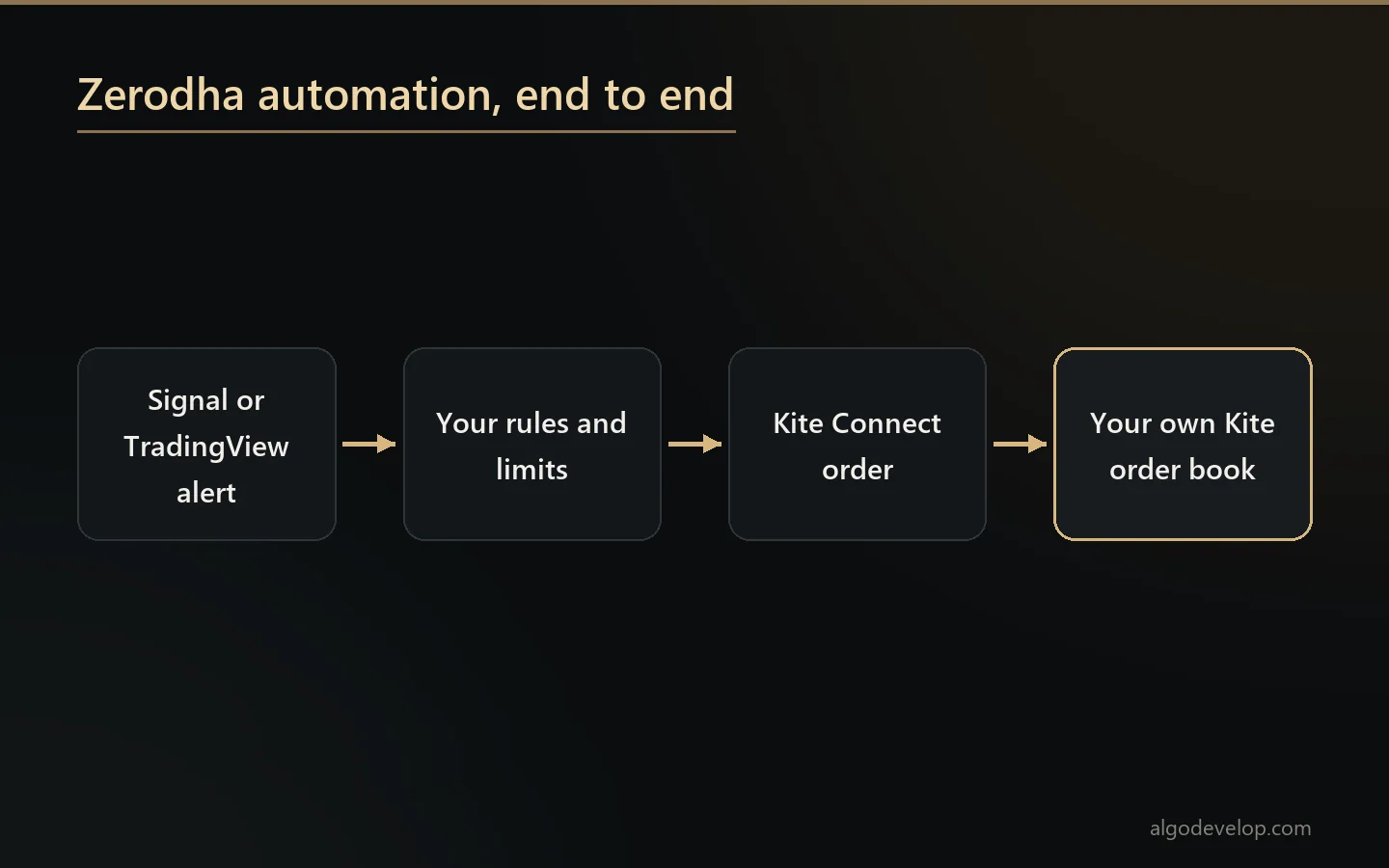
Zerodha automation is software that holds a Kite Connect session to your own account. It watches what you tell it to watch, and it places the order once your condition comes true. The order then lands in your normal Kite order book. Your funds never move, and nobody else touches the account.
Zerodha is one of the largest brokers in India, and Kite Connect has been around for years. That means two things. First, the API is mature and well documented. Second, many people have already tried to automate it badly, so the ways it fails are well known. Most of this page is about those.
Ready-made Zerodha automation: the two Indian copiers
Not every job needs custom code. Two of our ready-made apps already trade Zerodha through Kite Connect, along with nine other Indian brokers:
- The Telegram to Indian broker copier turns the calls in your Telegram channels into Kite orders.
- The TradingView to Indian broker copier does the same for your TradingView alerts.
For a Zerodha account, both of them handle the awkward parts for you:
- One click a day. Log in with Kite opens Kite’s own page, and the day’s token comes back to the app by itself.
- The right contract. They match each option against Kite’s own instrument list, so the tradingsymbol is never a guess.
- The right product. Intraday goes as MIS. Delivery goes as CNC for shares and as NRML for options.
- Large orders. An order above the exchange freeze limit goes out with Kite’s auto-slicing, and the journal lists every order id.
- Plain errors. Kite answers HTTP 403 both for a dead token and for too many requests, so the app tells you which one it was.
They trade options and NSE cash equity. Futures and MCX are outside them, so those need a custom build.
Built to your requirement
Custom Zerodha automation is not a ready-made bot you configure and hope suits you. Instead, you say what should happen, and that is what we write.
The requirements people bring us are just sentences. Enter only in the first hour and square off by 3:15. Skip the next signal if the last trade lost. Trade two lots on BANKNIFTY, one on NIFTY and nothing on stocks. Stop for the day after three losses, whatever arrives later. Send a Telegram message every time anything happens.
Tell us the requirement, and we will say plainly whether Kite Connect can do it before you commit, not after.
Where the signals come from
The decision can start anywhere, and Zerodha automation carries it out either way:
- Telegram – any channel, group or bot your own account can read.
- WhatsApp – groups or one-to-one chats, forwarded calls included.
- Discord – servers and channels, including bot posts and embeds.
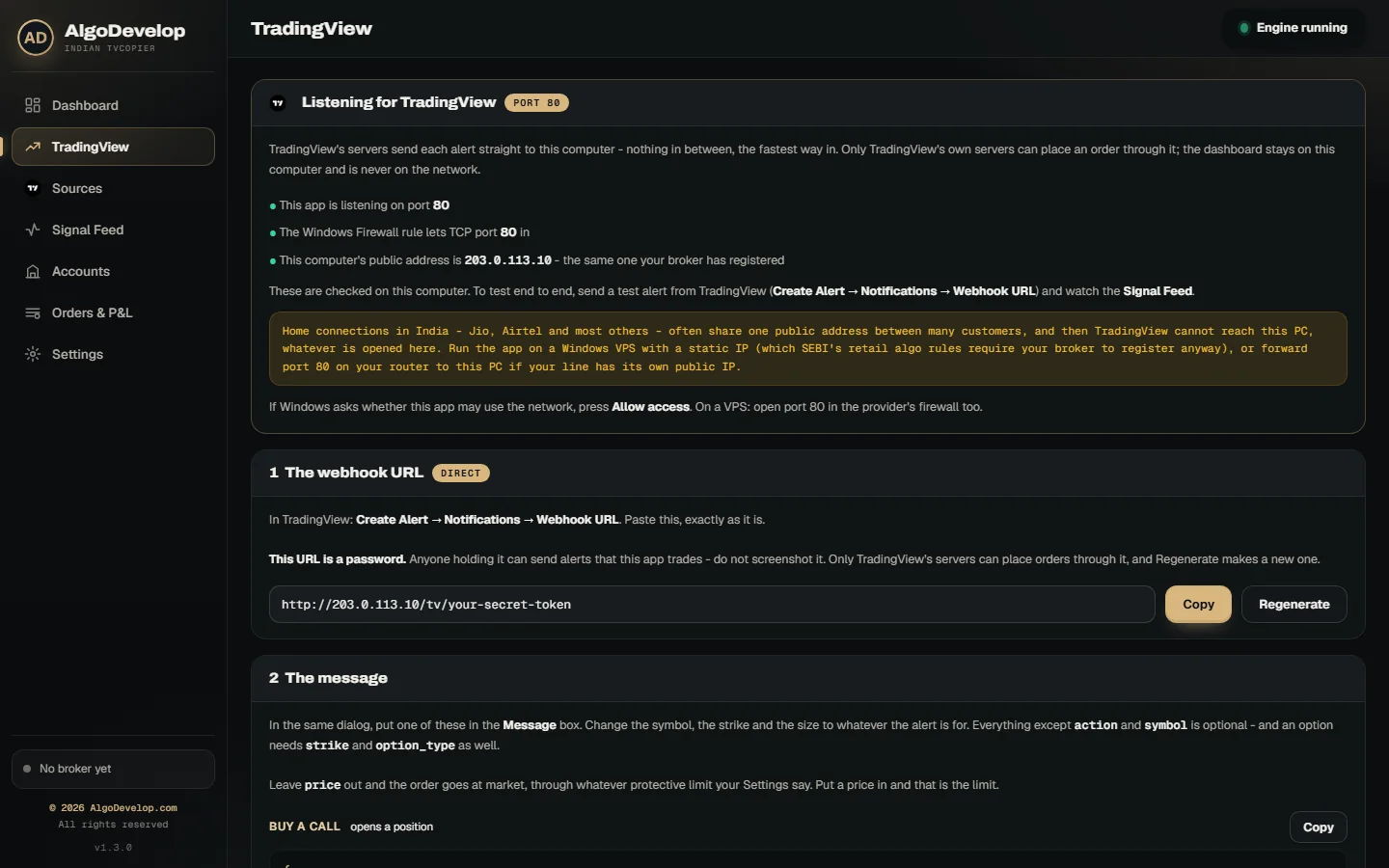
- TradingView – a webhook alert from your own Pine strategy. That way you trade something you built, not something you follow.
- Logic inside the software – crossovers, candle rules, time rules and streak rules, with no outside source at all.
- You, by hand – you decide, then it places the order and manages the position.
Several at once is normal. For example, a Telegram channel can drive your options while your own TradingView strategy trades futures. Each one keeps its own size and daily limits.
Kite Connect plans: what you pay Zerodha
This is the question that stops most people, so it deserves a straight answer.
Zerodha now offers two API plans. The free Personal plan places orders and reads your positions, holdings and funds, but it has no market data. The paid Connect plan adds live prices over WebSocket and historical candles. Any fee goes to Zerodha, not to us. So check the current terms on Zerodha’s own API page rather than trust a number on a page like this one.
Which plan you need depends on what the software must read. Placing an order needs no market data. However, anything that works from live prices does. That covers a limit set from the last price, a strike picked by its premium and a stop that trails.
Whether the paid plan pays for itself is arithmetic, not opinion. If the automation catches trades you kept missing, or enforces a rule you keep breaking, the fee is usually small next to that. If you place four orders a month, it may not be. We would rather you did that sum before you commission anything.
The login that expires every single day
Kite Connect does not keep you signed in. Your access token expires at 6 AM the next day, which the Kite Connect documentation calls a regulatory rule. So Zerodha automation needs a fresh token every trading morning.
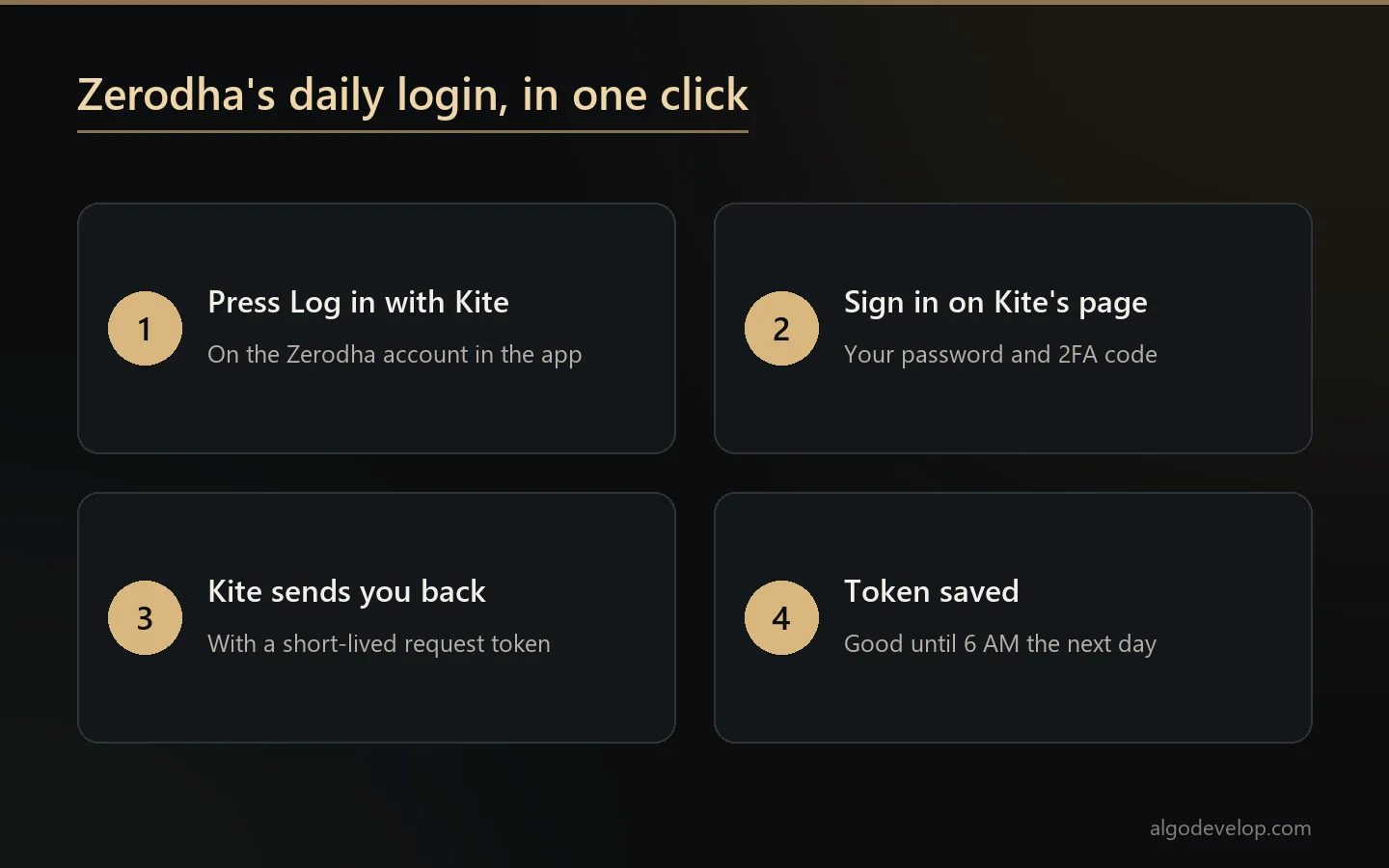
The login itself always happens on Kite’s own page, with your password and your 2FA code. After that, the ready-made copiers make the rest one click:
- Press Log in with Kite on the Zerodha account in the app.
- Sign in on Kite’s own page, which opens in your browser.
- Kite sends you back to the app with a short-lived request token.
- The app swaps it for the day’s access token and saves it to that account.
You set the redirect URL in your Kite Connect app once, and the Zerodha account shows the exact address to use. Pasting a token by hand still works too. Above all, a dead token never fails quietly: the app names it as the reason, so you do not find out at lunch.
Your static IP and SEBI’s algo rules
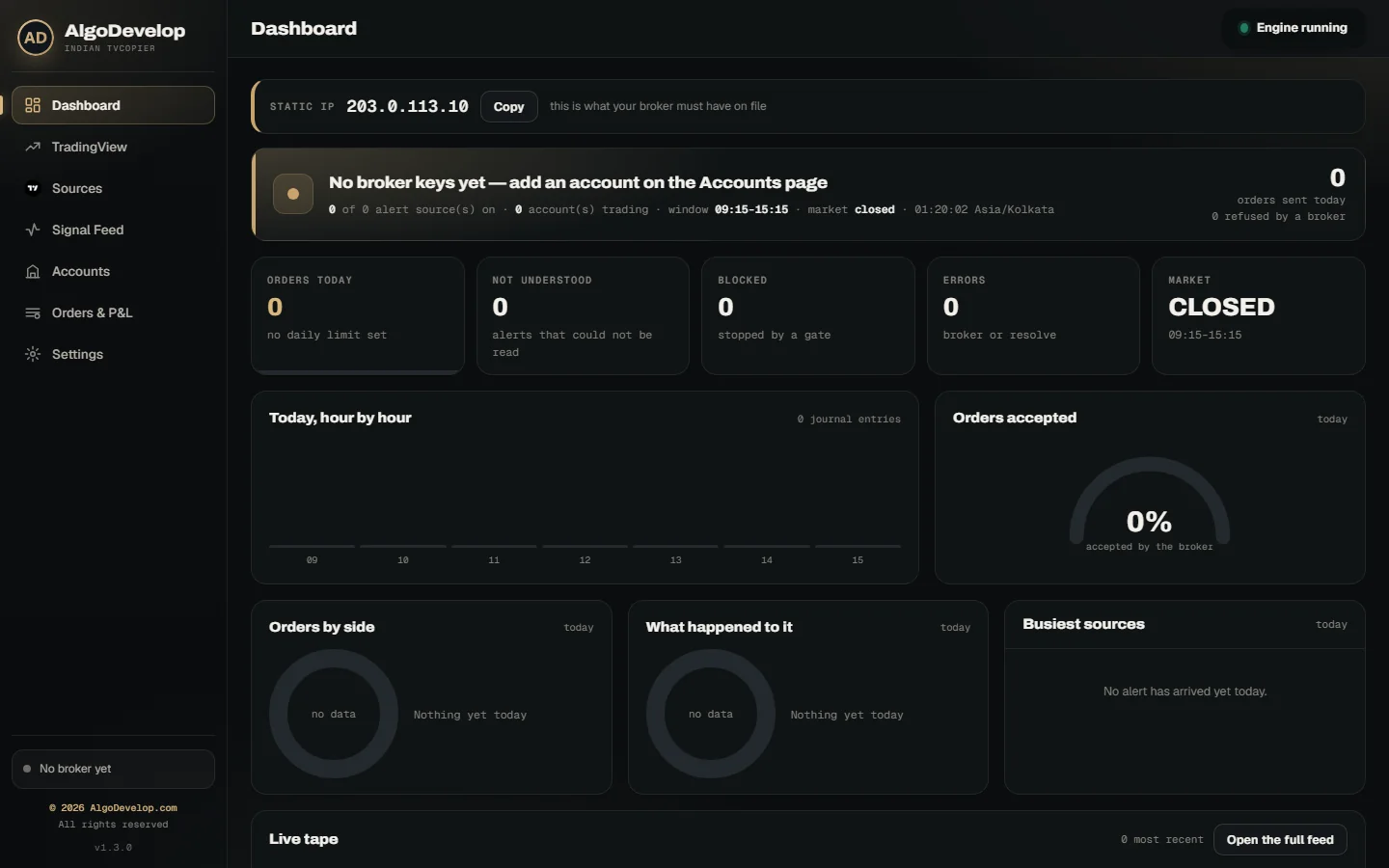
SEBI’s framework for retail algo trading has applied since 1 April 2026. Under it, Zerodha takes API orders only from a static IP that you have registered with it. So a home connection whose address keeps changing will not do. A VPS with a fixed IP will, and so will a static IP from your internet provider.
The rules also shape the orders. A market order from the API must carry a protection band, and the copiers send one. Better still, they turn market signals into protective limit orders by default. Each order also carries a tag, which keeps it apart from your manual trades.
The Dashboard shows the address your broker sees, with a Copy button. If that address changes, the app warns you, because Zerodha refuses orders from an IP it does not know.
Options, and the tradingsymbol that changes weekly
Equity is simple: a symbol, a quantity and a side. Options are where Zerodha automation either works or silently stops, so it helps to see why.
“NIFTY 24600 CE” is not an instrument yet. It becomes one only after the software finds the strike, the right weekly or monthly expiry and the exact tradingsymbol Kite expects for that contract. Those change at every expiry. So anything that hard-codes them works for a week and then quietly does nothing.
That is why the copiers download Kite’s instrument list and reload it every six hours. With no expiry named, they take the nearest one that has not passed. A SENSEX option needs one more check, because Zerodha blocks SL-M orders on BSE segments. In that case the app sends an SL order through your protection band instead, and the journal says so.
A custom build does the same for futures, and for MCX where your account has it.
MIS, CNC, NRML and squaring off on your terms
You choose the product per strategy or per account. MIS is intraday, with its compulsory same-day exit. CNC is delivery for shares, while NRML carries an F&O position forward.
Next, set your own square-off time. At that minute, Zerodha automation squares off what is still open, before Zerodha’s own auto square-off runs. You exit at your time rather than theirs, and you avoid the fee Zerodha charges for squaring off on your behalf. If you carry positions overnight, simply leave the time blank.
The limits, and why they belong in code
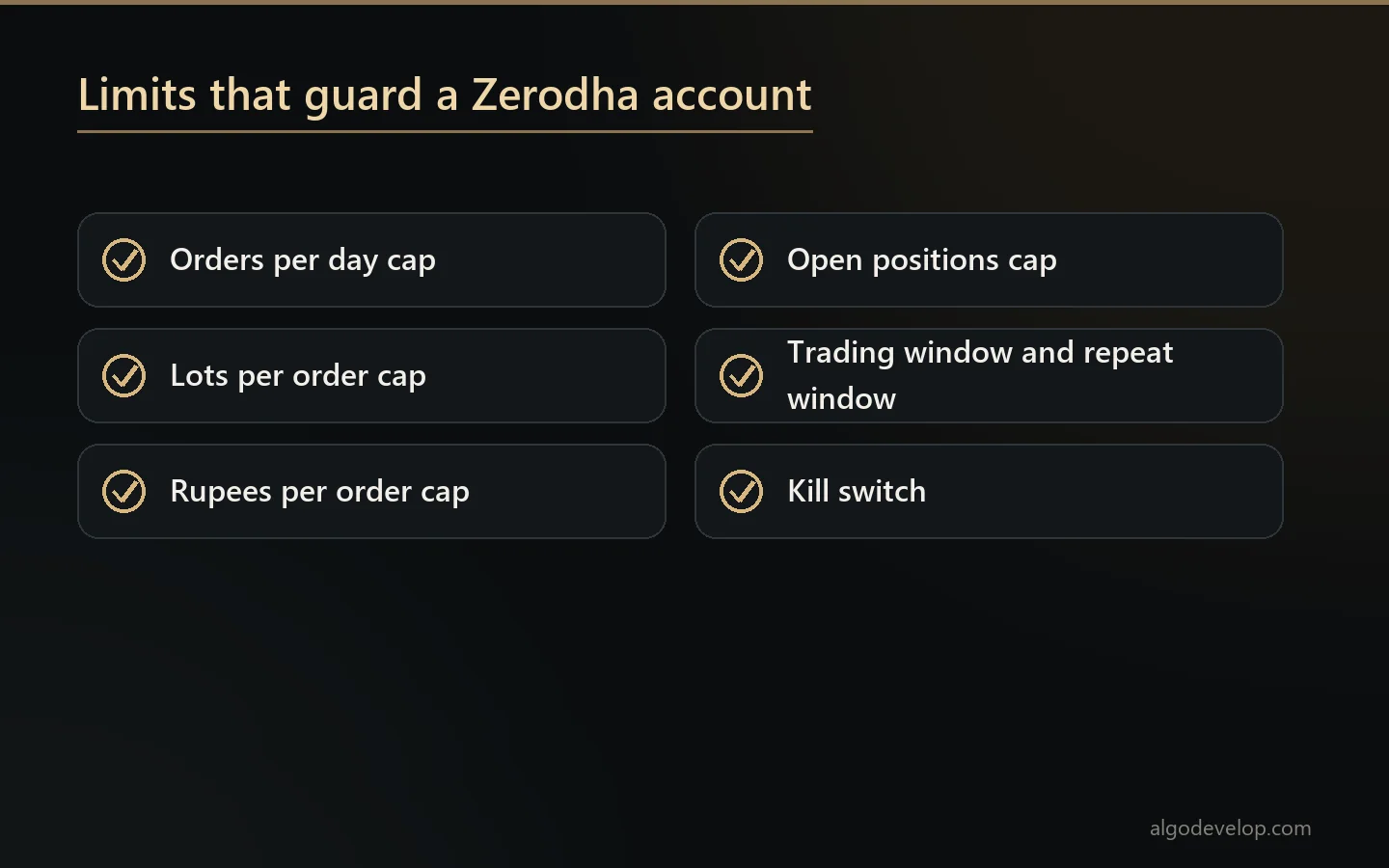
A limit you keep in your head breaks on a bad day, but a limit in code does not. So both ready-made copiers carry these for each Zerodha account:
- A daily cap on orders, 10 to start with, and a cap on lots per order.
- Ceilings on rupees per order and on open positions.
- A slippage guard that skips an entry when the price has run too far.
- Trading hours of 09:15 to 15:15 by default, plus a repeat window for calls posted twice.
- One kill switch that refuses every new order at once.
A custom build can add more, such as a daily loss cap, a daily profit target and a list of allowed instruments. Either way, every refusal goes into the log with its reason.
Where you stand
Your own Zerodha account, your own API keys and your own rules: that is you trading your own money, with a tool you paid to have built.
Running it on other people’s accounts falls under SEBI’s rules in India. We build software, nothing more. AlgoDevelop is not a SEBI-registered intermediary, adviser or research analyst, and it is not your broker or fund manager. We give no tips, we do not run the software for you, and we promise no outcome. You make the trading decisions, and you handle any registration your use may need. Read whether copy trading is legal in India before you accept anyone else’s capital.
Starting without risking anything
- Describe the requirement on WhatsApp: entries, exits, instruments, sizing, and what should happen if a signal arrives while you already hold a position.
- We tell you what Kite Connect can and cannot do for that Zerodha automation, then quote a fixed price with a timeline.
- You create the Kite Connect app and keep the keys. You also register your static IP with Zerodha.
- Run one session with trading switched off, or in Paper mode with a ready-made copier. Then read the log: it shows every signal seen and every order it would have placed.
- Go live small, and scale only when the log matches what you expected.
Trading elsewhere as well? We do the same work for Angel One, Upstox, Fyers and Dhan. One strategy can also drive several accounts through multi-broker copy trading. For a step-by-step guide, read how to automate Zerodha, or simply ask for a quote.
Zerodha automation – frequently asked questions
Is there a ready-made Zerodha bot?
There are two. The Telegram to Indian broker copier and the TradingView to Indian broker copier both trade Zerodha through Kite Connect. For anything they do not cover, we write Zerodha automation to your requirement.
Can it take signals from Telegram, WhatsApp or Discord?
The ready-made copiers take Telegram calls and TradingView alerts. A custom build can also read WhatsApp and Discord, run its own logic or take a manual trigger. Several sources can run at once, each with its own size and limits.
Do I have to pay Zerodha for API access?
Placing orders works on Zerodha’s free Personal plan, which has no market data. Live prices and historical candles come with the paid Connect plan. Any fee goes to Zerodha, not to us, so check the current terms on Zerodha’s API page.
Do I have to log in every morning?
Once a day, yes, because a Kite token expires at 6 AM the next day. In the ready-made copiers it takes one click. Log in with Kite opens Kite’s own page, and the token comes back to the app by itself.
Why does Zerodha need my static IP?
Since 1 April 2026, SEBI’s retail algo rules let Zerodha accept API orders only from a static IP you have registered. The app shows the address your broker sees, with a Copy button.
Can it trade options like BANKNIFTY 52000 CE?
It can. The software matches the strike, expiry and exact tradingsymbol against Kite’s own instrument list, because those symbols change at every expiry.
Can it trade futures or MCX?
Not in the ready-made copiers, which trade options and NSE cash equity and refuse a futures signal with a clear reason. A custom build can, as long as your account has that segment.
Can it run my own TradingView strategy?
Of course. Your Pine strategy fires a webhook alert, and Zerodha automation places the order. That way you trade something you built rather than something you follow.
Do you provide signals or run it for me?
Neither. We build the software, and you run it on your own account with your own keys. We are not a SEBI-registered intermediary, adviser or research analyst.
Do I own what you build?
You do. Custom Zerodha automation comes with its documentation. There is no per-trade fee, and nothing of ours it has to reach in order to run.
Can I test it without placing real orders?
Yes, in two ways. Run a session with trading switched off, or use Paper mode in a ready-made copier. Either way, the log shows every signal, every order it would have placed and the reason for anything skipped.
What about SEBI compliance?
Trading your own account with your own keys and rules is you trading your own money. Running it for other people falls under SEBI’s rules, so take your own advice first.