Upstox Automation
Upstox automation takes the decision you would have made and places it for you, on your own Upstox account. We build it to your specification, and Telegram, WhatsApp, Discord, TradingView or a strategy inside the software can drive it.
You run the software on your own PC or VPS, under your own Upstox API keys. AlgoDevelop is a software developer, not a SEBI-registered intermediary. So we give no signals or advice, we place no trades for you, and we never manage your funds.
On this page
- What Upstox automation actually means
- Ready-made Upstox automation: the two Indian copiers
- The OAuth redirect, which is where people actually get stuck
- Built to your requirement
- Where the signals come from
- Testing before real money is involved
- Your static IP and SEBI’s algo rules
- Options and the weekly symbol problem
- Product types and square-off
- Limits worth setting before you need them
- Where you stand
- Starting
- Frequently asked questions
What Upstox automation actually means
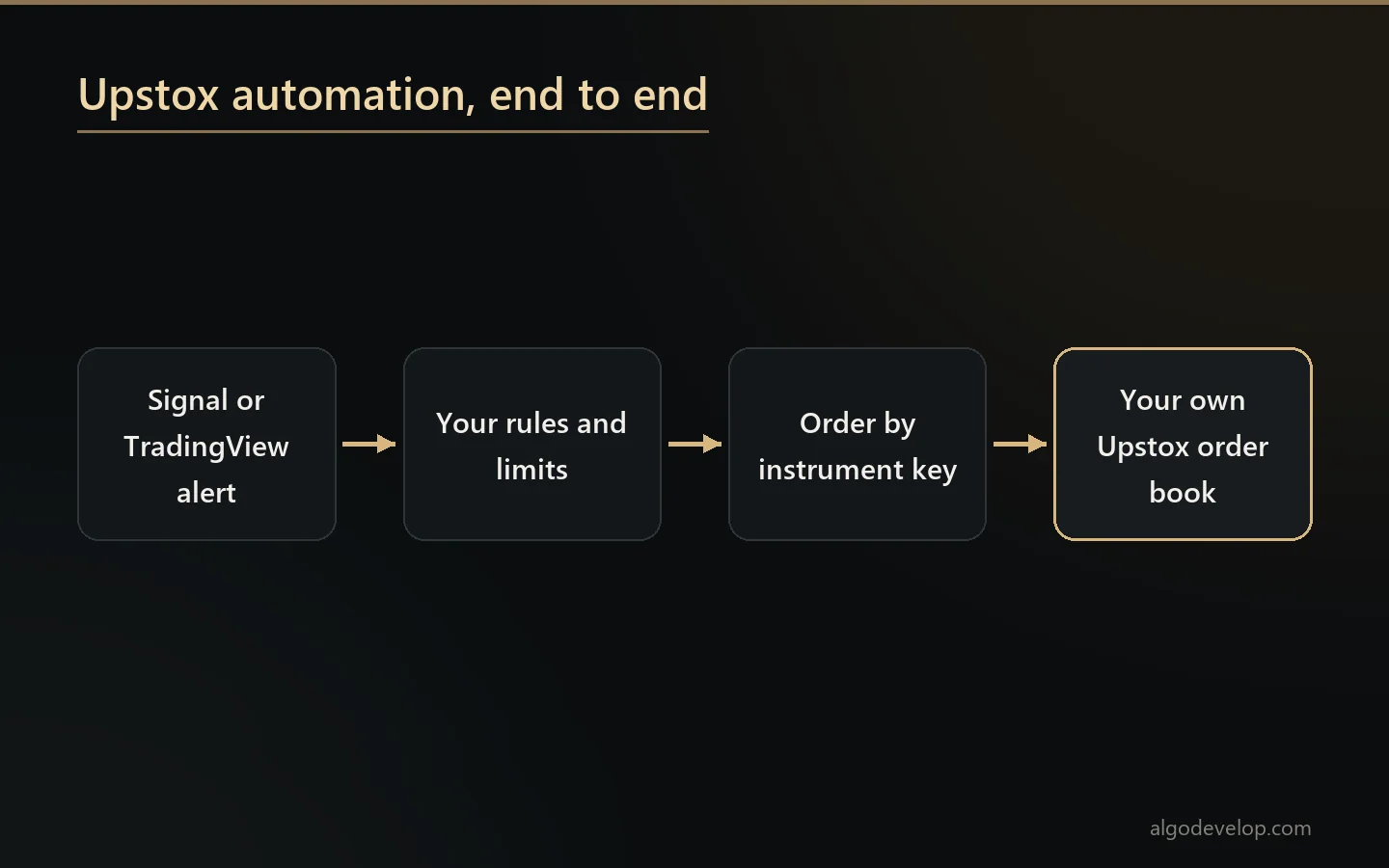
Upstox automation is software that holds a signed-in session to your own Upstox account. It places orders through the Upstox API whenever your conditions come true. The orders then appear in your normal order book, while your money and your login stay under your control.
Upstox lists its trading and data APIs as free, so the API itself adds no monthly bill. Brokerage still applies to each order, so check Upstox’s own pricing before you plan around a number.
Ready-made Upstox automation: the two Indian copiers
Not every job needs custom code. Two of our ready-made apps already trade Upstox, along with nine other Indian brokers. The Telegram to Indian broker copier turns the calls in your channels into orders. The TradingView to Indian broker copier does the same for your TradingView alerts.
For an Upstox account, both of them handle the awkward parts:
- The instrument key. Upstox names every contract by a key such as NSE_FO|43919, never by its symbol. So the app finds that key in Upstox’s own instrument file.
- The fast order host. Orders go to Upstox’s low-latency order address, not the general one.
- Large orders. An order above the exchange freeze limit goes out sliced by Upstox, and the journal lists every order id it became.
- Safe market orders. Market signals become protective limit orders by default. If a market order does go out, it carries Upstox’s protection band.
- The right exchange. A stock listed on both exchanges trades on NSE. BSE is only a fallback, and the app labels it as one.
- Upstox’s own words. When Upstox refuses an order, such as for low funds, the journal shows its reason rather than a bare error code.
They trade options and NSE cash equity. Futures and MCX are outside them, so those need a custom build.
The OAuth redirect, which is where people actually get stuck
Upstox signs you in through an OAuth flow. It is the most common reason a first attempt at Upstox automation does not work, so get it right before anything else.
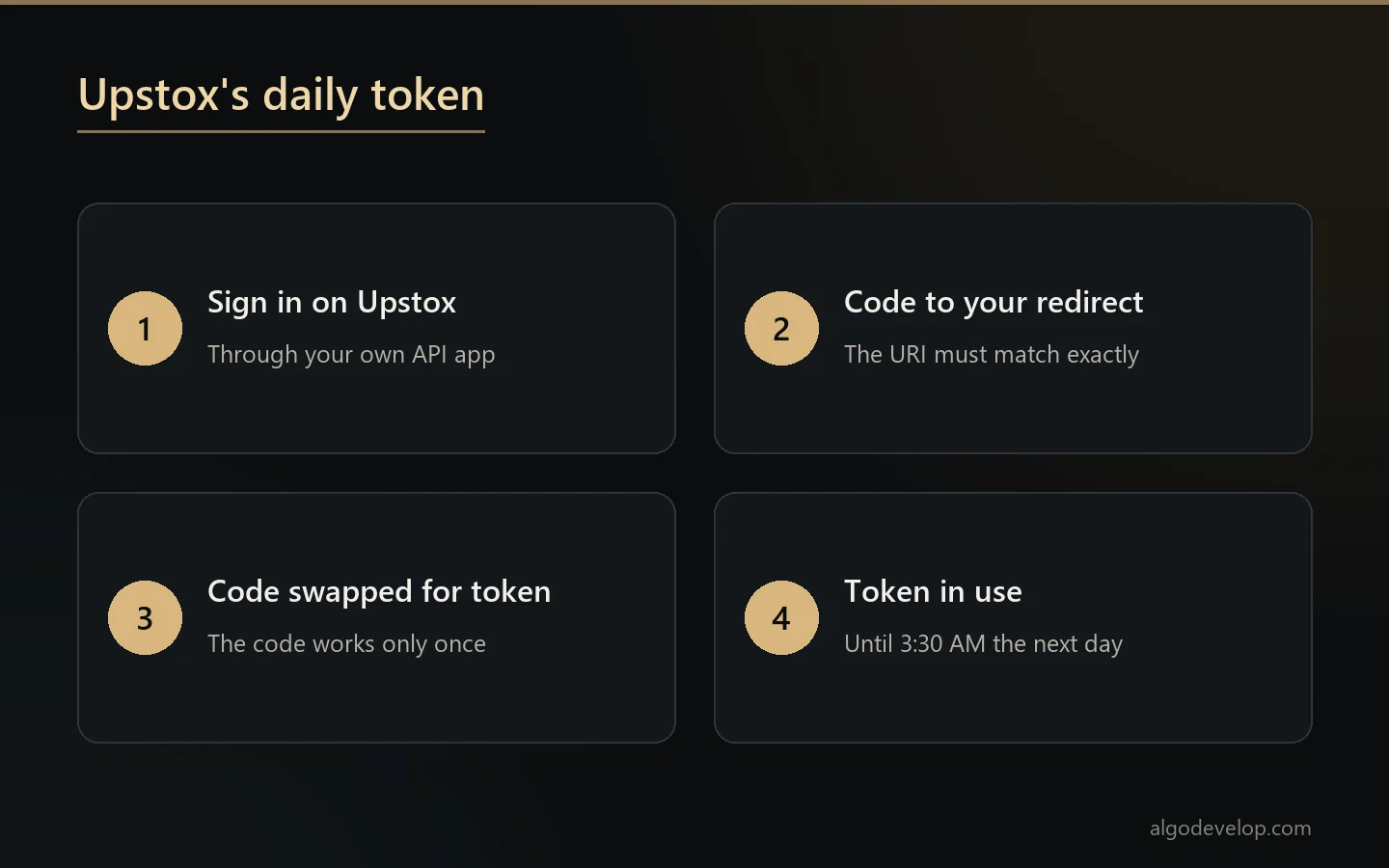
First, you register an app in the Upstox developer console and set a redirect URI. After you sign in, Upstox sends you there with a code in the address. Then the software swaps that code for an access token, and each code works only once. If the registered URI differs at all from the one the software uses, the login fails with an error that explains nothing. Protocol, port and path all count.
The token lasts until 3:30 AM the next day, whenever you made it. So someone has to sign in, or approve a sign-in, once each trading day. In the ready-made copiers, you paste the day’s token on the account each morning. Test the connection then confirms it, and an expired token shows up as a plain message rather than a silent failure.
A custom build can take the code swap off your hands. It can also use Upstox’s token request, which you approve on your phone instead. The Upstox API documentation covers all three ways, and the redirect URI is the setting to check first.
Built to your requirement
Custom Upstox automation is not a fixed product with a settings page. Instead, you describe the behaviour you want, and that is what we build.
The requirements are usually plain English. Trade only the first hour. Skip the next signal if the previous one lost. Put two lots on the index and none on stocks. Stop after three losses. Message me on Telegram when anything happens. Those sentences are the specification.
Tell us yours, and we will say whether the Upstox API supports it before you commit to anything.
Where the signals come from
Upstox automation carries out the decision wherever it starts, and several sources can run together:
- Telegram – any channel, group or bot you can already read.
- WhatsApp – groups, direct messages and forwarded calls.
- Discord – servers and channels, bot posts and embeds included.
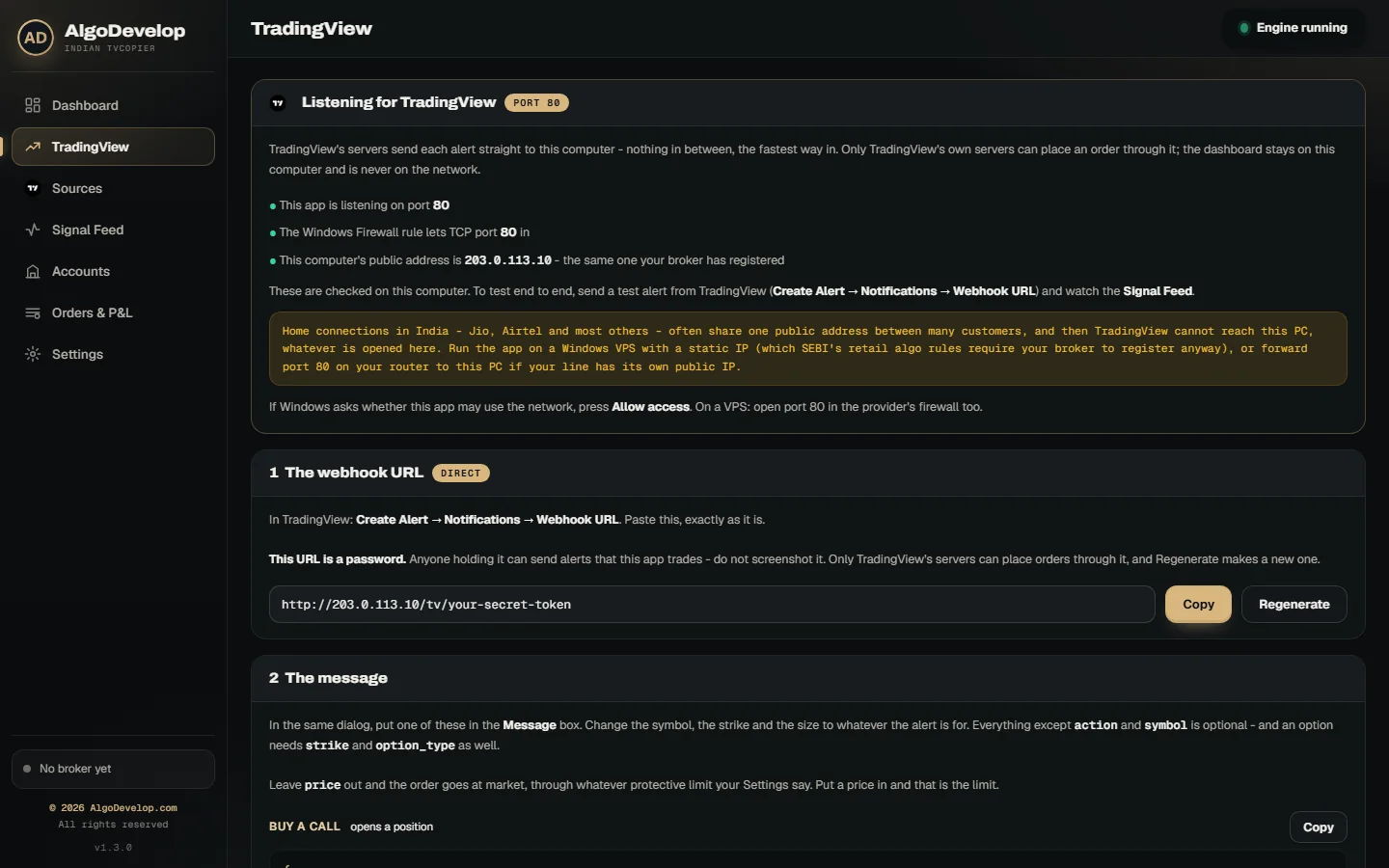
- TradingView – webhook alerts from your own indicator or strategy.
- Logic inside the software – with no outside source at all.
- Manual – you press, then it places the order and manages it.
More than one at a time is normal, each with its own quantity and its own daily limits.
Testing before real money is involved
Upstox offers a sandbox, which makes testing Upstox automation easier than at most brokers. Its sandbox covers placing, changing and cancelling orders, and a sandbox token lasts 30 days. However, you get one sandbox app per user, and its tokens never touch your live account.
We use the sandbox where it covers what you need. Where it does not, we run a session with trading switched off, so the log shows every order the software would have placed. The ready-made copiers add Paper mode too. It reads live prices from your real Upstox account, but fills every order in the app’s own book. Either way, you read the log before anything goes live.
Your static IP and SEBI’s algo rules
SEBI’s framework for retail algo trading has applied since 1 April 2026. Under it, Upstox takes API orders only from a static IP that you have registered with it. So a home connection whose address keeps changing will not do. A VPS with a fixed IP will, and so will a static IP from your internet provider.
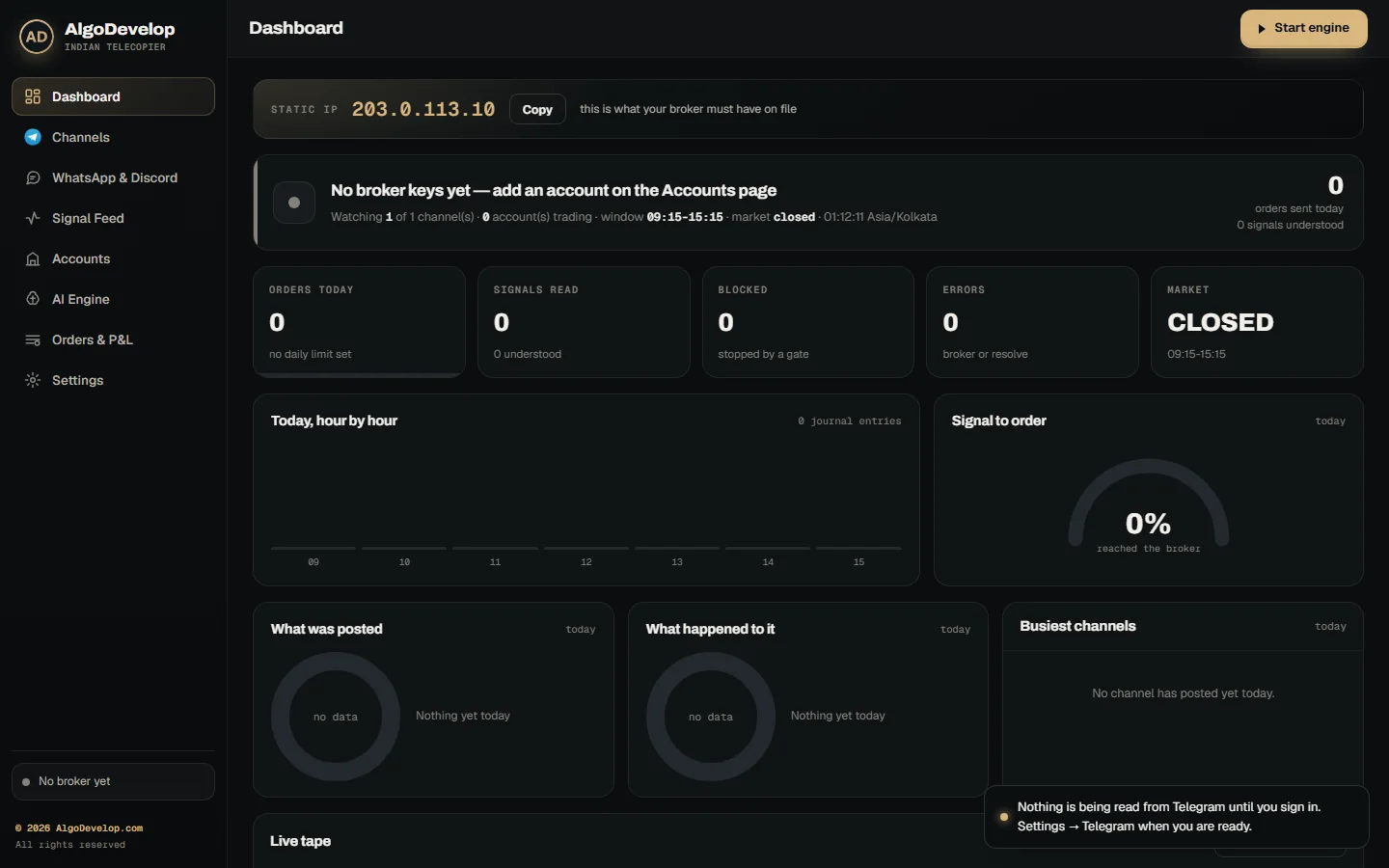
The Dashboard shows the address Upstox sees, with a Copy button. If that address changes, the app warns you, because Upstox refuses orders from an IP it does not know.
Options and the weekly symbol problem
For Upstox automation, an instruction like “NIFTY 24600 CE” is not yet an instrument. The software has to find the strike, the expiry and the exact instrument key Upstox uses. Those change at every expiry, so anything hard-coded works for a week and then silently stops.
That is why the copiers download Upstox’s instrument file and reload it every six hours. With no expiry named, they take the nearest one that has not passed. A custom build matches futures and MCX contracts the same way, where your account has them.
Product types and square-off
Upstox writes its products as single letters: I for intraday and D for delivery. Send the full word, and Upstox answers with an unhelpful error, so the app always sends the letter.
Give Upstox automation its own square-off time, and it squares off what is still open at that minute. That way you are not waiting for the broker’s automatic square-off. If you carry positions overnight, simply leave the time blank.
Limits worth setting before you need them
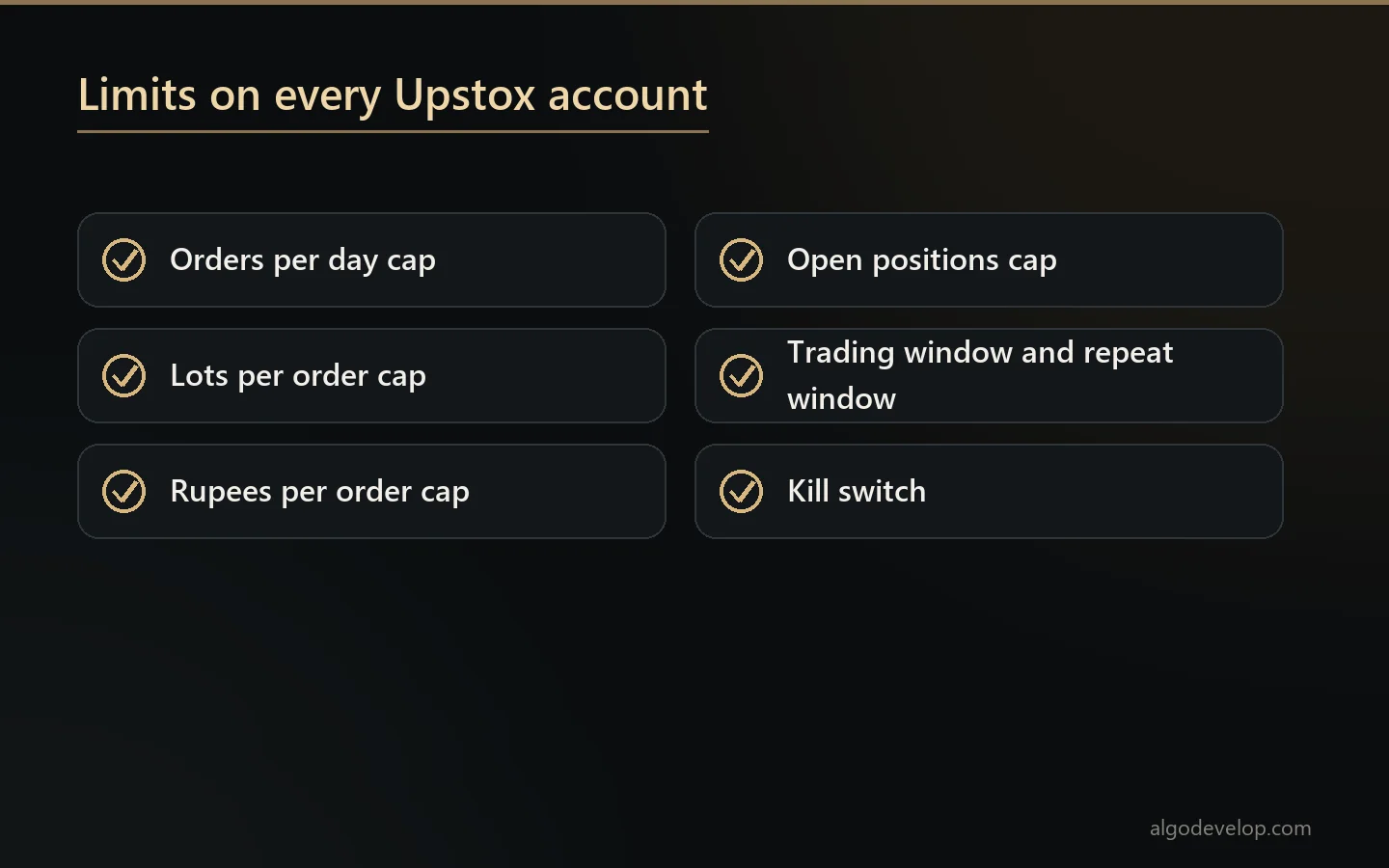
Both ready-made copiers carry these limits for each Upstox account:
- A daily cap on orders, 10 to start with, and a cap on lots per order.
- Ceilings on rupees per order and on open positions.
- A slippage guard that skips an entry when the price has run too far.
- Trading hours of 09:15 to 15:15 by default, plus a repeat window for calls posted twice.
- One kill switch that refuses every new order at once.
A custom build can also carry a daily loss cap, a daily profit target and allowed instruments and hours. Those extra limits stay off until you switch them on. Either way, each refusal goes into the log with its reason.
Where you stand
Your account, your credentials and your rules: that is you trading your own money with software you commissioned.
Doing the same on other people’s accounts falls under SEBI’s rules in India. We build software, nothing more. AlgoDevelop is not a SEBI-registered intermediary, adviser or research analyst, and it is not your broker or fund manager. We give no tips, we do not run the software for you, and we promise no outcome. You make the decisions, and you handle any registration your use may need. Before you trade for anyone else, read whether copy trading is legal in India.
Starting
- Describe the requirement in whatever form you have it.
- We scope the Upstox automation against their API and quote a fixed price.
- You register the app, set the redirect URI and register your static IP.
- Test in the sandbox, in Paper mode or with trading switched off, and read the log.
- Go live small, then scale once the log matches what you expected.
Other brokers too: Zerodha, Angel One, Fyers and Dhan. You can also run them all together with multi-broker copy trading. When you are ready, ask for a quote.
Upstox automation – frequently asked questions
Is there a ready-made Upstox bot?
There are two. The Telegram to Indian broker copier and the TradingView to Indian broker copier both trade Upstox. For anything they do not cover, we write Upstox automation to your requirement.
Why does my Upstox app fail to sign in?
Almost always, the redirect URI is the cause. The one in the developer console must match the one the software uses exactly, including protocol, port and path.
Do I have to log in every morning?
Once a day, yes, because an Upstox token lasts only until 3:30 AM the next day. In the ready-made copiers you paste the new token each morning. A custom build can shorten that to approving a token request on your phone.
Can it take signals from Telegram, WhatsApp or Discord?
The ready-made copiers take Telegram calls and TradingView alerts. A custom build can also read WhatsApp and Discord, run its own logic or take a manual trigger, and several can run at once.
Does the Upstox API cost anything?
Upstox lists its trading and data APIs as free. Brokerage still applies to each order, so check Upstox’s own pricing page for the current rate.
Can I test it without real money?
Yes, in three ways. Upstox has a sandbox for orders, the ready-made copiers have Paper mode, and any build can run with trading switched off.
Why does Upstox need my static IP?
Since 1 April 2026, SEBI’s retail algo rules let Upstox accept API orders only from a static IP you have registered. The app shows the address Upstox sees, with a Copy button.
Can it trade options like BANKNIFTY 52000 CE?
It can. The software finds the strike, expiry and exact instrument key in Upstox’s own instrument file, since those change at every expiry.
Can it run my own TradingView strategy?
Of course. Your strategy fires a webhook alert, and Upstox automation places the order, so you trade a strategy you wrote rather than one you follow.
Do you provide signals or run it for me?
Neither. We build the software, and you run it on your own account with your own credentials.
Do I own what you build?
You do. Custom Upstox automation comes with its documentation. There is no per-trade fee, and nothing of ours it has to reach in order to run.
What about SEBI compliance?
Trading your own account with your own rules is you trading your own money. Running Upstox automation for other people falls under SEBI’s rules in India.