Indian Broker Automation
Indian broker automation, built to your requirement, means your own rules placing your own orders. They go through your broker’s official API, on your own account. This page covers the Indian brokers we automate, and what really differs between them.
On this page
- What Indian broker automation actually means
- Built to your requirement
- Where the signals come from
- What every Indian broker API has in common
- The three things that actually differ
- Which brokers we cover
- Risk controls that belong in code
- Where you stand, plainly
- Starting without risking anything
- Frequently asked questions
What Indian broker automation actually means
Indian broker automation is software that holds your broker’s API connection. It watches what you tell it to watch, and it places the order once your condition holds. Then the orders appear in your normal order book. Your funds never move, and nobody else trades the account.
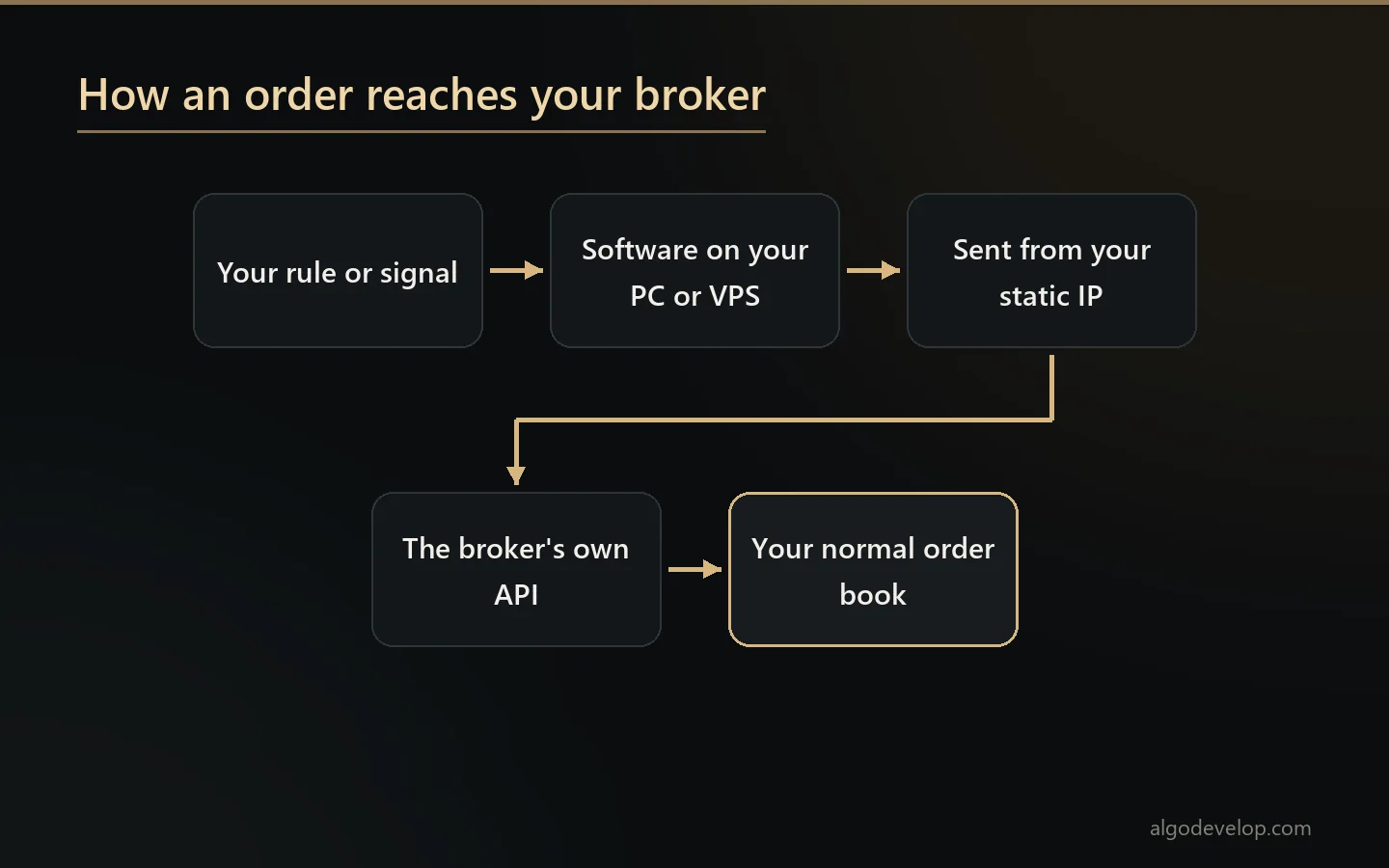
Which of the Indian brokers you use changes less than people expect, and more than vendors admit. The next sections cover exactly that. First comes what stays the same everywhere, and then the three things that really differ.
Built to your requirement
First of all, a custom build here is not a subscription bot with a settings page. Instead, you describe what should happen, and we write that for your broker and your rules.
The requests people bring are plain sentences. Enter only in the first hour and square off by 3:15. Skip the next signal if the last trade lost. Put two lots on BANKNIFTY, one on NIFTY and nothing on stocks. Stop for the day after three losses. Message me on Telegram whenever it does anything.
Tell us the requirement, and we will say plainly whether your broker’s API can do it before you commit.
Where the signals come from
The software does not care where the decision starts:
- Telegram – any channel, group or bot your account can read.
- WhatsApp – groups and direct messages, forwards included.
- Discord – servers and channels, including bot posts.
- TradingView – a webhook alert from your own strategy.
- Logic inside the software – such as indicators, candles, time and streak rules, with no outside source at all.
- You – a manual trigger, after which the software manages the position.
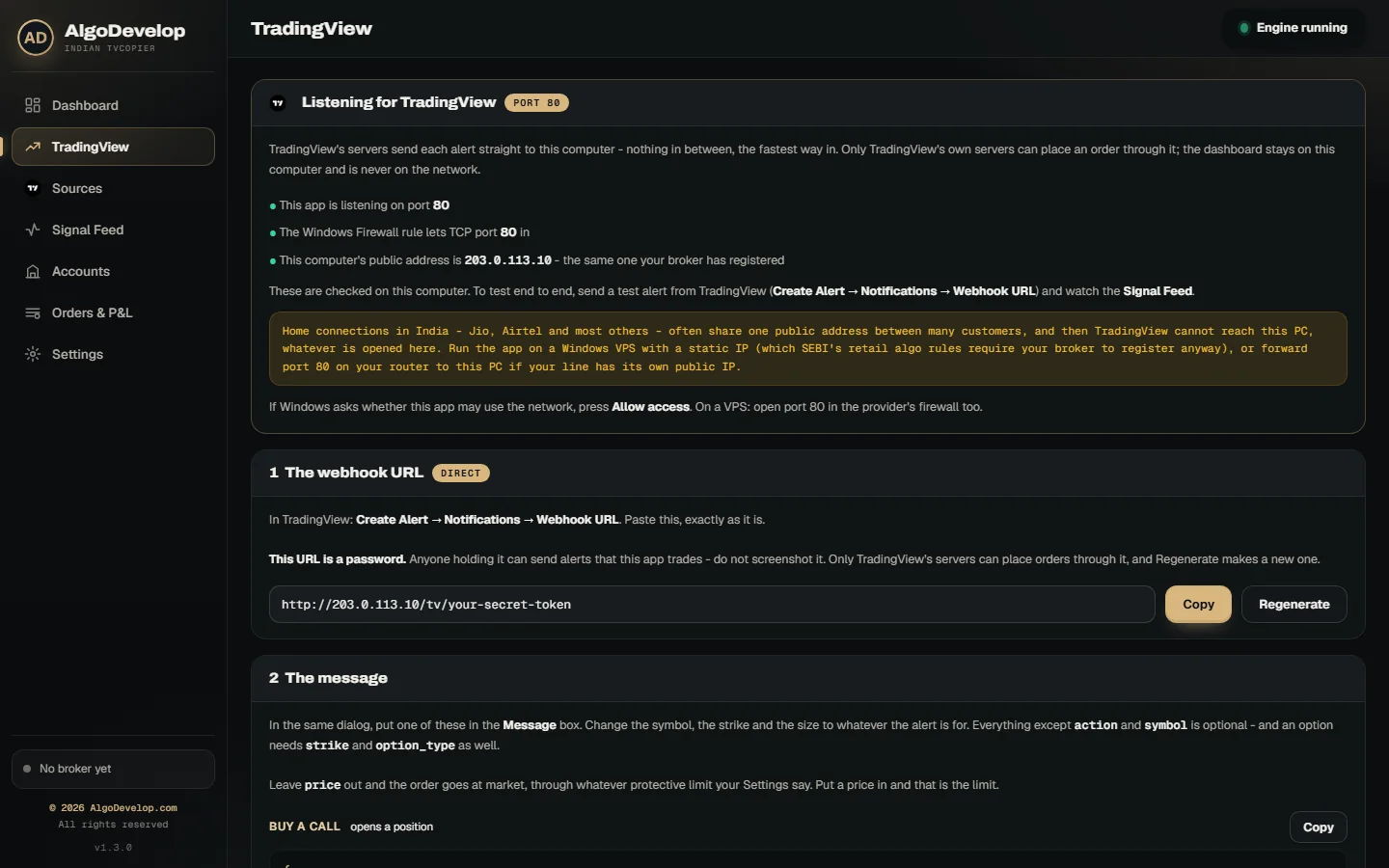
Two of these sources already have ready-made tools. The Telegram to Indian broker copier trades a channel’s calls, while the TradingView to Indian broker copier trades your alerts. Both work with ten brokers: Groww, Zerodha, Angel One, Upstox, ICICI Direct, 5paisa, Dhan, Fyers, Kotak Neo and Alice Blue. They trade options and stocks, but they refuse futures calls and do not trade MCX.
What every Indian broker API has in common
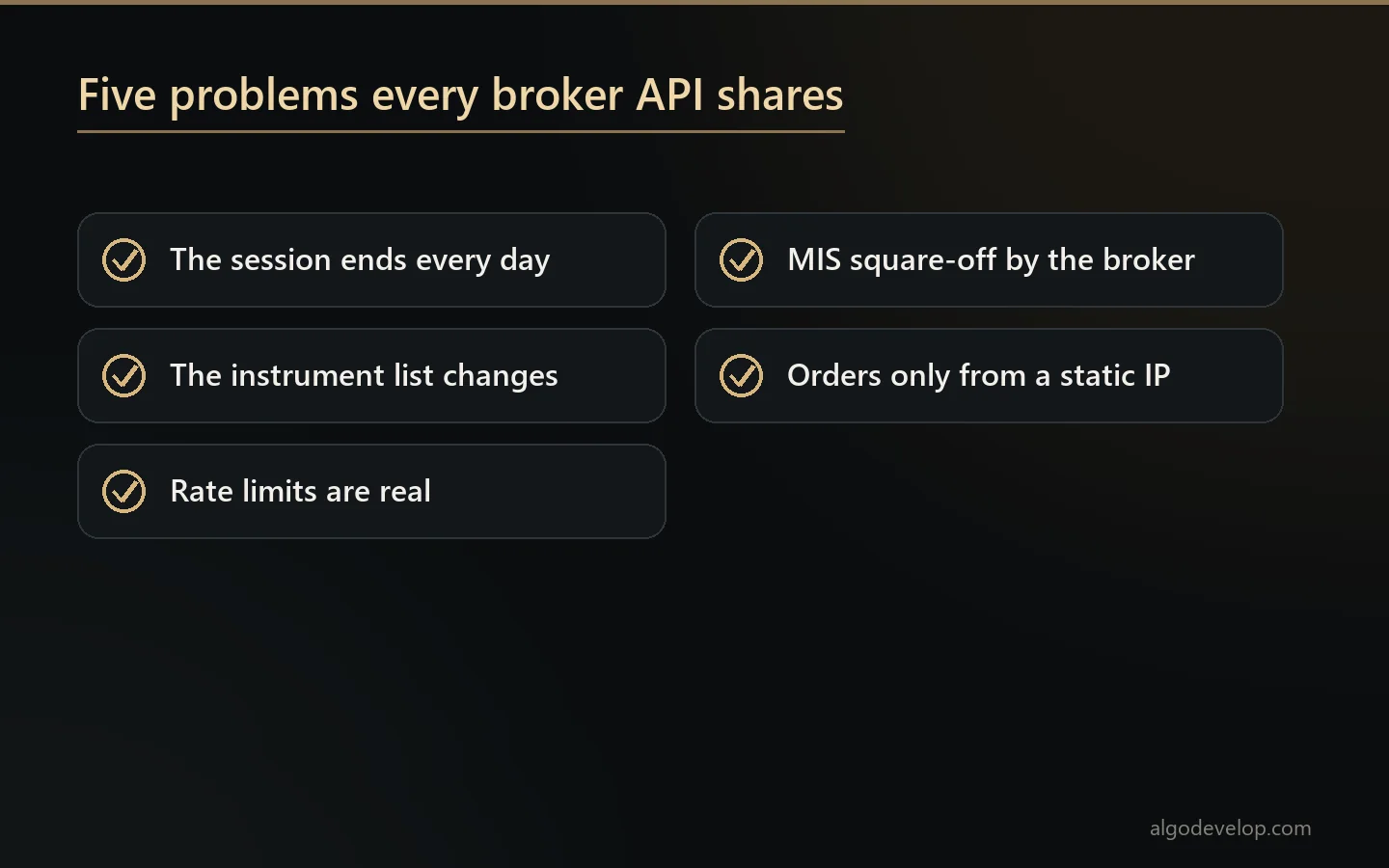
Whichever broker you pick, the software has to solve the same five problems. So any vendor who has actually shipped one will recognise all of them.
- The session ends every day. Some APIs, such as Angel One’s SmartAPI, take a TOTP login that the software can complete by itself. Others, however, need a fresh login each morning. Kite Connect’s documentation, for example, says a Zerodha token expires at 6 AM the next day.
- The instrument list changes. “BANKNIFTY 52000 CE” is not an instrument until the software resolves the strike, the expiry and the exact tradingsymbol. Those change at every expiry, so hard-coded symbols work for seven days.
- Rate limits are real. Every API caps requests and orders per interval. A strategy has to live inside that, rather than pretend it does not exist.
- Product types and square-off. MIS, CNC and NRML behave differently. If you leave an MIS position open, the broker closes it at their time and their price. So setting your own square-off time stops that.
- Orders must come from a static IP. Since 1 April 2026, brokers accept API orders only from an IP address you have registered with them.
The three things that actually differ
Whether the API costs money. Some brokers charge a monthly fee for API access and some do not. So check this first, because it decides whether a small account is worth automating at all. Any fee goes to the broker, not to us. Check the current price on the broker’s own developer site, since these change often.
How you log in. At one broker you may meet a TOTP, and at another an OAuth redirect. Then a third has a token you generate yourself. It sounds like a detail, yet it is the thing that breaks at 9:10 in the morning.
How each broker names instruments. Every broker has its own format for an option contract, and some pack more into the symbol than others. Getting that wrong does not throw an error. Instead, it trades the wrong contract.
Which brokers we cover
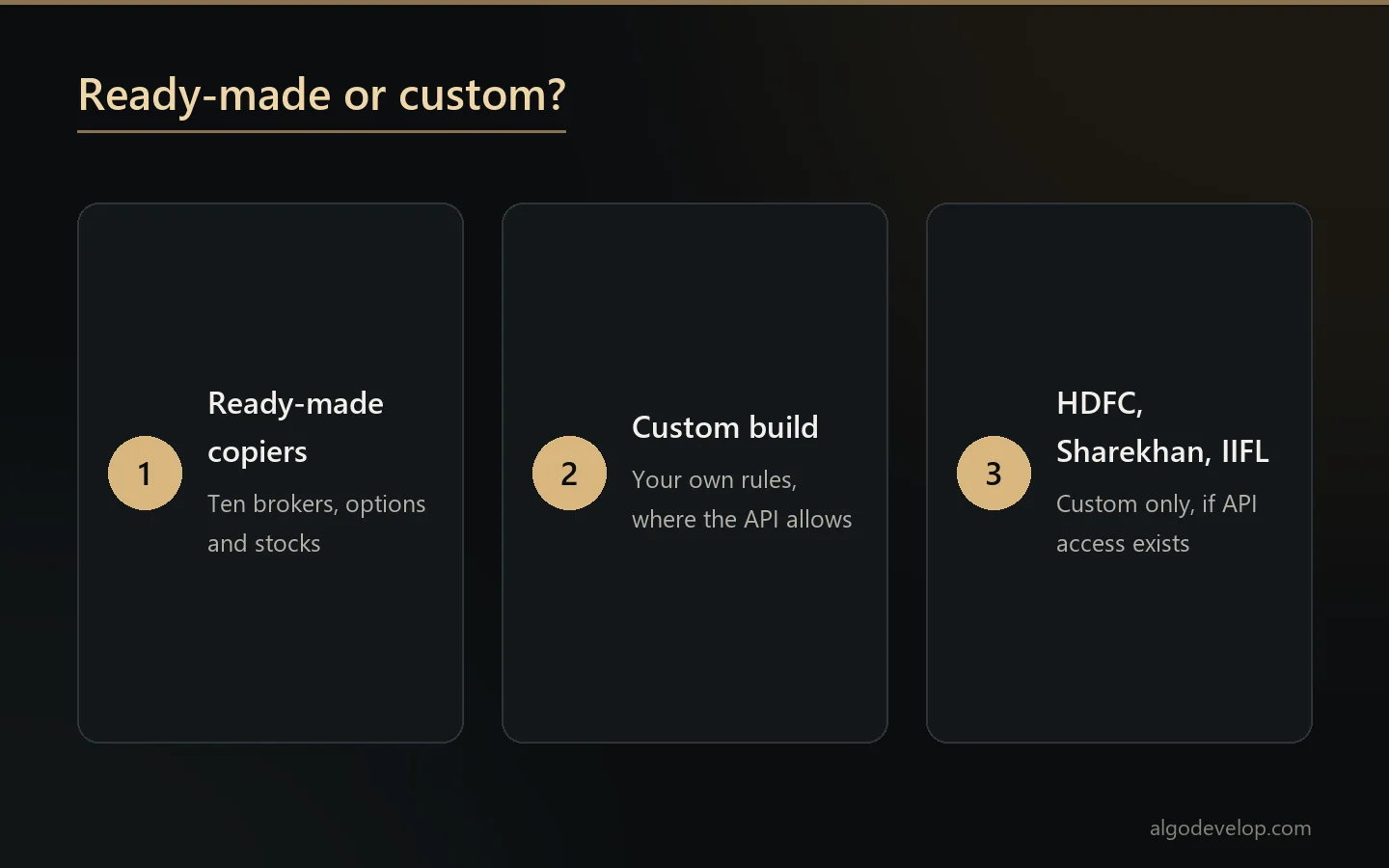
We cover twelve brokers. Each one has its own page on that broker’s API: Zerodha, Angel One, Upstox, Fyers, Dhan, Groww, 5paisa, Kotak Neo, ICICI Direct, HDFC Securities, Sharekhan and IIFL.
Nine of the twelve also work with the ready-made copiers, which add Alice Blue as a tenth. HDFC Securities, Sharekhan and IIFL are custom work only. Even then, it depends on what API access each of them gives its customers, and we check that before quoting.
Trading somewhere else? If the broker has an API for placing orders, send us its docs. We will tell you plainly whether automation is possible, and what it would involve.
Risk controls that belong in code
Automation will keep trading a bad day until something stops it. Each of these limits stays off until you switch it on, and the log records every refusal with its reason:
- Daily loss cap and daily profit target.
- A limit on orders per day, as well as a maximum number of open positions.
- Per-order value cap, so a mis-sized instruction cannot become a disaster.
- Allowed instruments and allowed hours.
Where you stand, plainly
SEBI’s retail algo framework has applied since 1 April 2026. Under it, every API order must come from your registered static IP, and market orders need a price-protection band. Angel One, for example, refuses plain market orders from algos. Below 10 orders a second, you do not need to register a strategy. The SEBI circular on retail algo trading has the details.
Running Indian broker automation on your own account, with your own credentials and rules, is you trading your own money with a tool you commissioned.
However, running it for other people is a different activity, and in India it is a regulated one. We build software. We are not a SEBI-registered intermediary, adviser or research analyst. Nor do we give tips or manage anybody’s money. So take your own advice before accepting anyone else’s capital.
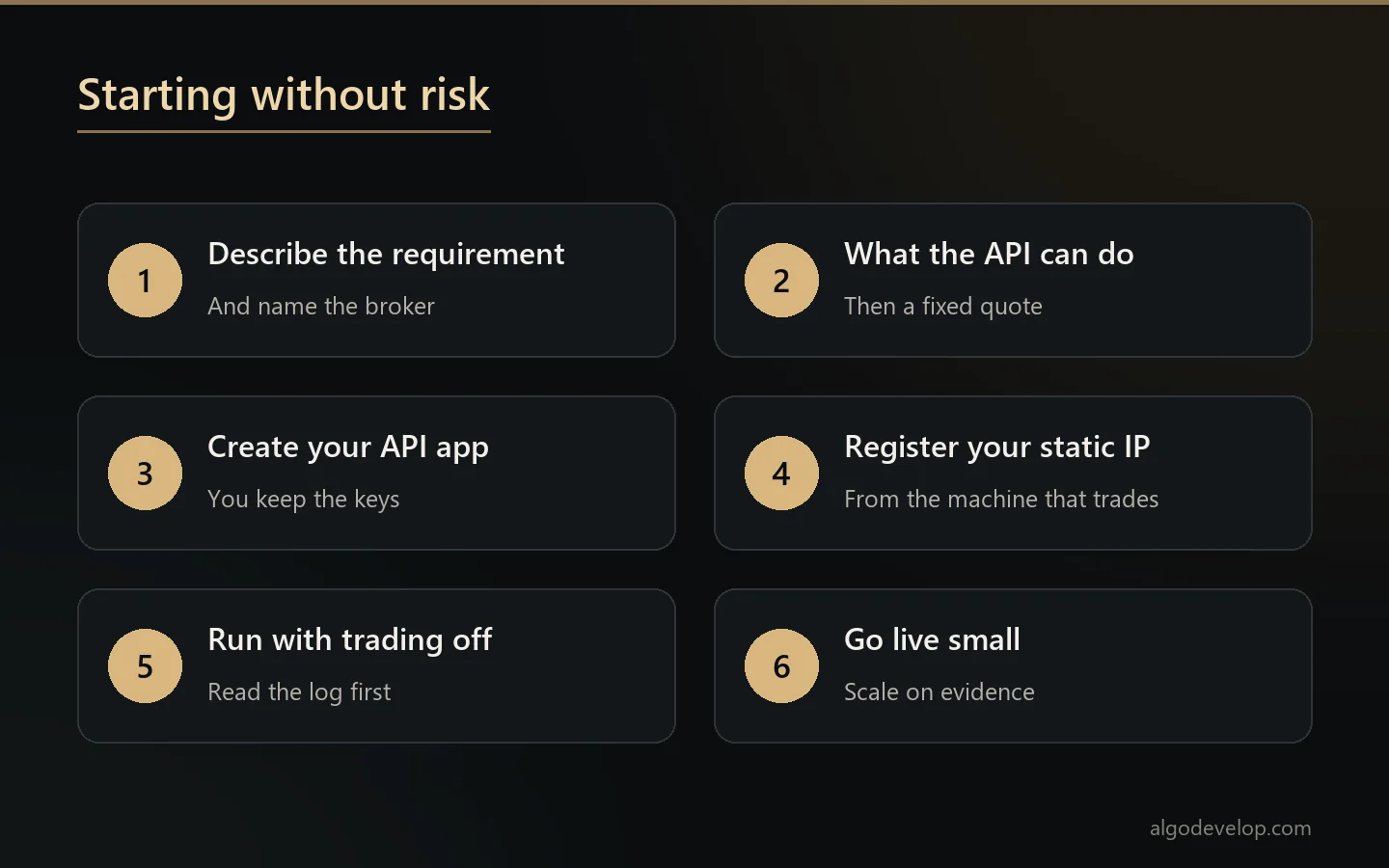
Starting without risking anything
- Describe the requirement and name the broker. We scope the work from those two answers.
- Next, we tell you what that broker’s API can and cannot do for it, and quote a fixed price with a timeline.
- Then you create the API app in the broker’s developer console, and you keep the credentials.
- Register your static IP with the broker, from the machine that will send the orders.
- Before going live, run a session with trading disabled and read the log: every signal seen, and every order it would have placed.
- Go live small, and scale on evidence.
Automating something you trade by hand? That is Indian stock market automation.
Indian broker automation – frequently asked questions
Which Indian brokers can be automated?
Zerodha, Angel One, Upstox, Fyers, Dhan, Groww, 5paisa, Kotak Neo and ICICI Direct, each through its own official API. HDFC Securities, Sharekhan and IIFL are custom work, where the broker gives its customers API access. The ready-made copiers also cover Alice Blue.
Does it matter which broker I use?
Less than people expect. Three things differ: whether the API costs a monthly fee, how the login works, and how each broker names option contracts. Apart from those, it is the same problem everywhere.
Do I need my own API key?
Yes. You create an app in your broker’s developer console, and the keys stay on your own machine. So we never see them.
Do I need a static IP?
Yes. Since 1 April 2026, brokers accept API orders only from a static IP you have registered with them. A small VPS with a fixed address is the simple answer.
Do I have to log in every morning?
It depends on the broker. Angel One’s SmartAPI takes a TOTP login, so the software signs in by itself. Zerodha’s Kite, however, needs a fresh login each morning, which takes one click. Most others issue a token that lasts one trading day.
Can it trade options like BANKNIFTY 52000 CE?
Yes, and that is most of what it does. Every session, the software looks up the strike, expiry and tradingsymbol in the broker’s live list of contracts.
Where can the signals come from?
Telegram, WhatsApp, Discord, TradingView webhook alerts, logic inside the software, or a manual trigger. You can also use several at once.
Is any of this a ready-made product?
Two tools are. The Telegram to Indian broker copier and the TradingView to Indian broker copier work with ten brokers, for options and stocks. Anything else, such as futures or your own logic, is a custom build where the broker’s API allows it.
What if my broker is not on your list?
If it has an API for placing orders, send us its docs. Then we will tell you whether automation is possible for it.
Is this SEBI compliant?
On your own account, you are trading your own money with your own credentials and rules. Your orders must still meet SEBI’s April 2026 framework, such as coming from a registered static IP. Running it for other people is a regulated activity, so take your own advice first.
Can I test it without placing real orders?
Yes. Run a full session with trading disabled and read the log: every signal seen, every order it would have placed, and why. The ready-made copiers also offer a Paper mode for the same purpose.
Ready to start?
Tell us your requirements and get a fixed quote — usually within a few hours. Get a Free Quote on WhatsAppDisclaimer: AlgoDevelop is a software & automation development studio — not a SEBI-registered intermediary, broker, investment adviser, or research analyst. We do not provide trading signals, tips, or investment advice, do not execute trades as a service, and do not manage funds or accounts. Every tool is custom software that you operate on your own account, with your own credentials and API, under your own control. You alone make your trading decisions and are responsible for your results and for any registrations, approvals, or compliance your usage may require (including SEBI/exchange rules in India). Trading carries substantial risk of loss; past performance and backtests do not guarantee future results. No guarantee of profit.