Indian Stock Market Automation
Indian Stock Market Automation turns your trading rules into a fully automated system. The software finds the signals your rules describe, places the orders and manages the risk. So your strategy runs the same way every day, without you watching the screen.
Indian stock market automation means your own rules placing your own orders, through your own broker’s API. So the trade happens at 9:16 whether or not you are at the screen.
On this page
- What Indian stock market automation actually is
- Brokers, APIs and what each one costs you
- Equity, F&O and the option-resolution problem
- The daily login problem nobody warns you about
- MIS, CNC, NRML and the square-off you must not forget
- Risk controls that belong in code, not in your head
- Where you stand, plainly
- Getting started without risking anything
- Frequently asked questions
What Indian stock market automation actually is
Indian stock market automation is software that holds your broker’s API connection. It watches whatever your strategy watches, and it places the order once your conditions hold. The orders appear in your normal order book. Your funds never leave your account, and nobody else trades it.
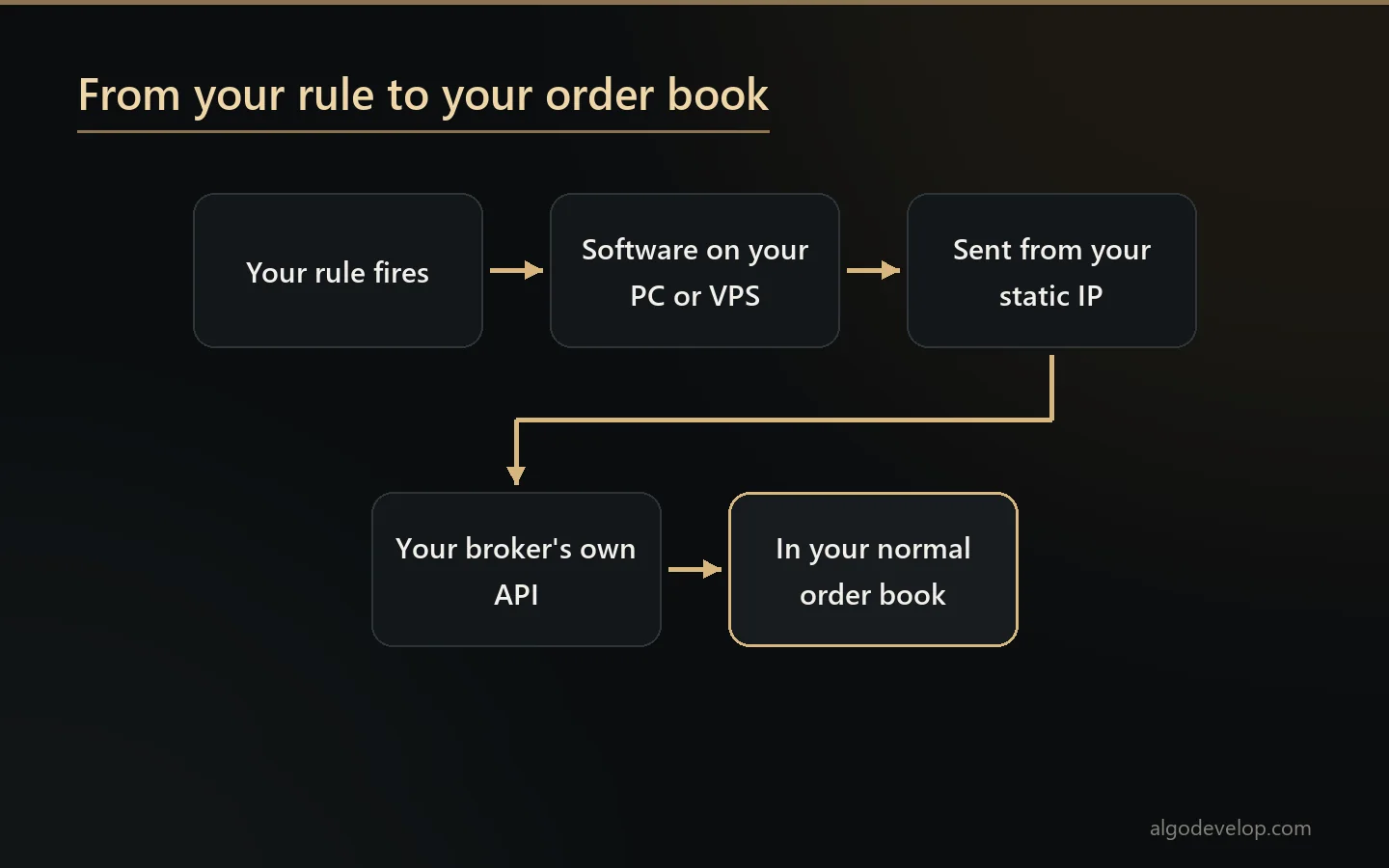
It is not a signal service, and it is not a managed account. Do you want to follow somebody else’s calls rather than run your own rules? Then a ready-made tool does the same execution work with a different source. The Telegram to Indian broker copier trades a channel’s calls, and the TradingView to Indian broker copier trades your TradingView alerts.
Brokers, APIs and what each one costs you
Indian stock market automation needs a broker that publishes an order API. In India, most of the large ones now do:
- Zerodha through Kite Connect.
- Angel One through SmartAPI.
- Upstox, Fyers and Dhan through their own APIs.
The two ready-made copiers already cover ten brokers: Groww, Zerodha, Angel One, Upstox, ICICI Direct, 5paisa, Dhan, Fyers, Kotak Neo and Alice Blue. The full list, with a page per broker, is on Indian broker automation.
Two things are worth knowing before you commit. First, some brokers charge a monthly fee for API access and some do not. Any fee goes to the broker rather than to us, and it usually applies per app, not per strategy. Second, rate limits are real. An API that allows a set number of orders per second is a limit your strategy has to live inside.
Equity, F&O and the option-resolution problem
Cash equity is the easy part: a symbol, a quantity and a side. Options are where Indian stock market automation gets interesting, and where most home-built attempts break.
An instruction like “BANKNIFTY 52000 CE” is not an instrument yet. First the software has to resolve the strike and the right weekly or monthly expiry. Then it needs the exact tradingsymbol your broker expects this week. Those tradingsymbols change at every expiry. So software that hard-codes them works for seven days and then quietly stops.
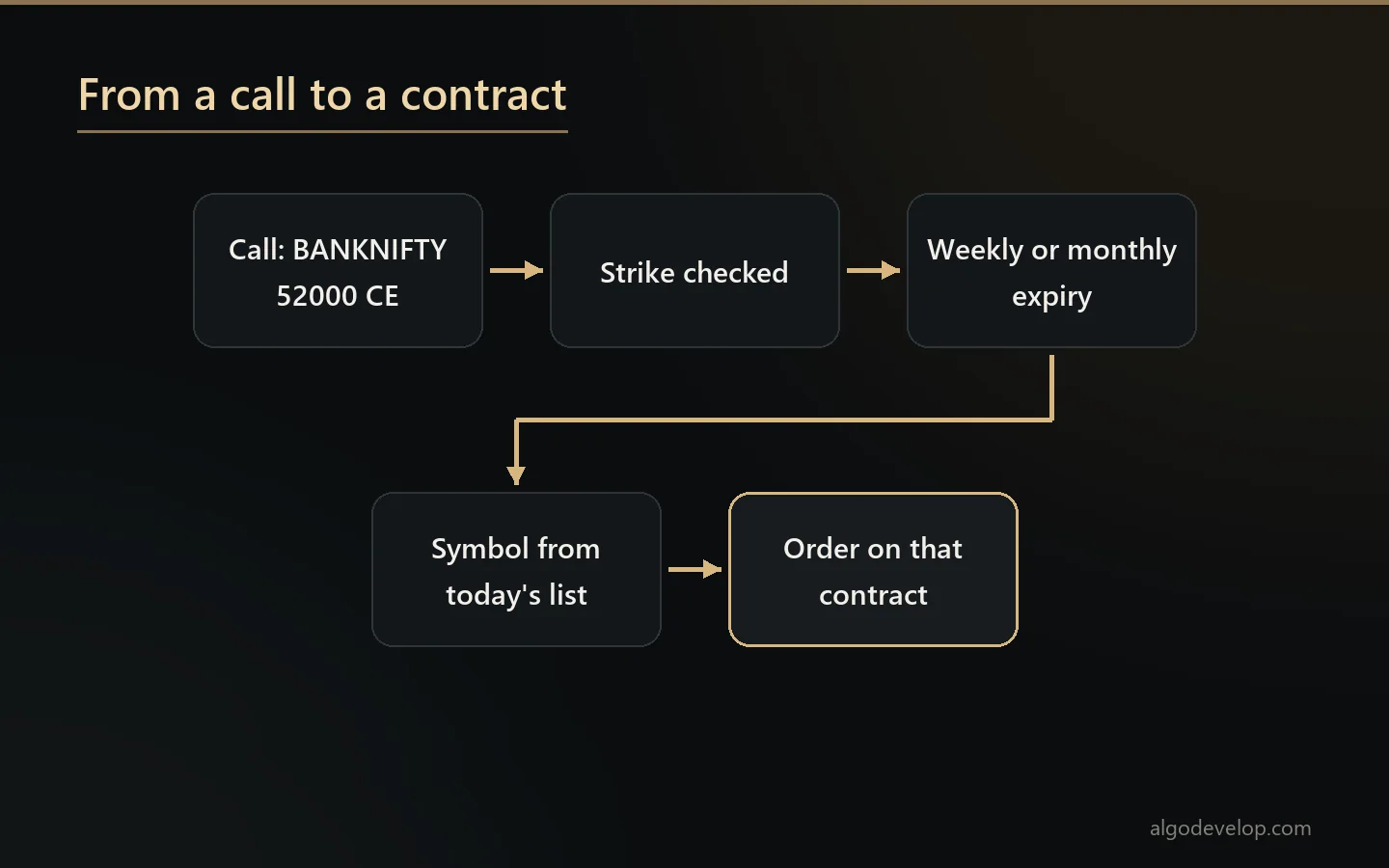
That is why the software downloads the broker’s instrument list every session and matches against it. In a custom build, futures, MCX commodities and stock options work the same way, where your broker’s API offers them. The ready-made copiers, by contrast, trade options and stocks only. They refuse futures calls and do not trade MCX.
The daily login problem nobody warns you about
This is the biggest difference between Indian stock market automation and automating a forex terminal. It catches everyone once.
Indian broker API sessions expire daily. For example, Kite Connect’s own documentation says a Zerodha token expires at 6 AM the next day. So every morning your software needs a fresh session before the market opens.
How that works depends on the broker. Angel One’s SmartAPI takes a TOTP login, so the software makes the six-digit code itself and signs in on its own. Zerodha, by contrast, needs a fresh Kite login each morning, which the software turns into one click. Either way, a missing token is loud. You get an alert straight away, not a quiet morning of missed signals.
MIS, CNC, NRML and the square-off you must not forget
- MIS for intraday, with the leverage and the mandatory same-day exit.
- CNC for delivery.
- NRML for carry-forward positions in F&O.
The software sets the product type per strategy, and it matters more than it looks. If you leave an MIS position open, the broker squares it off at their time, at their price, with their charge. So set your own square-off time instead, and the automation closes the position before that happens, on your terms.
Risk controls that belong in code, not in your head
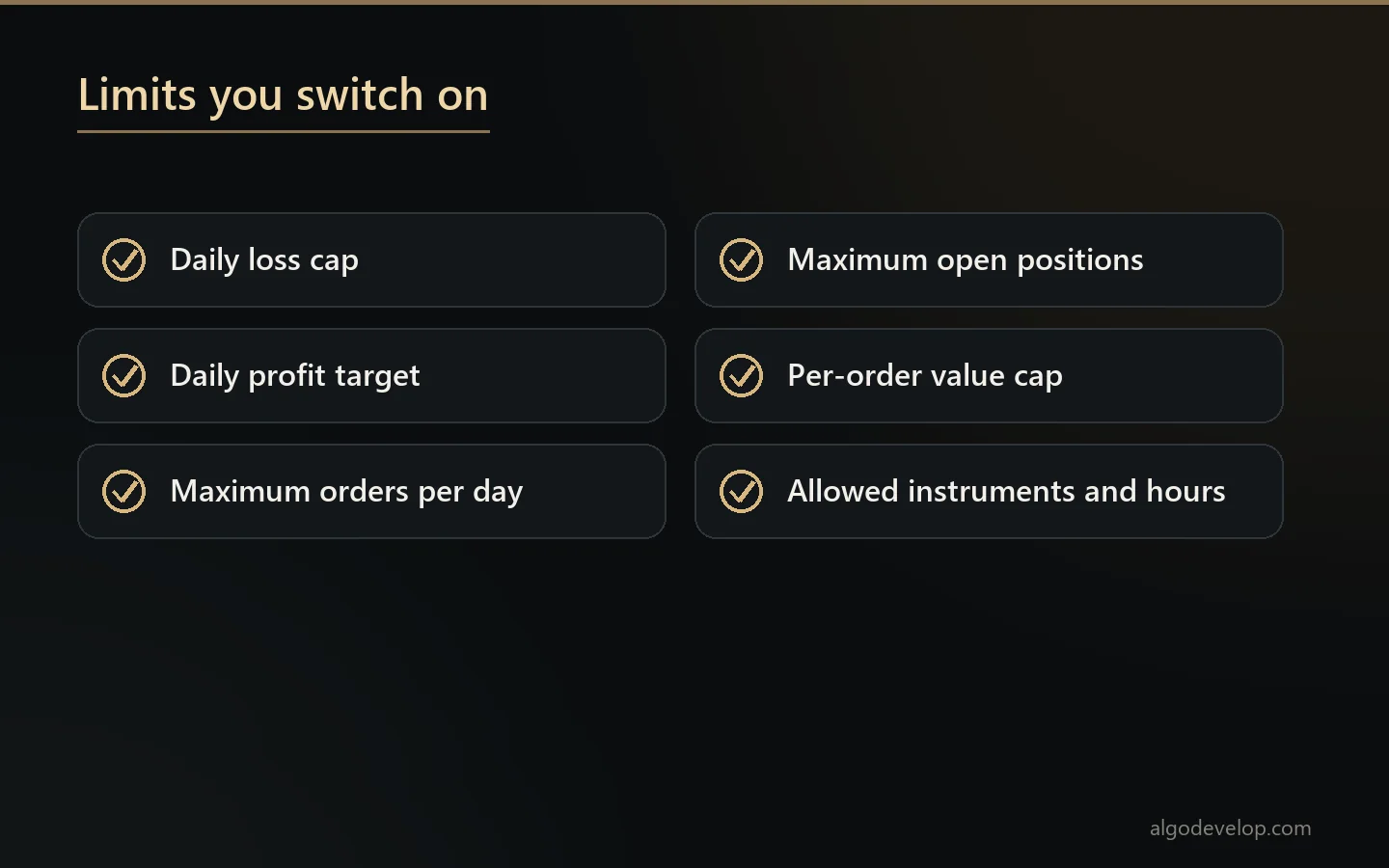
Indian stock market automation will keep trading a bad day until something stops it. Each of these limits stays off until you switch it on, and the log records every refusal with its reason:
- Daily loss cap – stop for the session when you are down your limit.
- Daily profit target that does the same on a good day.
- Maximum orders per day and maximum open positions.
- Per-order value cap, so a mis-sized instruction cannot become a disaster.
- Allowed instruments and allowed hours – nothing fires before 9:15 or after your own cut-off.
Where you stand, plainly
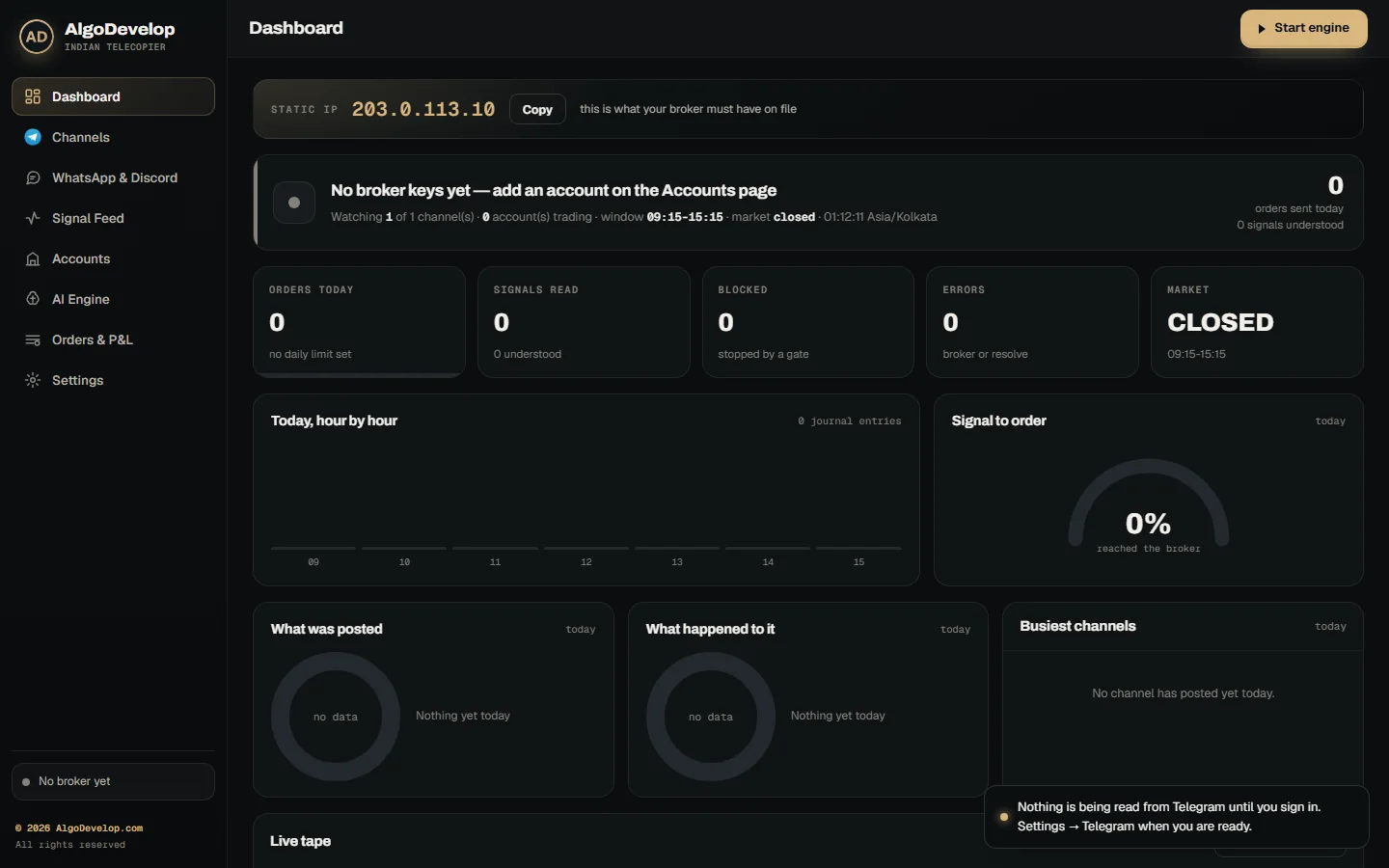
SEBI’s retail algo framework has applied since 1 April 2026, and it changes what an API order may look like. Above all, your broker accepts API orders only from a static IP that you have registered with it. A home connection whose address changes will see its orders refused. So a small VPS with a fixed IP is the usual answer.
The same framework also needs market orders to carry a price-protection band, and Angel One refuses plain market orders from algos. Every API order also carries a tag, so the exchange can track it apart from manual orders. Below 10 orders a second, you do not need to register a strategy. The SEBI circular on retail algo trading has the full text.
Running Indian stock market automation on your own account, with your own credentials and your own rules, is you trading your own money with a tool you commissioned. However, operating it for other people’s accounts is a different activity, and SEBI regulates it. We build software. We are not a SEBI-registered intermediary, adviser or research analyst, we do not provide tips, and we do not manage anybody’s money. If you plan to run it for anyone but yourself, take your own regulatory advice first.
Getting started without risking anything
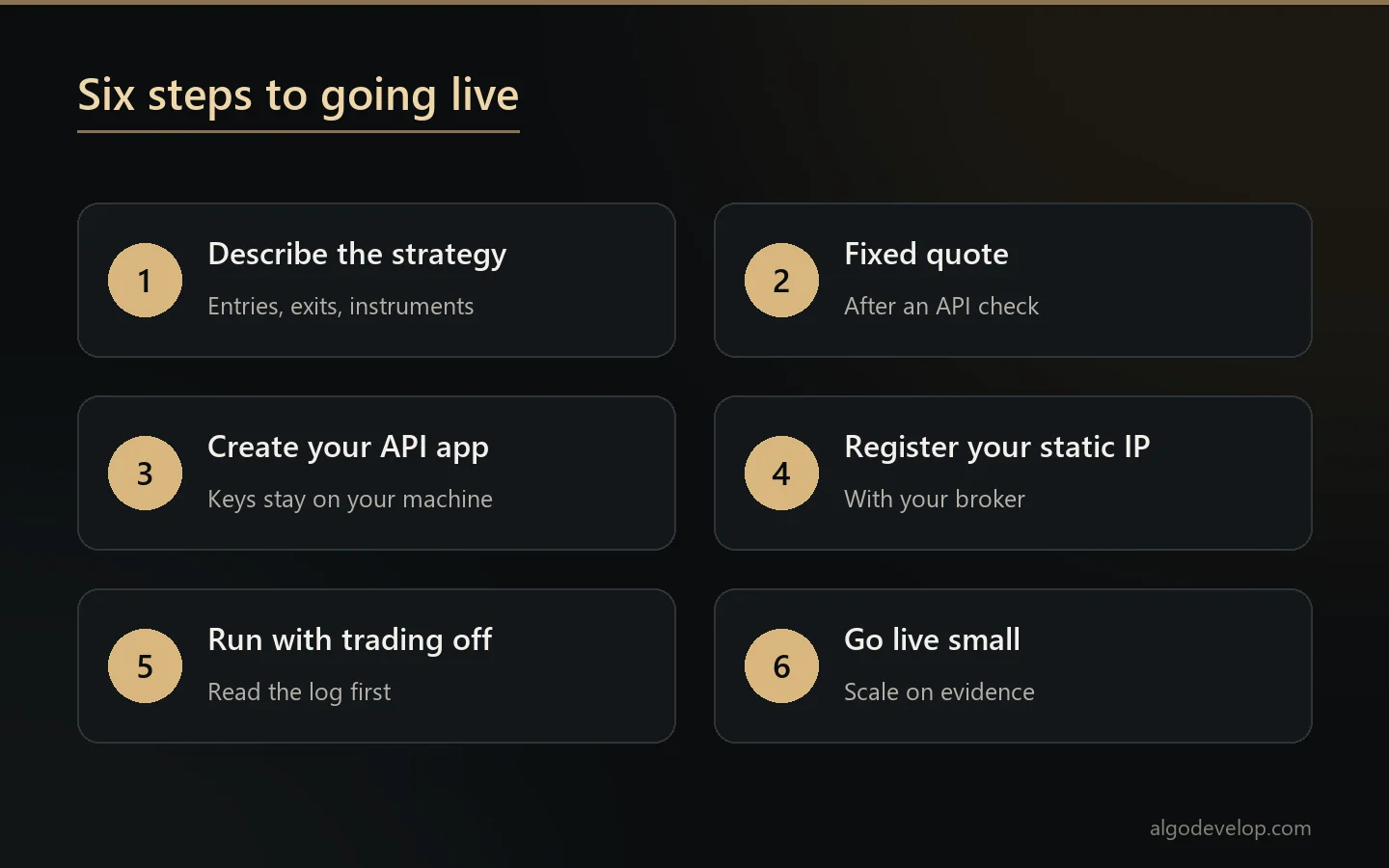
- Describe the strategy. Name the entries, exits, instruments and timeframe. Also say what happens when a signal arrives while a position is already open.
- We scope it and quote a fixed price, after telling you anything the broker’s API cannot do.
- Create your API app in the broker’s developer console. The keys stay on your machine, and we never see them.
- Register your static IP with the broker, from the PC or VPS that will place the orders.
- Run a session with trading disabled. The log records every signal it saw and every order it would have placed. Read it before you enable anything.
- Go live small, and scale only once the log matches what you expected.
Indian stock market automation – frequently asked questions
Which Indian brokers can be automated?
Zerodha through Kite Connect, Angel One through SmartAPI, and Upstox, Fyers and Dhan through their own APIs. The ready-made copiers add Groww, ICICI Direct, 5paisa, Kotak Neo and Alice Blue. If yours is not listed, send us its API documentation and we will tell you whether it is workable.
Do I need my own API key?
Yes. You create the app in your broker’s developer console, and the keys stay on your own machine. We never see them. If your broker charges for API access, you pay that fee to the broker, not to us.
Do I need a static IP?
Yes. Since 1 April 2026, brokers accept API orders only from a static IP you have registered with them. A small VPS with a fixed address is the simple answer, and the software runs there.
Do I have to log in every morning?
It depends on the broker. Angel One’s SmartAPI takes a TOTP login, so the software signs in by itself. Zerodha’s token expires at 6 AM each day, so Kite needs one click each morning. A missing token raises an alert straight away.
Can it trade options like BANKNIFTY 52000 CE?
Yes, and that is most of what Indian stock market automation does. Every session, the software resolves the strike, expiry and exact tradingsymbol against the broker’s live instrument list. Those symbols change at every expiry.
Is this legal?
Trading your own account, with your own credentials and your own rules, is you trading your own money with a tool you commissioned. Operating it for other people’s accounts is a regulated activity in India. We build software, and we do not provide tips or manage money.
What product types are supported?
MIS for intraday, CNC for delivery and NRML for carry-forward, set per strategy. You can also set your own square-off time. Then the software closes an MIS position on your terms, before the broker closes it on theirs.
Can I test it without placing real orders?
Yes, and every project should. Run a full session with trading disabled. The log then shows every signal it saw and every order it would have placed, with the reason. Read it before you enable anything.
What stops a bad day running away?
A daily loss cap, a daily profit target, limits on orders per day and open positions, a per-order value cap, and limits on instruments and hours. All of them stay off until you switch them on.
What if I want to follow a channel instead of my own rules?
Then you want the Telegram to Indian broker copier. It does the same execution work with a channel as the source, rather than your own logic.
How much does Indian stock market automation cost?
The price depends on the strategy, the instruments and how much risk logic it needs. Describe what it should do and we will quote a fixed price: ask for a quote.
Ready to start?
Tell us your requirements and get a fixed quote — usually within a few hours.
Get a Free Quote on WhatsAppDisclaimer: AlgoDevelop is a software & automation development studio — not a SEBI-registered intermediary, broker, investment adviser, or research analyst. We do not provide trading signals, tips, or investment advice, do not execute trades as a service, and do not manage funds or accounts. Every tool is custom software that you operate on your own account, with your own credentials and API, under your own control. You alone make your trading decisions and are responsible for your results and for any registrations, approvals, or compliance your usage may require (including SEBI/exchange rules in India). Trading carries substantial risk of loss; past performance and backtests do not guarantee future results. No guarantee of profit.