What Is Copy Trading? A Complete Guide
Published July 18, 2026 · Updated October 14, 2026
What is copy trading? In short, it lets trades from one source open on your own account by themselves. The source can be another trader, a signal channel or an alert from your own chart. You set the size and the limits, then software does the copying.
First, this guide explains how it works and the four main kinds. Then it covers the real risks and how to test a copier safely. It also shows how copy trading runs on MT4 and MT5, at Indian brokers and on crypto exchanges.
On this page
What is copy trading, in plain words?
First, someone or something makes a trading decision. A copier then repeats that decision on your account, at your size and within your rules. That is the whole idea.
For example, a channel posts BUY XAUUSD at 2358, SL 2352, TP 2364. A copier reads the call, then sizes it by your lot rule and places it in MetaTrader. So you never had to see the message, open the platform or type the order.
Three parts make up every setup:
- The source is where decisions come from, such as a trader’s account, a chat channel or an alert.
- The copier sits in the middle, because something has to read each decision and turn it into an order.
- Your account is where the order lands, at your own broker and with your own money.
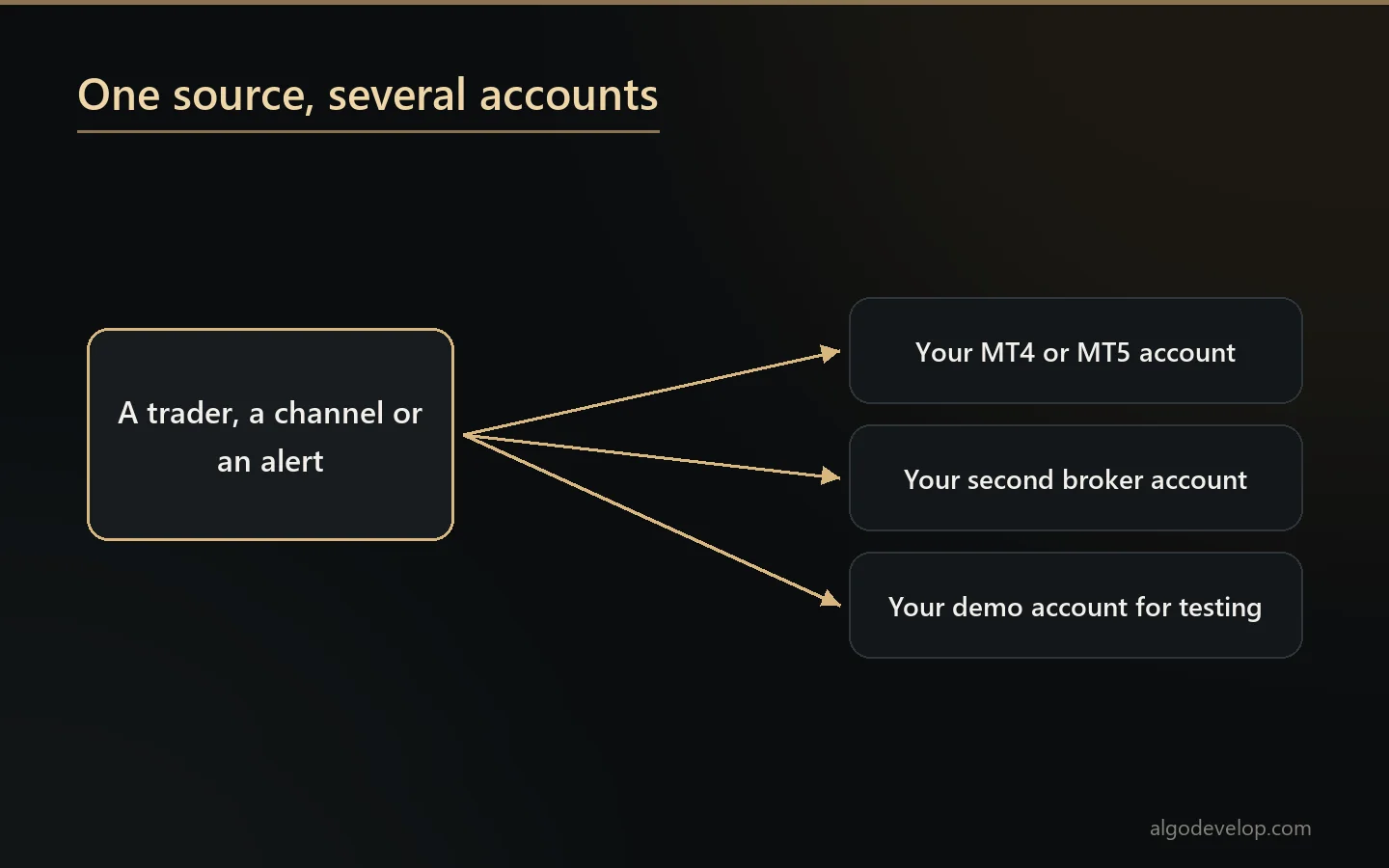
The source decides the direction, but you decide the risk. That split matters, because it is the main thing you control.
How copy trading works, step by step
- First, a source decides: a trader opens a position, a channel posts a call, or your chart fires an alert.
- Next, the copier picks it up, by reading a message, catching a webhook or watching a master account.
- Then it builds an order, working out the symbol, the side, the entry, the stop and the targets.
- After that, your rules apply: lot size, a daily loss limit, the most trades you allow and your symbol list.
- Once the checks pass, the order goes in at your broker, with any stop and targets attached.
- Finally, the copier keeps watch. Good copiers also act on follow-ups, such as close half or move the stop to entry.
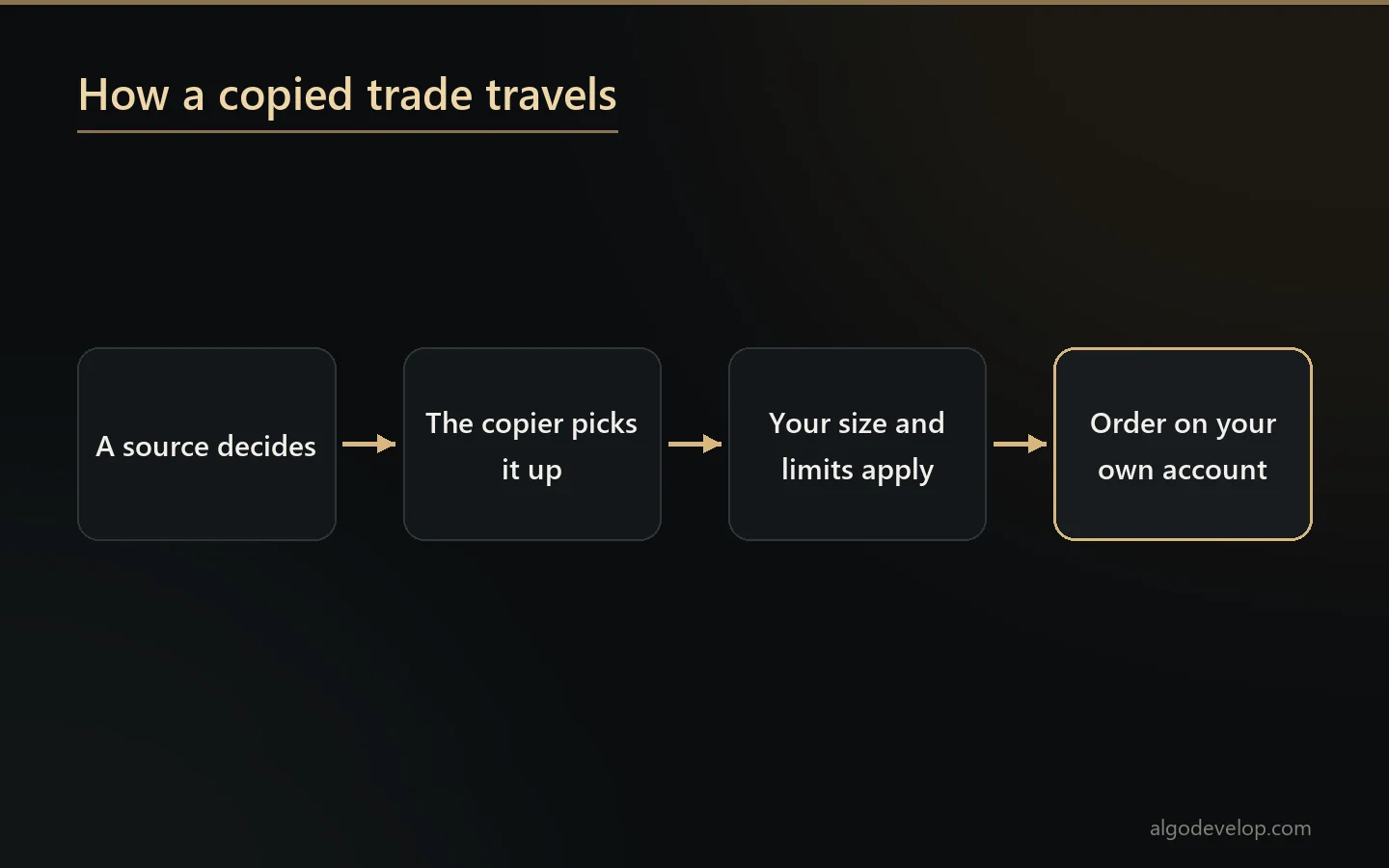
The hard part is usually step two. A chat message is messy text, while an alert is a short data packet. A master account, on the other hand, is a live terminal. So each kind of copy trading needs a different reader.
The four main kinds of copy trading
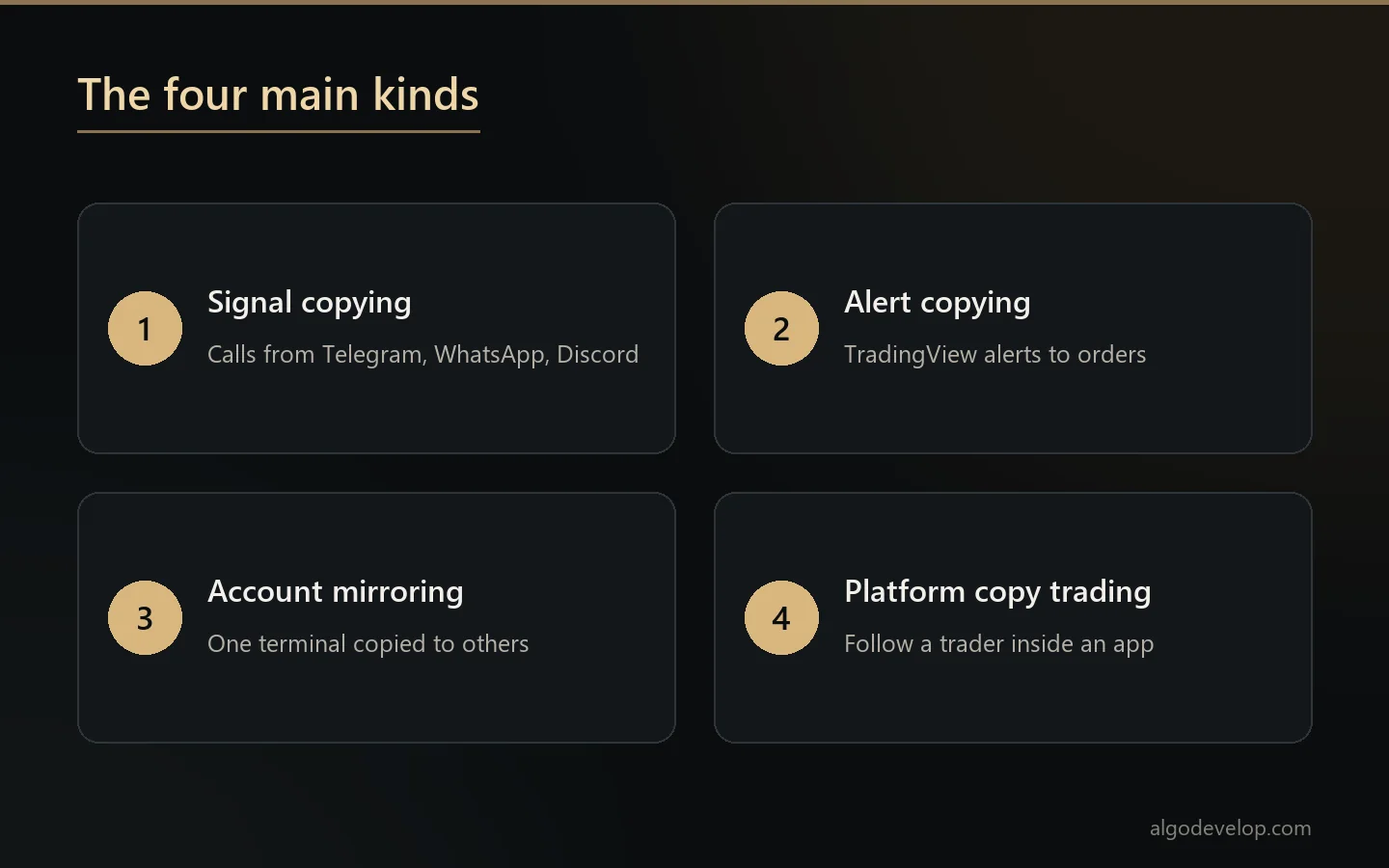
1. Signal copying from chats
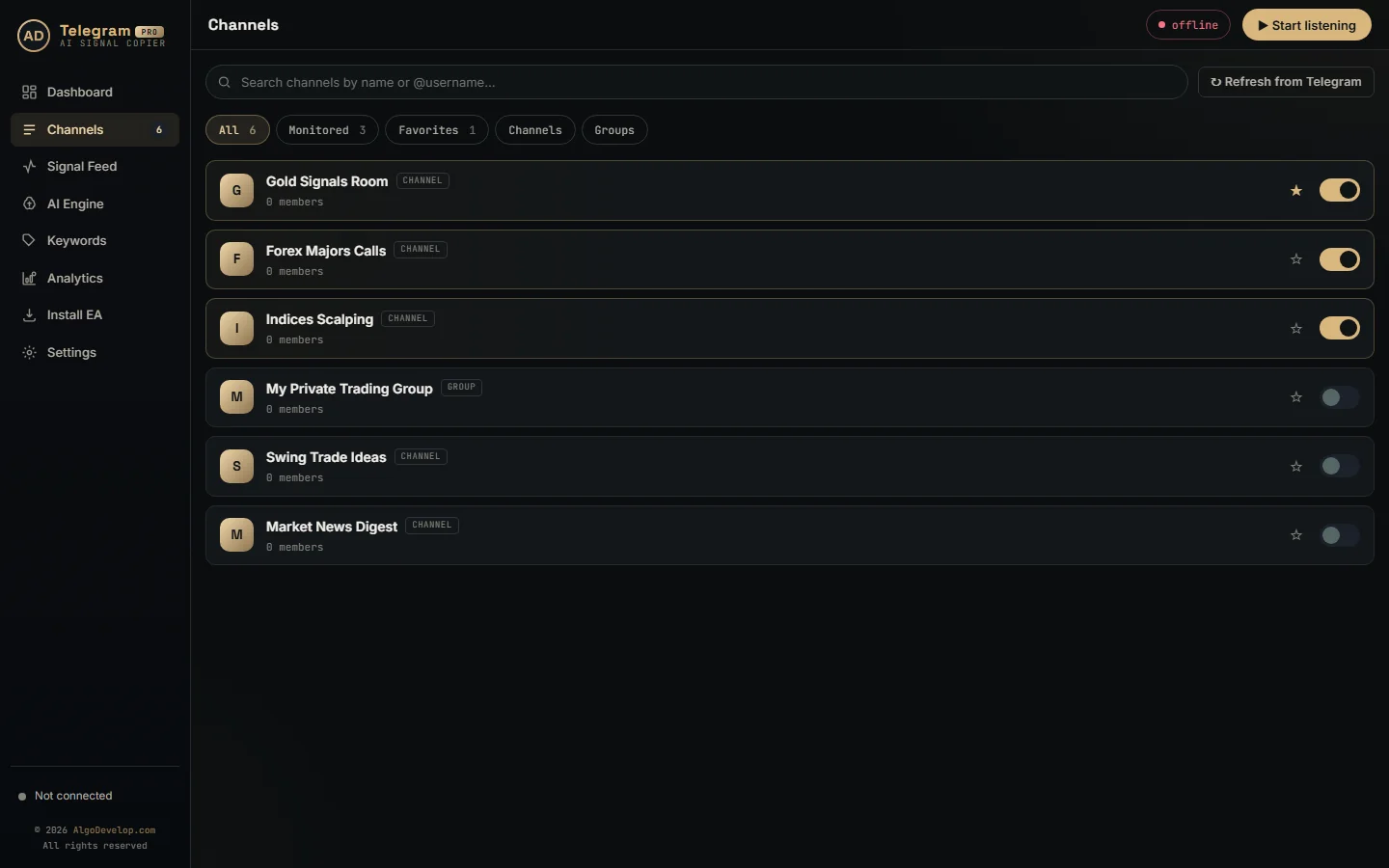
Here the source is a chat, such as a Telegram, WhatsApp or Discord channel. Because people type calls at speed, they often add emojis or switch to Hindi. So the copier needs a strong reader, and ours use an AI model for that job.
For example, our Telegram to MT4/MT5 copier reads the channels you switch on. Then an Expert Advisor in your terminal places the trades, once you turn on algo trading in MetaTrader. There are also versions for WhatsApp, for Discord and for Indian brokers.
2. Alert copying from TradingView
Here the source is your own strategy. Your chart fires an alert, and then TradingView sends it to a web address. After that, a copier turns it into an order. You also need a TradingView plan with webhook alerts, and TradingView only sends them once two-factor authentication is on.
See the TradingView to MT4/MT5 copier, or our guide on how to connect TradingView to MT4 and MT5.
3. Account mirroring
Here the source is a trading account. A trade copier watches one terminal, the master, and then repeats every trade on the followers. It copies the exact volume, partial closes and stop moves, because it reads the trade itself rather than a message.
Our MT4 to MT5 copier works in all four directions, with MT4 or MT5 on either side. Meanwhile, multi-broker copy trading takes one master to MetaTrader, Indian and crypto accounts at once.
4. Platform copy trading
Some apps build copying into the platform itself. First you browse a list of traders, then you pick one and set an amount. After that, the platform mirrors their trades inside its own accounts. There is nothing to install, but you can only trade where that platform allows.
The real risks of copy trading
Copy trading saves time, but it does not remove risk. Before you start, know these:
- The source can be wrong, and then a copier copies the loss as faithfully as any win.
- Past results can mislead, because a channel’s record is hard to check and screenshots prove very little.
- Your fill is not theirs, since spreads and slippage differ between brokers.
- Sizing errors multiply: with one order per target, for example, 0.10 lots and three targets make 0.30 lots.
- Leverage cuts both ways, so a run of copied losses on forex or crypto futures can drain an account fast. Futures also carry liquidation risk.
- Rules depend on where you live, so check them first. In India, for instance, SEBI’s algo rules and RBI’s forex rules both apply. Our post on whether copy trading is legal in India explains both.
Nobody can promise you a profit from copy trading, so distrust anyone who does. In the end, you stay responsible for every trade on your account.
How to choose and test a copier
To begin with, pick by where you trade, not by where the signals come from. Then check each of these points:
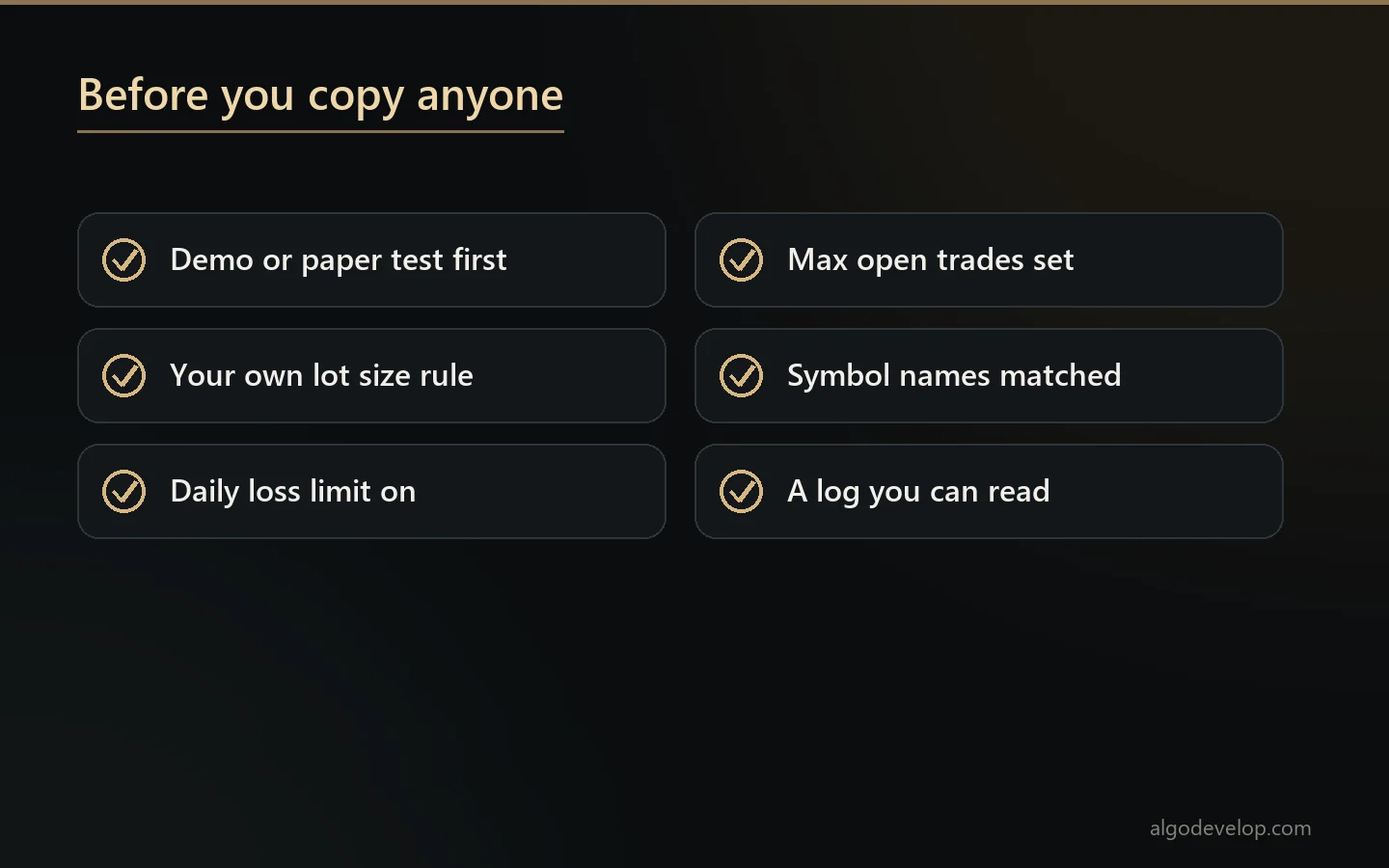
- It runs on your side, so your logins or API keys stay on your own PC or VPS.
- You control the limits, such as a daily loss cap, a cap on open trades and a symbol filter.
- It explains itself, because a good log shows every message, what the copier did and why.
- It handles follow-ups, since closes, partial closes and stop moves matter as much as entries.
- You can test it on a demo or paper account first, then go live at the smallest size.
Copy trading tools we build
We build copy trading software that you run yourself, on your own account. The copy trading page also lists every tool by platform: MetaTrader, Indian brokers, binary platforms and crypto exchanges. For channel owners, the Telegram to Telegram copier forwards calls to a channel of your own instead of trading them.
New to signal copiers? Then our Telegram signal copier guide walks through a full setup. Otherwise, if none of the ready-made tools fits, ask for a quote on a custom one.
What is copy trading – frequently asked questions
What is copy trading in simple words?
In short, software repeats another source’s trades on your own account, at your size and within your limits. The source can be a trader, a signal channel or your own alert.
What is copy trading versus social trading?
Social trading is the wider idea of following and discussing other traders, often inside one app. Copy trading, by contrast, is the part where their trades open on your account by themselves.
Is copy trading profitable?
It can lose as easily as it wins, because it copies the source’s mistakes too. Nobody can promise a profit, so test on demo first and keep your size small.
Is copy trading legal?
That depends on your country and on what you copy. For Indian readers, our guide to whether copy trading is legal in India covers SEBI’s and RBI’s rules.
Do I need to know how to code?
No. Our copiers run as apps or Expert Advisors, so you never touch code. You sign in, pick your sources, set your size and limits, and then test.
Can I copy one source to several accounts?
Yes. For example, every MetaTrader terminal on the PC reads the same signals from our MetaTrader copiers. Also, the Indian copiers place each call at every account you switch on.
Does my computer have to stay on?
Yes, because the copier and your platform must both keep running. That is why many traders use a VPS, so copying goes on while their own PC is off.
What is copy trading on MT4 and MT5?
On MetaTrader, an Expert Advisor in your terminal places the copied orders. The source can be a Telegram channel, a TradingView alert or another MT4 or MT5 account.
How much does a copier cost?
It depends on the source, the platform and how much setup you want. Setup help comes with every tool, so ask for a quote.
Want this built for you?
We develop it as a service — reliable, tested, and yours to own.
Message Us on WhatsApp