Is Copy Trading Legal in India?
Published July 18, 2026 · Updated October 14, 2026
Is copy trading legal in India? It depends on what you copy, where the order goes and who places it. Copying calls into your own Indian broker account, with your own software, can fit SEBI’s 2026 algo rules. Copying forex trades on an unauthorised offshore platform is a different story, because RBI does not permit it for residents.
This post sets out the rules as of October 2026, with links to the official pages behind them. It is general information, not legal advice. For your own case, ask your broker or a qualified professional.
On this page
- Is copy trading legal in India? The short answer
- Copying calls into your own account
- Who sends the calls matters
- Never hand over your login
- Forex, binary options and offshore platforms
- Copying between family accounts
- A checklist before you copy anything
- Where our copiers fit
- Frequently asked questions
Is copy trading legal in India? The short answer
Copy trading is not one thing. So the answer is not one word either. Here are five common setups, and what the rules say about each:
| Setup | What the rules say |
|---|---|
| Your own software copies calls into your own Indian broker account | SEBI’s framework allows this through the broker’s API, from a static IP you register. A self-built strategy needs exchange registration only above a speed threshold. |
| A vendor’s platform places the orders through your broker | The vendor must sit on the exchanges’ panel of algo providers. For a black-box strategy, the vendor also needs a research analyst registration. |
| Someone sells you buy and sell calls | Acting as an investment adviser needs SEBI registration. SEBI warns investors against unregistered live trading tips. |
| Someone trades your account with your login | NSE tells investors never to share their trading credentials, and the law prohibits assured-return schemes. |
| You copy forex or CFD trades on an offshore platform | RBI lets residents trade forex only on platforms it has authorised, or on NSE, BSE and MSE. |
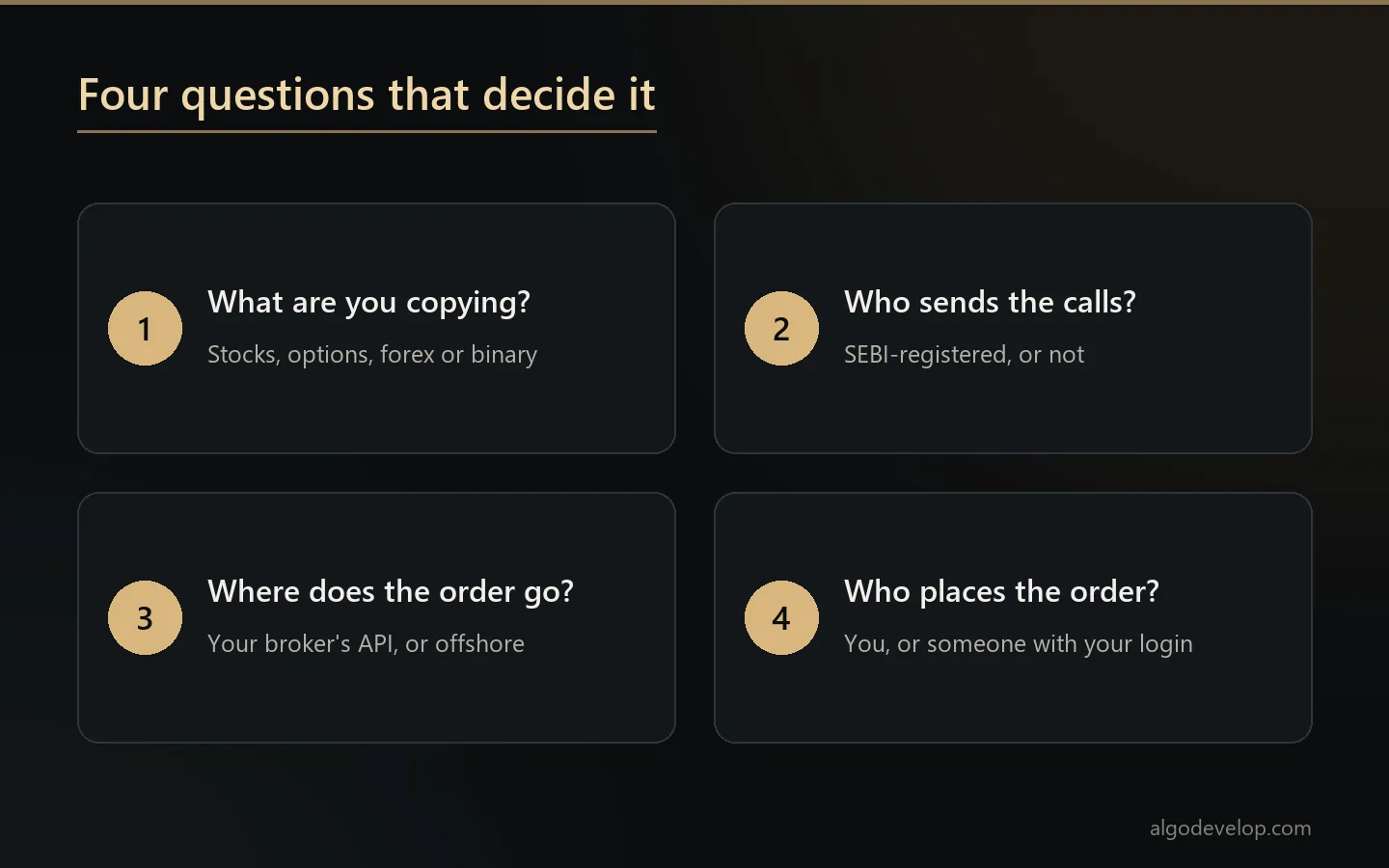
The sections below take each question in turn, starting with the most common case.
Copying calls into your own account
SEBI’s circular of 4 February 2025 sets out how retail investors may trade through algos and APIs. A second circular, dated 30 September 2025, then made it apply to all stock brokers from 1 April 2026. Under it, your broker is the principal, and any algo vendor acts as the broker’s agent.
For a trader, four points matter most:
- No open APIs. Brokers give API access only through a unique API key and a static IP they whitelist. They must also use OAuth logins with two-factor authentication.
- Tagged orders. Every algo order through an API carries a unique identifier from the exchange, so each one leaves an audit trail.
- A speed threshold. A strategy you code yourself needs exchange registration, through your broker, only above an orders-per-second threshold. Zerodha’s summary of the NSE rules puts that line at 10 orders per second per segment per exchange.
- A kill switch. Exchanges can halt every order from one algo ID at once.
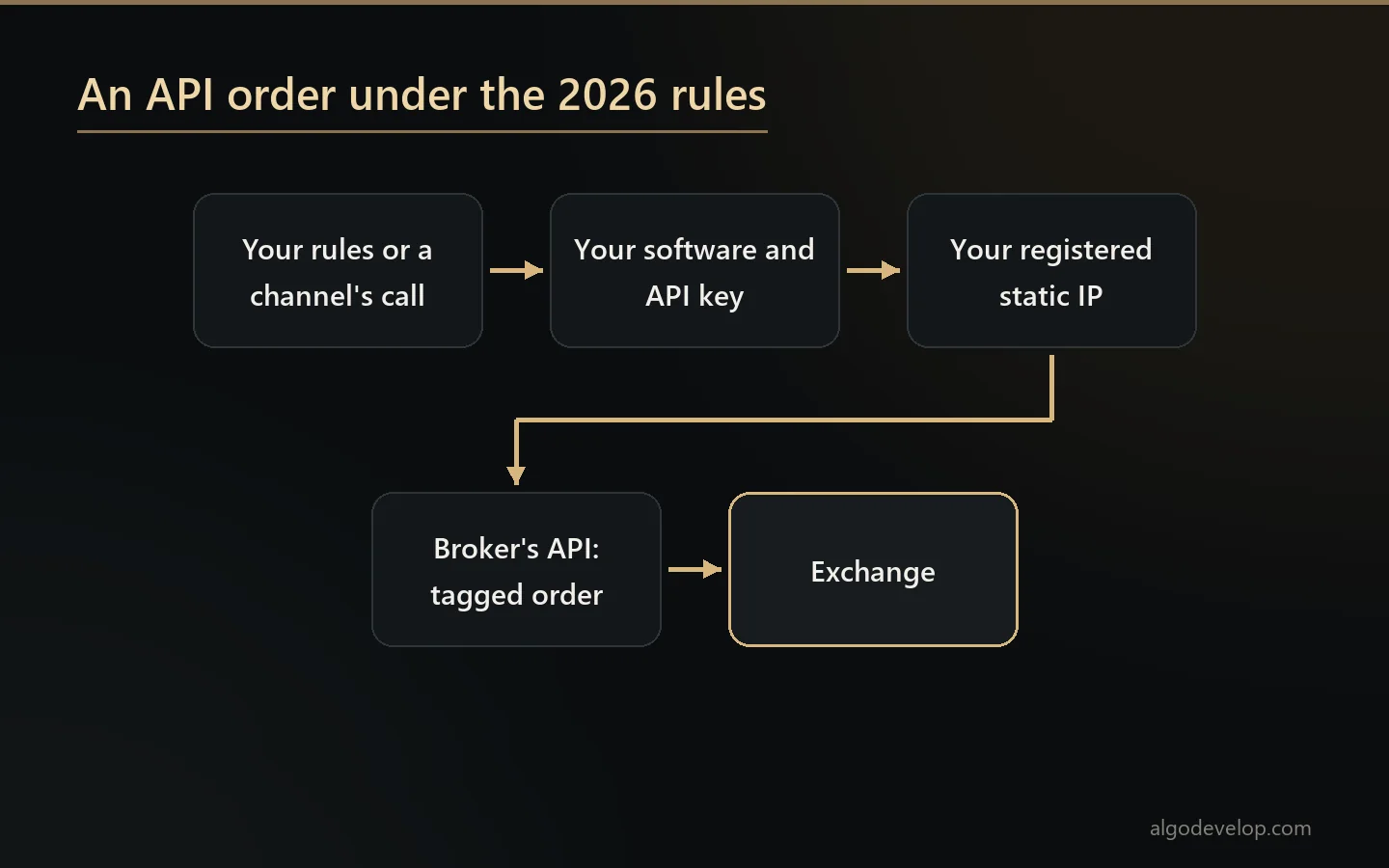
If a vendor runs the algo
Vendors fall under the same circular. SEBI does not regulate algo vendors itself. Instead, any vendor that places algo orders through a broker’s API must join a panel at the exchanges. Brokers may then deal only with vendors on that panel. If you cannot see the logic, as with a black box, the vendor must also register as a research analyst.
So where does a program you install and run yourself fit, with your own key and rules? That is a question for your broker, because the circular makes it answer for every algo order on its API. So ask before you go live, and keep the reply in writing.
Who sends the calls matters
A copier copies whatever the channel posts. So the person behind the calls matters as much as the software.
SEBI’s rules say nobody may act as an investment adviser without SEBI registration, unless the rules exempt them. On 17 August 2026, SEBI also warned investors about “live trading strategies” on social media. It said the live chats beside those sessions carry unregistered advice. It then told investors to deal only with people and firms that SEBI has registered.
Checking takes a minute. SEBI’s site lists registered investment advisers and research analysts. So search for the name or the registration number a channel shows. If neither list has it, treat the calls as unverified.
Promises are the other red flag. In its investor cautions, NSE says the law prohibits schemes that promise assured or guaranteed returns.
Never hand over your login
Some copy trading offers are really account handling. You give a stranger your user ID and password, and then they trade for you. NSE advises investors not to share their trading credentials with anyone. If a dispute arises with such a scheme, NSE says you lose the exchange’s investor protection and dispute help.
A copier you run yourself avoids this by design. It places orders with your own API key, from your own machine, so nobody else ever needs your password.
Forex, binary options and offshore platforms
Many global copy trading apps and MetaTrader brokers sit outside India. For residents, RBI’s forex rules decide this part, not SEBI’s.
RBI’s forex FAQ is clear on this. Residents may trade forex online only on platforms RBI has authorised, or on NSE, BSE and MSE. Under FEMA, residents may not trade forex on unauthorised platforms, and those who do risk penal action. Also, you cannot send margin money abroad under the Liberalised Remittance Scheme.
RBI also keeps an Alert List of unauthorised platforms. However, RBI warns that the list is not complete. A name missing from it does not mean RBI has approved it.
Most binary options apps run from outside India too. Several regulators restrict or ban them for retail traders. So check RBI’s rules and the Alert List before you deposit anything.
The same check applies to our MetaTrader copiers and binary bots. They place trades at the broker you already use. So whether you may use that broker from India is yours to check against these rules.
Copying between family accounts
Copying your trades into a relative’s account is common, and SEBI’s circular speaks to it. An investor may use a registered self-built algo for their family as well. The circular defines family as you, your spouse, dependent children and dependent parents. It does not stretch to other investors, so a friend’s account falls outside it.
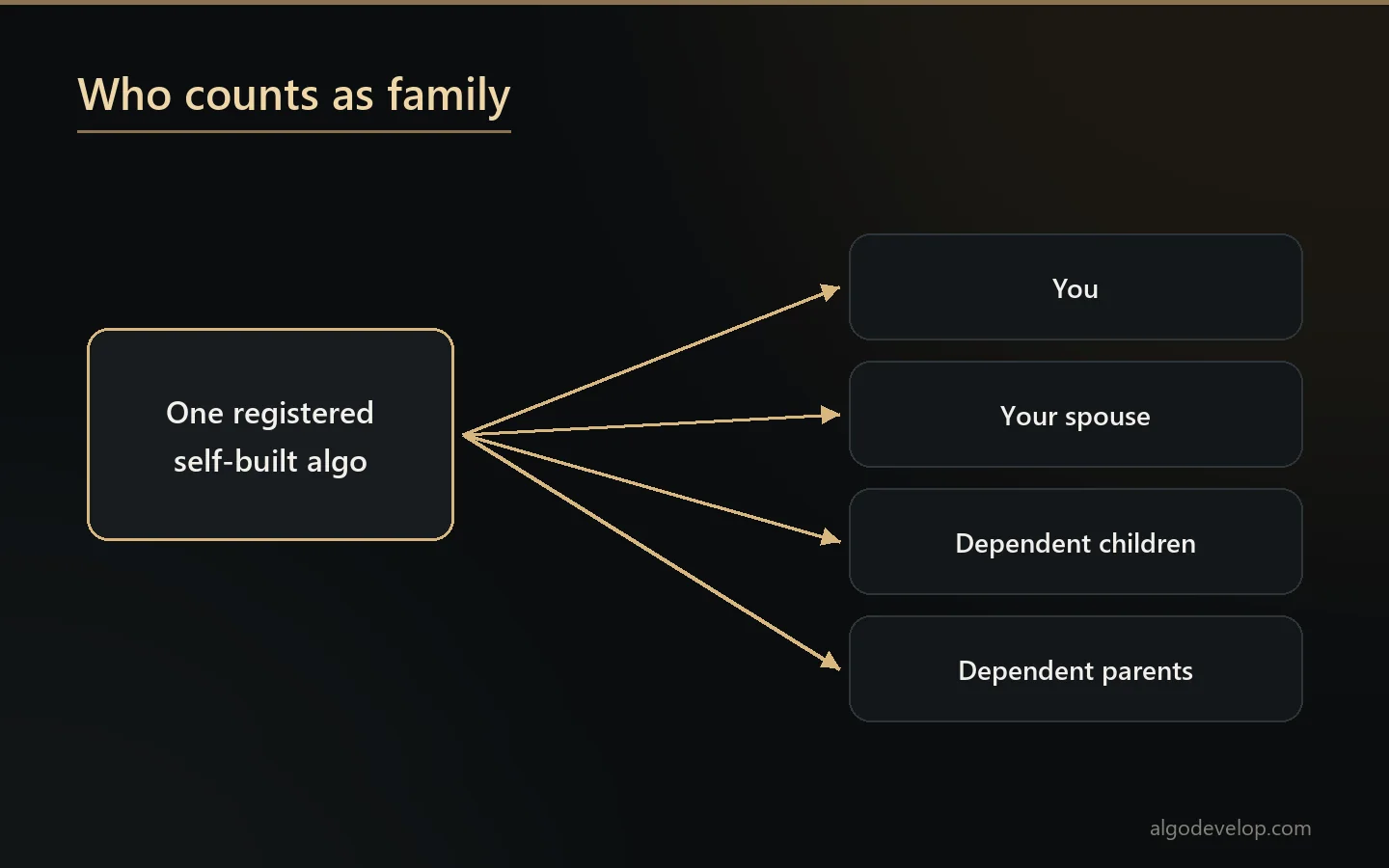
Brokers add their own rules on top. Zerodha, for example, lets those same family members share one static IP through a single developer account. Other brokers may differ, so check yours.
A checklist before you copy anything
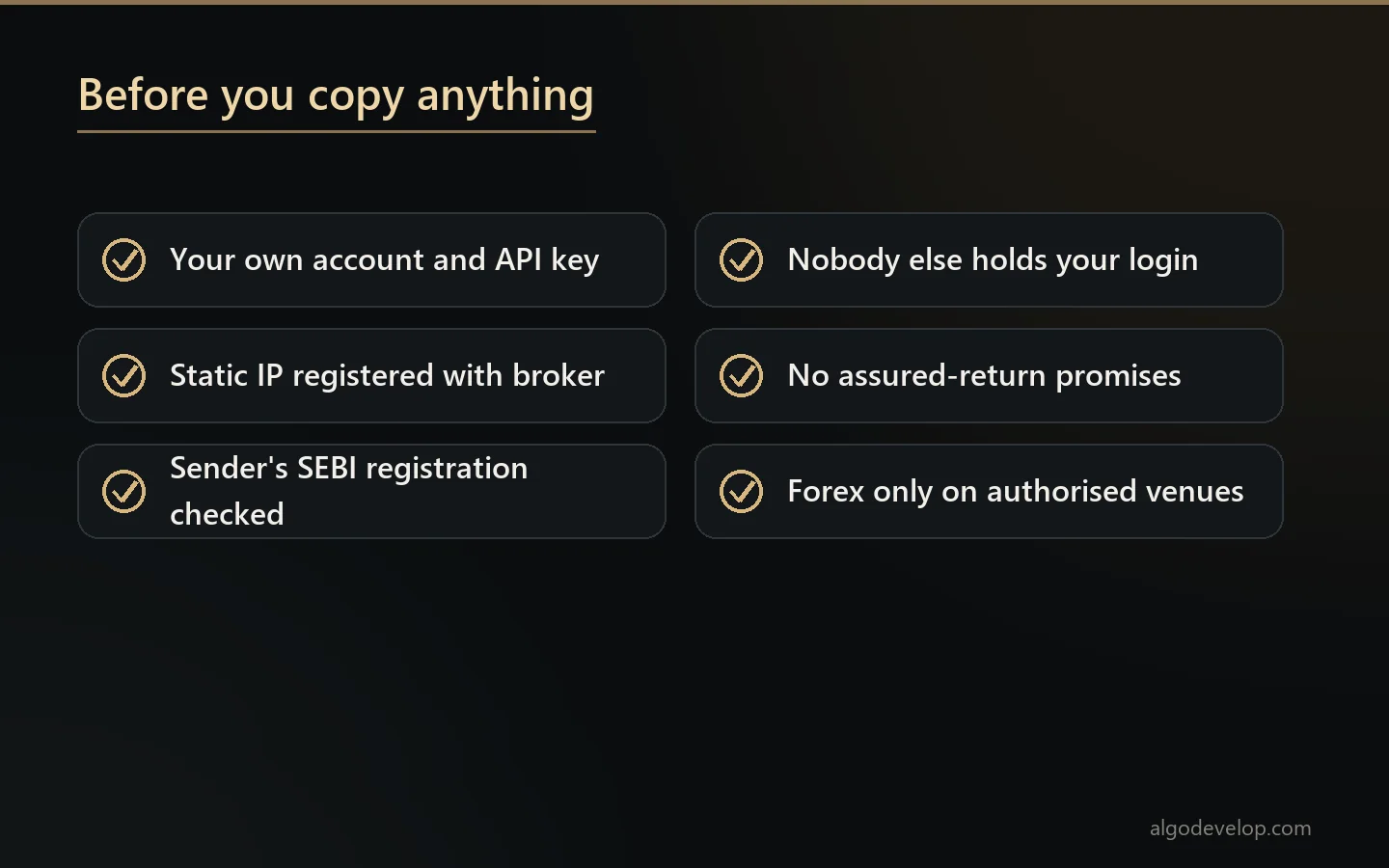
- Orders go to your own account, through your broker’s official API.
- Your static IP sits on your broker’s whitelist.
- You have checked whether the sender holds a SEBI registration.
- Nobody else holds your password, PIN or TOTP.
- Nobody has promised you fixed or guaranteed returns.
- Any forex runs on an RBI-authorised platform or on NSE, BSE or MSE.
- You tried the setup on paper, or at the smallest size, first.
Where our copiers fit
We build copier software, so here is plainly how ours sits within these rules. Our Telegram to Indian broker copier runs on your own PC or VPS, with your own API keys. So does our TradingView to Indian broker copier. Orders go through each broker’s official API, from the static IP you register.
The dashboard shows that IP with a Copy button, and it warns you if the address changes. Each account also gets its own daily order cap and lot cap, and one kill switch stops everything. Copying a channel’s calls stays far below 10 orders per second, too.
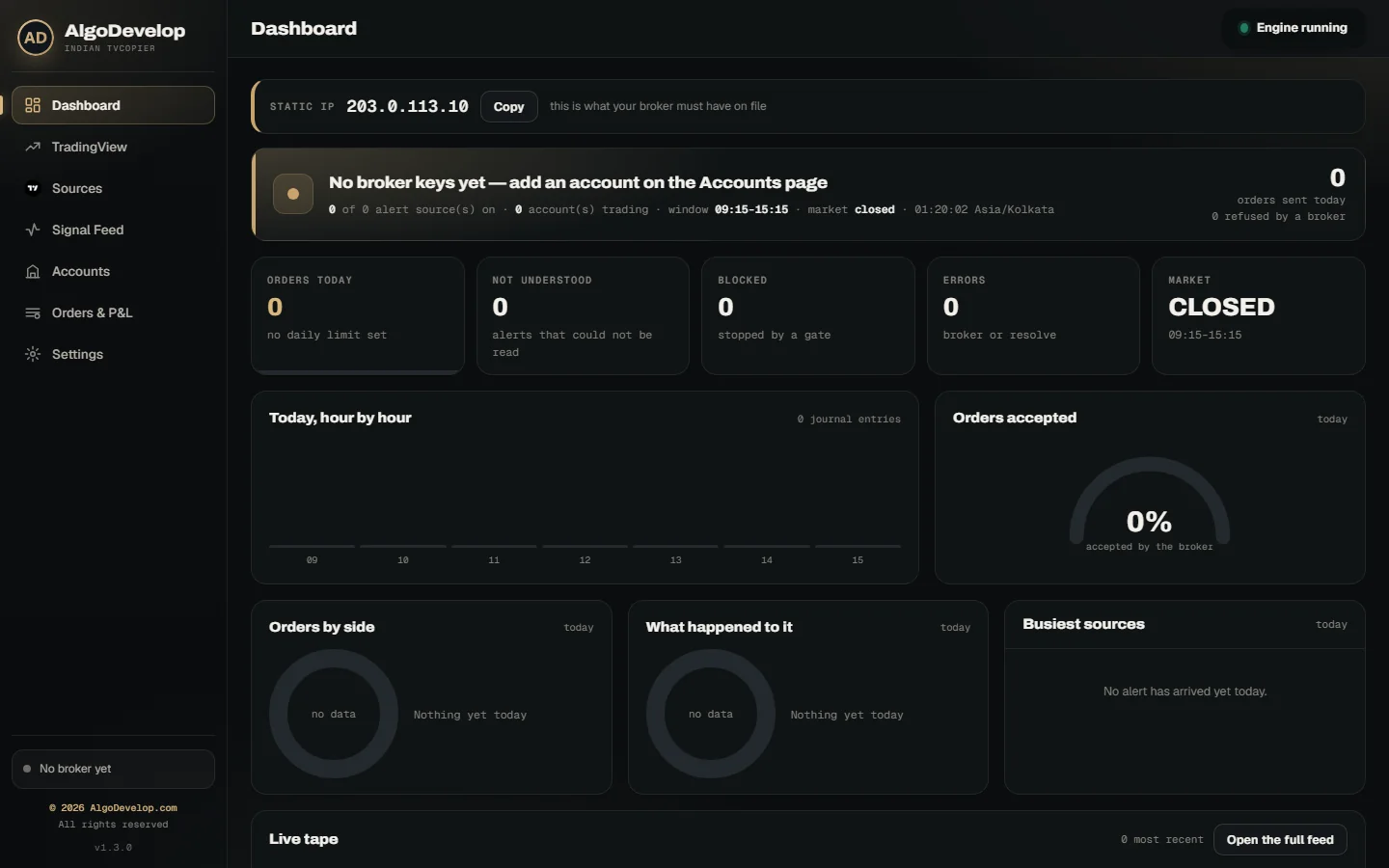
We do not sell signals, give investment advice or trade for anyone. You choose the sources, the size and the limits, and you stay responsible for them. For background, read what copy trading is or how to automate Zerodha, or browse the whole copy trading range. If you are unsure which tool fits, ask us.
Copy trading legal in India – frequently asked questions
Is copy trading legal in India for stocks and options?
Yes, within SEBI’s rules. Orders must go to your own account through your broker’s official API, from your registered static IP. A very fast strategy, above 10 orders per second, must also register with the exchange.
Is copy trading legal in India for forex?
Only on platforms RBI has authorised, or on NSE, BSE and MSE. RBI says residents may not trade forex on unauthorised platforms, and it keeps an Alert List of them.
Can I follow a Telegram tips channel?
Following a channel is your own choice. Still, SEBI warns investors against unregistered advice and live trading tips. So check whether the sender is a SEBI-registered investment adviser or research analyst before you trust the calls.
Can someone else trade my account for me?
NSE advises investors never to share their trading login with anyone. A copier you run yourself places orders without anyone else holding your password.
Do I need to register my copier with the exchange?
Not for a self-built algo below the orders-per-second threshold. Zerodha puts that line at 10 orders per second per segment. A vendor’s algo is different, so ask your broker how it treats the tool you plan to use.
Can I copy my trades into my family’s accounts?
SEBI’s circular lets an investor use a registered self-built algo for family: self, spouse, dependent children and dependent parents. It does not extend to other investors.
What about binary options apps?
Most binary options apps run from outside India. Several regulators restrict or ban them for retail traders. Indian readers should check RBI’s rules and its Alert List first.
Is this legal advice?
No. This post is general information as of October 2026, and rules change. Read the linked SEBI, RBI and NSE pages, then ask your broker or a qualified adviser about your own case.
Do you sell signals or manage accounts?
No. We build and set up copier software that you run on your own account. We do not sell signals, give investment advice or trade for anyone.
Want this built for you?
We develop it as a service — reliable, tested, and yours to own.
Message Us on WhatsApp