Python Crypto Trading Bot Development
A Python crypto trading bot runs your strategy against an exchange’s own API. It works on your server, with your keys, at whatever hour the market decides to move.
Bring a finished strategy or only a rough idea. Either way, we build exactly what you describe. You get it tested and documented, and you own it outright.
On this page
- What a Python crypto trading bot actually is
- Exchanges and what connecting to them involves
- The strategies people ask us to build
- The part that actually breaks: reconnects
- API keys, scopes and staying safe
- Backtesting, paper trading and going live
- Where it runs and what happens when it stops
- What you receive on delivery
- How a project runs
- Frequently asked questions
What a Python crypto trading bot actually is
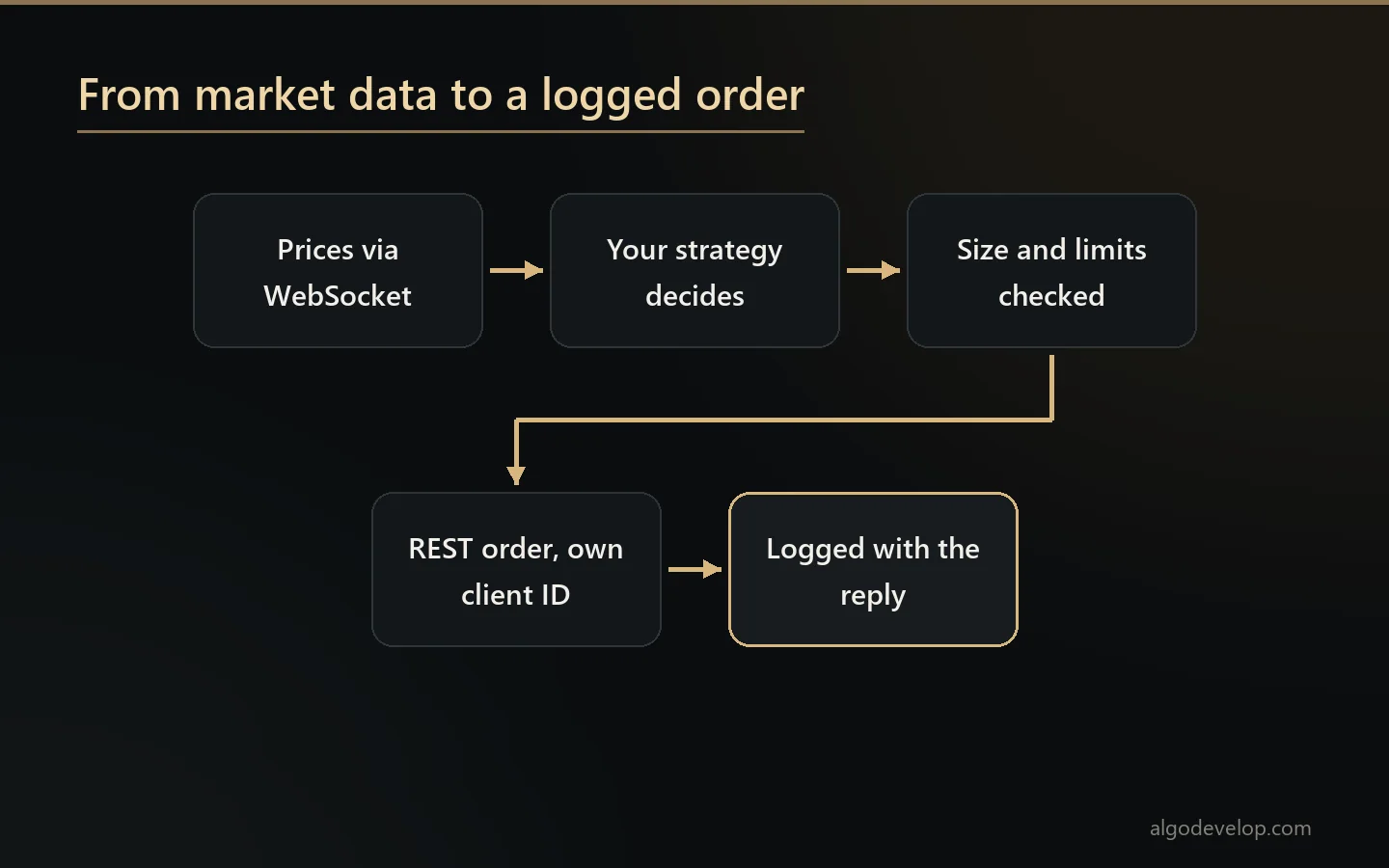
A Python crypto trading bot is a program that holds a connection to an exchange. It watches whatever your strategy watches, then sends orders once your conditions hold. There is no platform in the middle – no MetaTrader and no chart – just your code and the exchange’s API.
That directness is the appeal, and also the responsibility. At three in the morning, the bot does exactly what the code says, even when the code is wrong. So most of the work in building one properly sits in the parts that have nothing to do with the strategy.
Exchanges and what connecting to them involves
We build each Python crypto trading bot against the exchange’s official API. That covers Binance, Bybit, OKX, KuCoin, Kraken, Coinbase and others, for spot or derivatives. Each one publishes its own documentation and rules, such as the Binance developer docs or the Delta Exchange API docs. The bot has to respect those rules rather than work around them:
- REST for orders, WebSocket for data. Polling prices over REST burns your rate limit and arrives late. For anything time-sensitive, you want the stream.
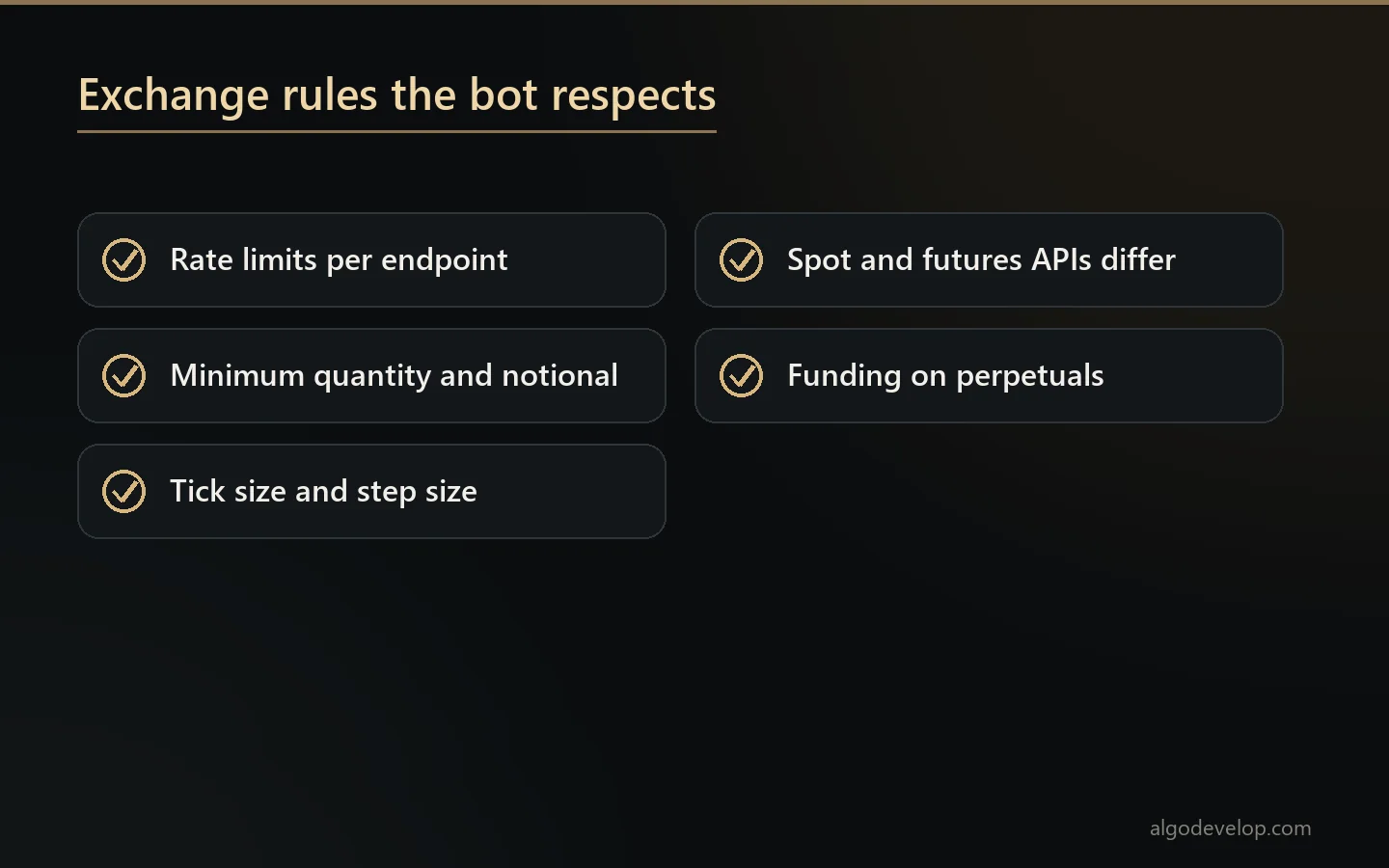
- Rate limits apply per endpoint and per account. If you hit them, the exchange throttles you or bans you for a while. So the bot has to budget its own requests.
- Precision and step size. Every symbol has a minimum quantity, a minimum notional and a tick size. The exchange rejects a quantity with too many decimals. Worse, rounding it the wrong way quietly increases your position.
- Spot and futures are different APIs at most exchanges, with different margin models. Perpetuals also add funding payments your strategy may care about.
Futures, perpetuals and options also carry liquidation risk. The leverage is always your own setting, and no bot can promise a profit.
The strategies people ask us to build
- Signal execution – your indicator, your TradingView alert or your own model, turned into orders.
- Grid and DCA bots – laddered entries with defined exits, and the position accounting that keeps them honest.
- Market making – quoting both sides with inventory limits and skew.
- Portfolio and rebalancing bots – hold target weights, then rebalance on a schedule or on drift.
- Arbitrage – between exchanges, or between spot and perpetual.
One honest word about arbitrage. Simple price gaps between exchanges are mostly gone, taken by firms co-located with the matching engine. What still works for a retail Python crypto trading bot is usually funding-rate or basis capture. There, the edge lasts days rather than milliseconds. If you have a specific arbitrage in mind, we will tell you frankly whether your latency can reach it.
Only need to copy signals? Then a ready-made bot may already fit. The Telegram to Binance bot and the Telegram to Delta Exchange bot trade channel signals on your own account. Likewise, the TradingView to Binance bot and the TradingView to Delta Exchange bot turn your TradingView alerts into orders.
The part that actually breaks: reconnects
Ask anyone who has run a Python crypto trading bot for a year what went wrong. It will not be the strategy. Instead, it will be a dropped WebSocket at the exact moment an order was in flight.
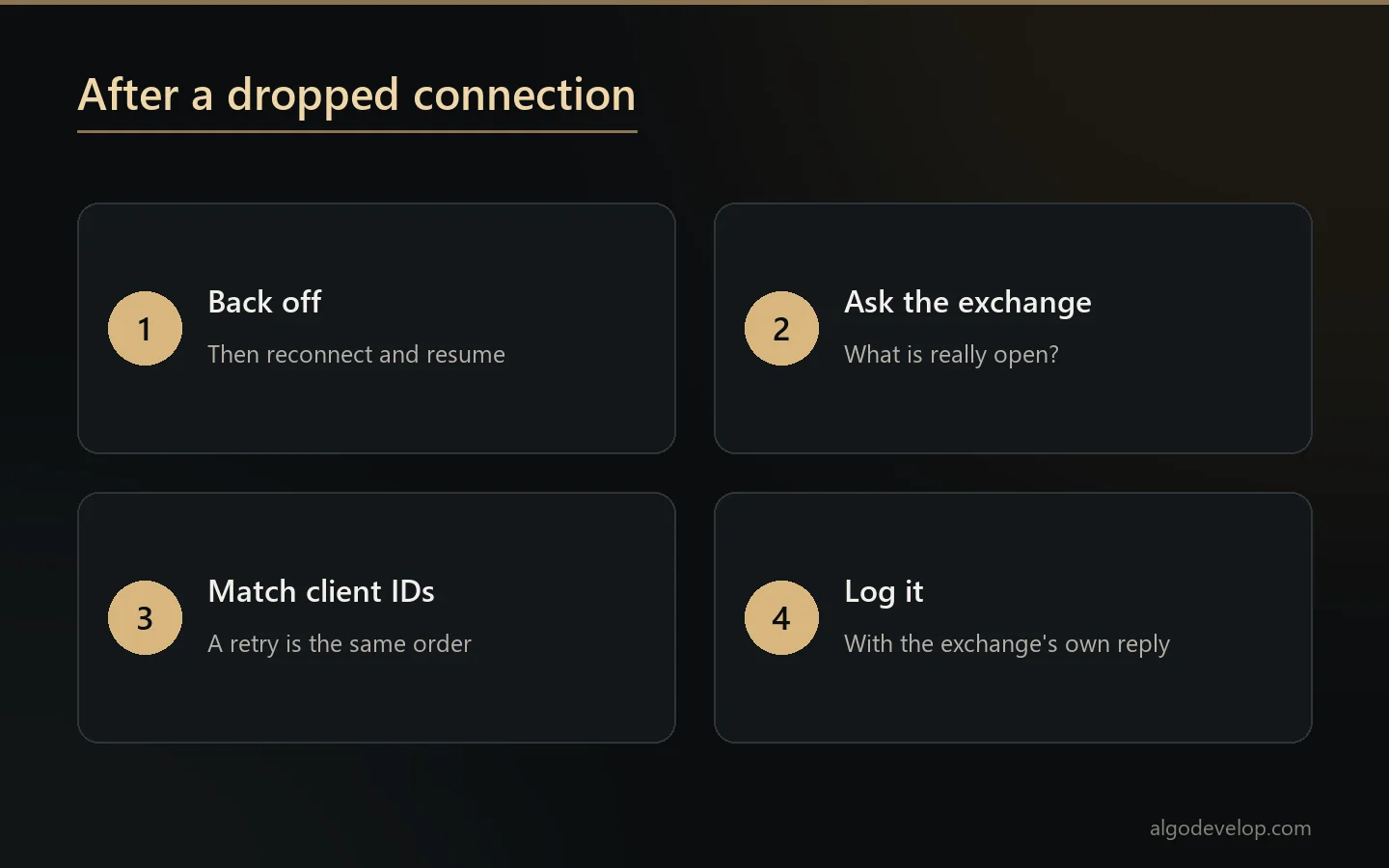
- Every order carries its own client ID. That way, the bot knows a retry after a timeout is the same order, not a second one.
- The bot reconciles state on reconnect instead of assuming it. It asks the exchange what is really open before it decides anything.
- A timeout is not a failure. An order that timed out may well have filled, and treating it as failed is how accounts end up double-sized.
- Exchange maintenance is normal, not a crash. The bot backs off, then resumes.
- The log records everything with a timestamp and the exchange’s own reply, so you can rebuild a disputed fill step by step.
API keys, scopes and staying safe
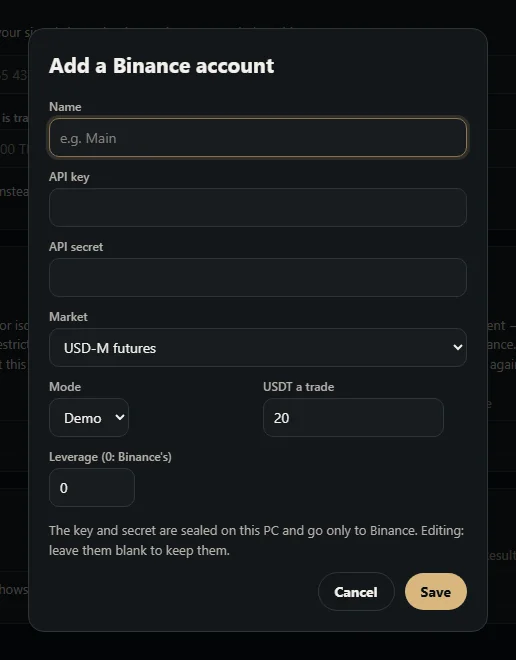
A Python crypto trading bot needs keys that you create in your own exchange account. They stay on your own server. We never hold them, and a bot we build does not send them anywhere except to the exchange.
- Enable trading, not withdrawal. The bot has no use for withdrawal rights and should never hold a key that has them.
- Restrict the key by IP to the server the bot runs on. Major exchanges support this.
- Use a separate sub-account where the exchange offers one, so the bot’s capital has a hard limit.
- Keep keys in environment variables or a secrets file, never committed next to the code.
Backtesting, paper trading and going live
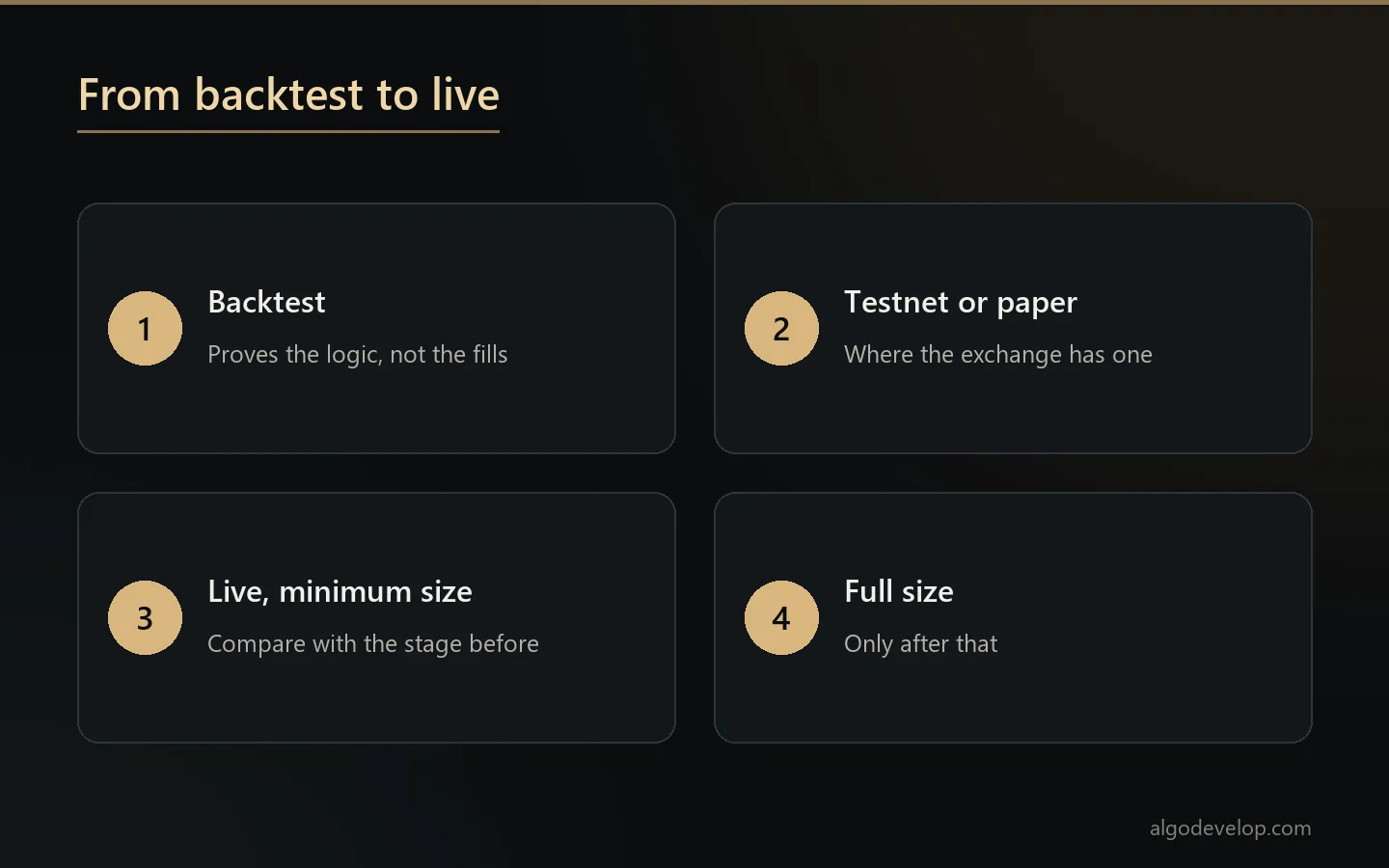
A backtest on historical candles proves the bot’s logic is what you described. However, it does not prove the fills. Crypto order books are thin at the edges, so a strategy that assumes a fill at the candle close is measuring something that never happened.
So for any Python crypto trading bot, we recommend four stages. First comes the backtest, then the exchange’s testnet or paper mode where one exists. Next, run it live at the smallest size the exchange allows, and only then at full size. Each stage produces logs you can compare with the stage before it.
Where it runs and what happens when it stops
Crypto never closes, so a Python crypto trading bot normally lives on a small VPS rather than your laptop. Every bot we deliver comes with these:
- Restart without harm. On startup, it reads its real position from the exchange rather than from a file that may be stale.
- A process supervisor, so a crash restarts the bot instead of ending the day.
- Alerts to you by Telegram or email when it stops, keeps failing, or hits a limit you set.
- Kill switches – a daily loss cap, a maximum position and a maximum number of orders per hour. All of them stay off until you switch them on.
What you receive on delivery
- Full Python source with comments, plus its list of dependencies.
- A configuration file for every parameter, so tuning never means editing code.
- Setup steps for your server, including the supervisor.
- A plain guide to every setting.
- Support after delivery, plus reasonable adjustments.
You own all of it. Nothing phones home, and there is nothing of ours it has to reach in order to run.
How a project runs
- You describe the strategy and name the exchange. Say which market, spot or futures, and what the bot should decide.
- We scope it and quote a fixed price, and we tell you anything we think will not work as described.
- Building and testing happen on testnet or at minimum size.
- You review the logs before it runs at size.
- We deliver, document and support it.
Still deciding how much to automate? Our guide on how to build a crypto trading bot walks through the choices. For a strategy you already trade by hand, see crypto trading automation, and the trading bot development page lists everything else we build.
Python crypto trading bot – frequently asked questions
Which exchanges can you build for?
We cover Binance, Bybit, OKX, KuCoin, Kraken, Coinbase and others, spot or derivatives, through each exchange’s official API. If yours is not on that list, send the API documentation. We will tell you whether it is workable.
Do you ever see my API keys?
No. You create them in your own exchange account, and they stay on your own server. A Python crypto trading bot we build sends them only to the exchange, and we keep no copy.
Should the key have withdrawal permission?
No, and this matters. Enable trading only, and restrict the key by IP to the server the bot runs on. Also use a sub-account where the exchange offers one, so the capital the bot can reach has a hard limit.
Can you build an arbitrage bot?
Yes, but we will be frank about which kind a retail bot can reach. Firms co-located with the matching engine take most simple price gaps between exchanges. Funding-rate and basis capture, where the edge lasts days rather than milliseconds, are still within reach.
What happens if the connection drops mid-order?
This is the failure that really costs people money. Every order carries its own client ID, and the bot checks state with the exchange on reconnect instead of assuming it. As a result, it never blindly resends a timed-out order and turns it into two positions.
Will it keep running if my computer is off?
Yes, because it normally runs on a small VPS with a process supervisor. It restarts after a crash and reads its real position from the exchange on startup. It also alerts you by Telegram or email when something stops.
Can I test it before risking money?
Yes. Backtest first, then use the exchange’s testnet or paper mode where one exists, then go live at the smallest size allowed. A backtest proves the logic but not the fills, which is why the middle step matters.
Can it trade futures and perpetuals, not just spot?
Yes. Futures use a separate API with a different margin model, and perpetuals add funding payments your strategy may need to handle. They also carry liquidation risk, and the leverage stays your own setting. Say which market you want at the start.
Do you have a ready-made crypto bot?
Yes, for copying signals. Our Telegram and TradingView bots trade on Binance and Delta Exchange, on your own account with your own API key. For your own strategy logic, a custom Python crypto trading bot is the answer.
Do I get the source code?
Yes. You get the full Python source with comments, a configuration file for every parameter, setup steps for your server and a plain guide. Nothing phones home.
How much does a Python crypto trading bot cost?
It depends on the strategy, the exchange, and whether it trades spot or derivatives. Describe what it should do, and we will quote a fixed price. Ask for a quote.