How to Build a Crypto Trading Bot in Python
Published July 18, 2026 · Updated October 14, 2026
To build a crypto trading bot in Python, you need four things. The first is a set of clear rules. Then come an exchange API key, code that turns signals into valid orders, and a safe place to run it day and night. None of them is hard on its own, but each has traps.
This guide walks through those parts in seven clear steps. Along the way, it shows where most home-made bots break, and when a ready-made bot or a custom build saves you the trouble.
On this page
What a crypto trading bot actually does
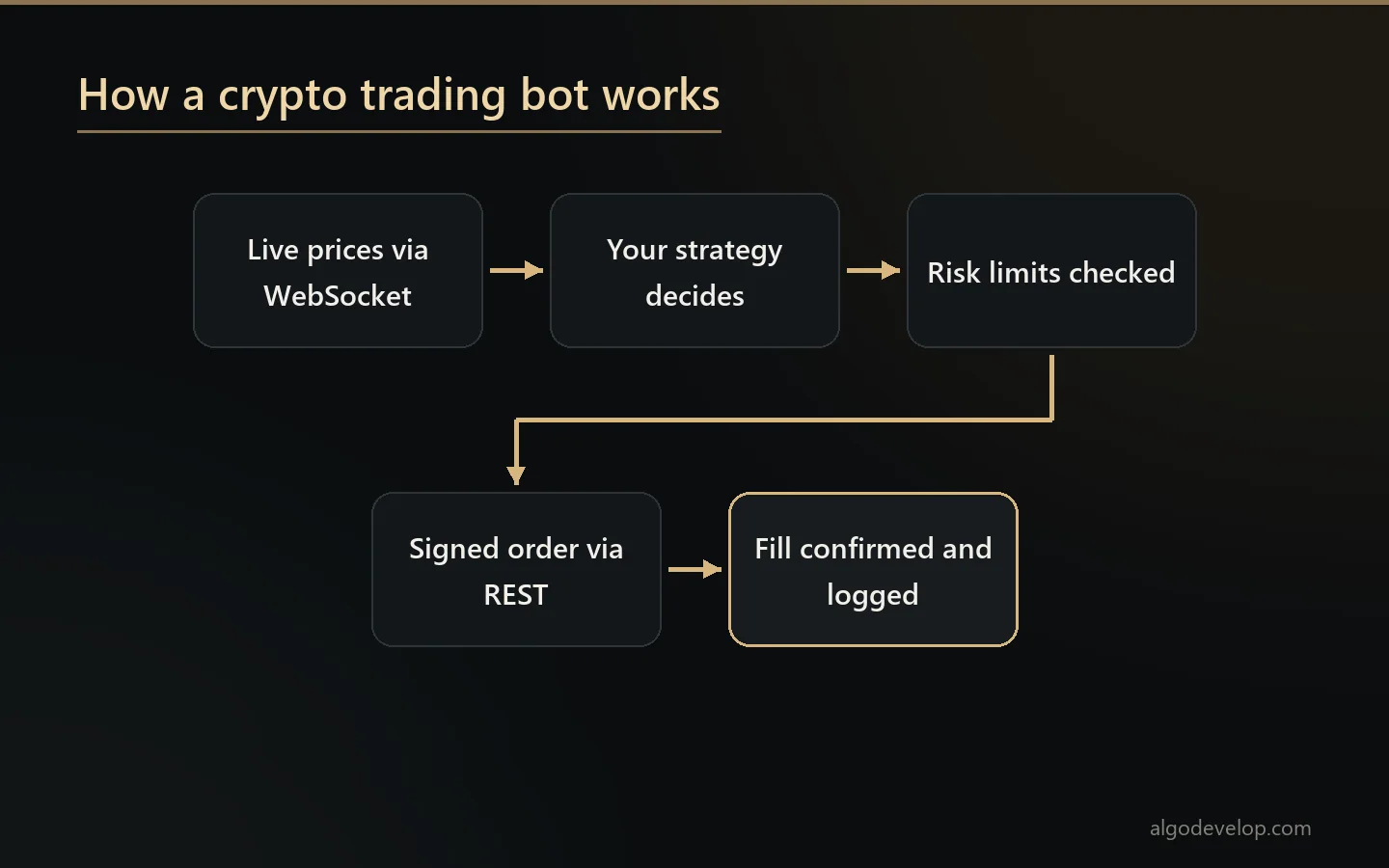
A crypto trading bot is a program that keeps a line open to an exchange. It watches whatever your strategy watches, and it sends an order the moment your conditions hold. There is no platform in the middle, so there is no MetaTrader and no chart. It is just your code and the exchange’s API.
That directness is the appeal, and also the risk. The bot does exactly what its code says at three in the morning, mistakes included. Since crypto never closes, it has to cope with every hour of the week.
What you need before you build a crypto trading bot
- Python 3 and a code editor you like.
- An exchange account with API access, plus its test network if it has one.
- A client library. Either use the exchange’s own SDK, or an open-source library such as CCXT, which speaks to many exchanges through one interface.
- Your rules in writing. Entry, exit, size and the odd cases, before any code.
- A small VPS for later, because a laptop sleeps and a bot must not.
Most of all, you need the exchange’s own API documentation. For example, Binance’s developer docs set out every endpoint, limit and error code. Read them before you trust any tutorial, including this one.
How to structure the code
Keep each job in its own module. That way, you can test the strategy without touching the exchange, and you can swap exchanges without touching the strategy.
- Config holds symbols, sizes and limits, and reads the keys from the environment.
- Data feed keeps the WebSocket open and hands on each new price or candle.
- Strategy takes prices in and returns a decision: buy, sell or nothing.
- Risk checks size, open positions and the daily loss limit before anything goes out.
- Execution signs and sends orders, then tracks each one by its client order ID.
- State and logs keep a record of every decision. After a restart, the bot checks that record against the exchange.
How to build a crypto trading bot in 7 clear steps
Step 1: Write your rules down
Before you build a crypto trading bot, write the entry, the exit and the size in plain words. Then answer the awkward questions. What if an order only half fills? What if the bot restarts while it holds a position? And what if two signals arrive in the same second? A bot that has no answer will make one up.
Step 2: Pick the exchange and the market
Spot and futures are separate APIs at most exchanges, with different rules. Spot is simpler: you buy a coin and you hold it. Futures add leverage and the risk of liquidation, where the exchange closes your position for you. Perpetual futures also carry funding payments between buyers and sellers. Leverage is your own setting, so start low or stay on spot while you learn.
Step 3: Create a safe API key
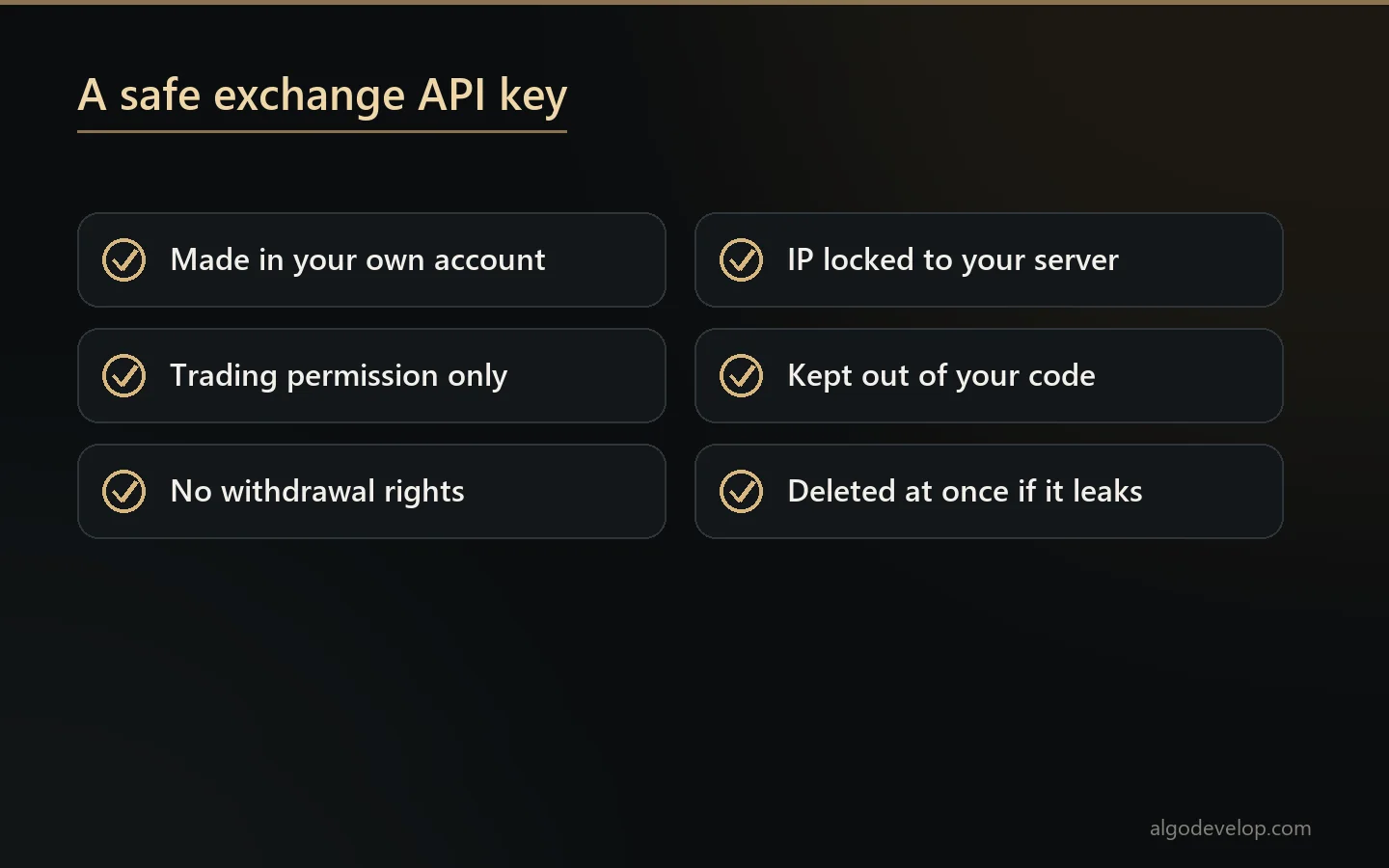
Make the key inside your own exchange account. On Binance, a new key cannot trade by default, so you switch trading on in API Management. Never switch withdrawals on, because a bot has no use for them. Then lock the key to your server’s IP address. Finally, keep the key and secret in environment variables, not in your code.
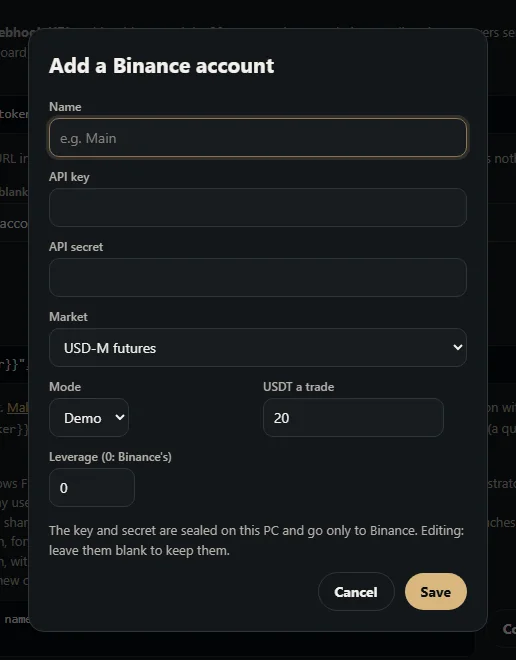
Our ready-made crypto bots follow the same pattern. You paste your own key into the app on your own PC or VPS, and we never hold it.
Step 4: Read market data the right way
Use REST calls for snapshots, such as your balance or the rules of a symbol. For live prices, though, open a WebSocket stream. Polling prices over REST arrives late and burns your rate limit. Exchanges also limit how many requests you send. Binance gives each request a weight, and it answers with error 429 once you go over. If you keep pushing, it bans your IP for anything from two minutes to three days.
Step 5: Turn signals into valid orders
Orders need a signature and a timestamp, so check that your server clock stays in sync. Next, respect each symbol’s filters. There is a step size for quantity, a tick size for price and a minimum order value. Round the quantity down, never up, or you quietly trade more than you meant. Also give every order your own client order ID.
Step 6: Handle the messy parts
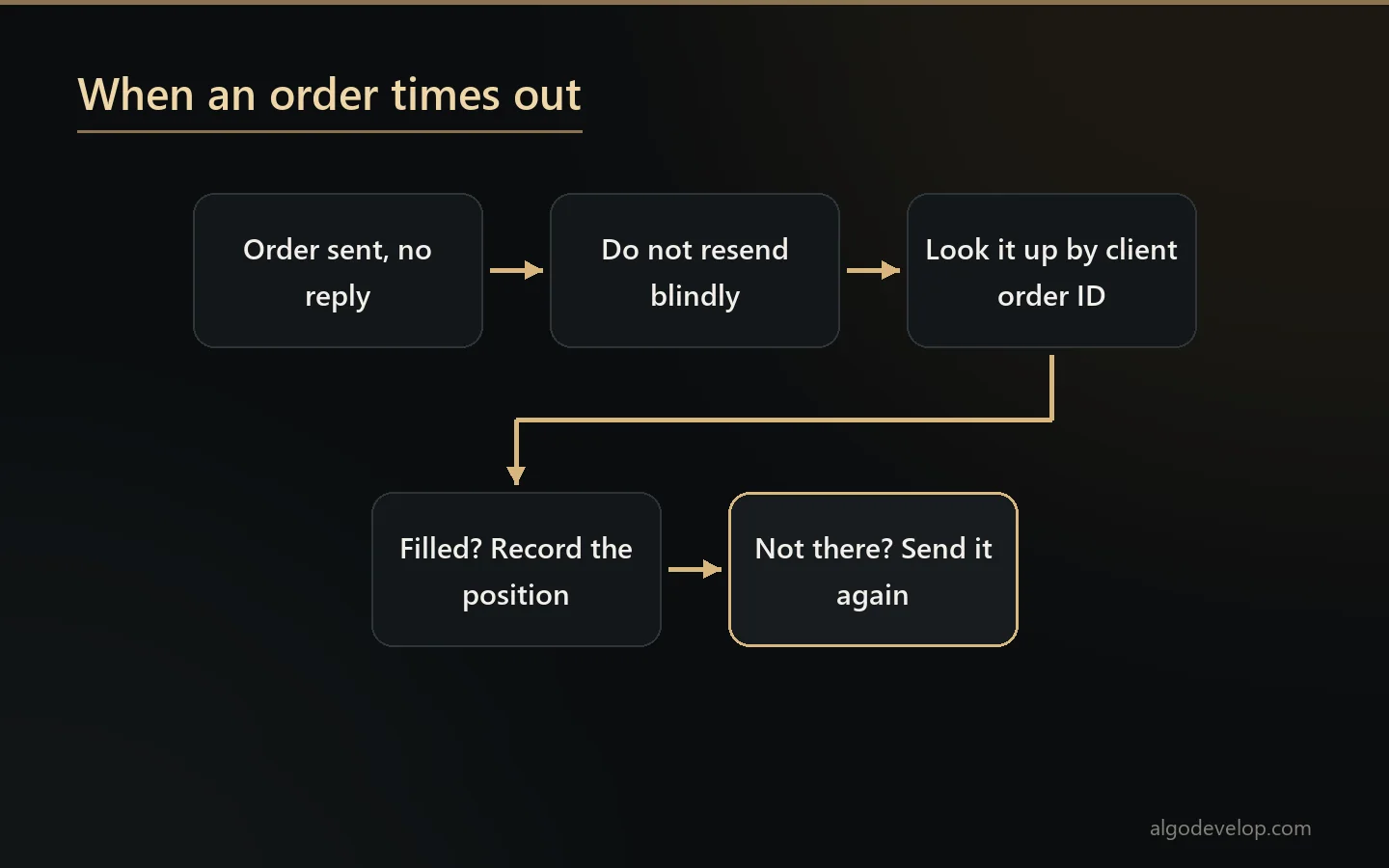
This is where home-made bots fail. A timeout does not mean the order failed, since it may well have filled. So look it up by its client order ID before you send anything again. After a restart, ask the exchange what is open rather than trusting a local file. When the WebSocket drops, reconnect and check your position before you trade again. Finally, log every request and reply with a timestamp.
Step 7: Test, then go live slowly
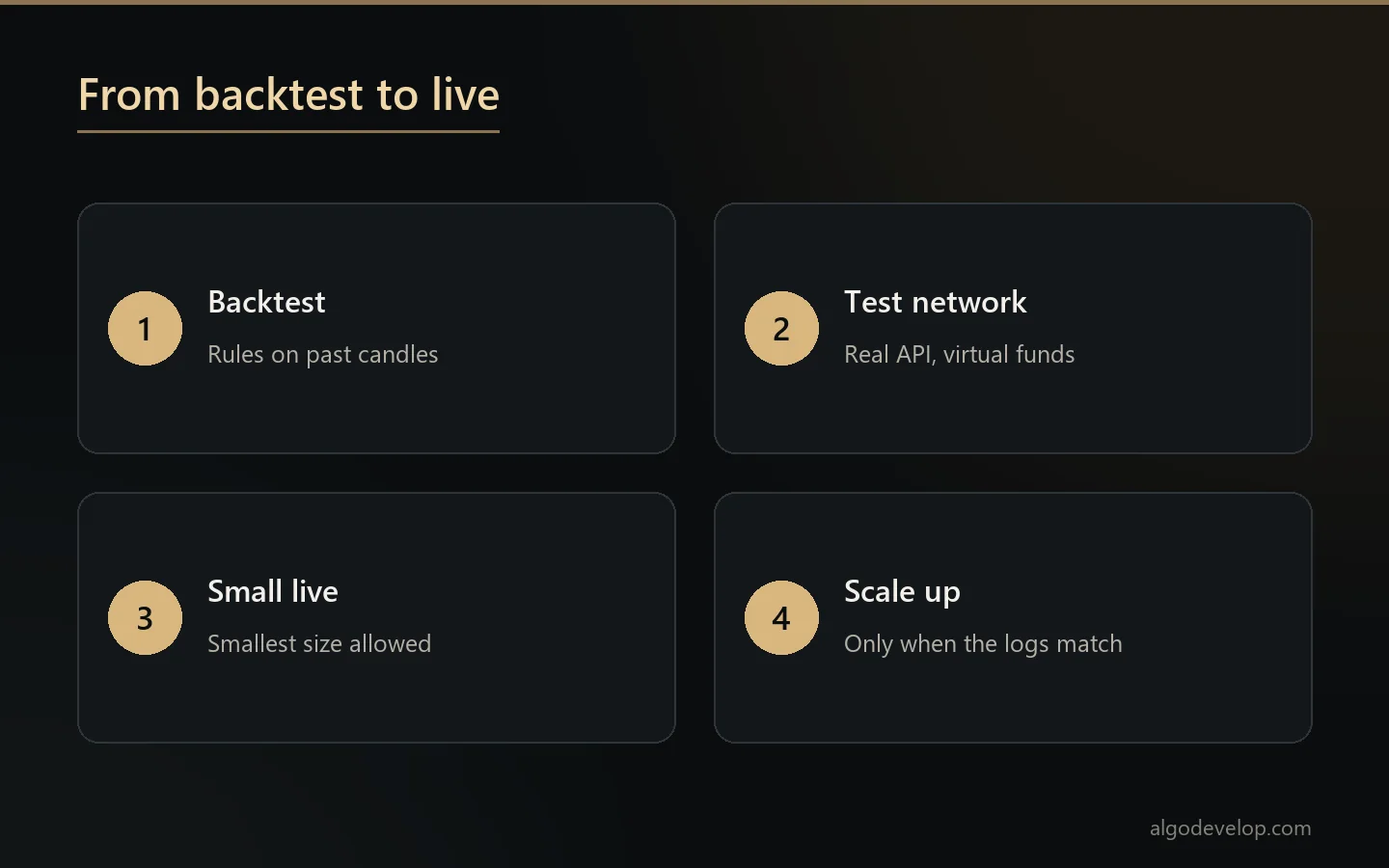
A backtest on past candles proves your logic, but not your fills. Order books are thin at the edges, so real prices often differ from the candle close. Next, run the bot on a test network. The Binance Spot Test Network, for instance, mirrors the real API with virtual funds, and it resets about once a month. Then go live at the smallest size the exchange allows. Scale up only once the live logs match the test logs.
When it goes live, run it on a VPS under a process supervisor, so a crash means a restart rather than silence. Add an alert to your phone for errors, too.
Signals from TradingView or Telegram? Skip the build
Many traders do not need to build a crypto trading bot at all. Instead, they want someone else’s calls, or their own TradingView alerts, placed on the exchange. For that, our ready-made apps already exist:
- Telegram to Binance bot and Telegram to Delta Exchange bot read the channels you choose and trade the calls.
- TradingView to Binance bot and TradingView to Delta Exchange bot turn your alerts into orders through a webhook.
Each one runs on your own PC or VPS, with your own API keys. We never hold them.
When to have it built for you
If you enjoy the work and have time to test, build a crypto trading bot yourself. On the other hand, if your strategy is clear but the plumbing is not your thing, we can build it. We write Python bots against each exchange’s official API, including Binance, Bybit, OKX, KuCoin, Kraken and Coinbase. Every one ships with the client order IDs, restart checks and logs described above. See Python crypto trading bot development for how a project runs. For grid and DCA bots, read about crypto trading automation.
How to build a crypto trading bot – frequently asked questions
Is Python fast enough for a crypto trading bot?
Yes, for strategies that act in seconds or minutes. It cannot race firms that sit next to the exchange’s matching engine, but few retail strategies need that.
Can the bot withdraw my money?
Not if its key has no withdrawal permission. A trading bot never needs that right, so leave it switched off.
Do I need a VPS?
In practice, yes. Crypto trades around the clock, and a VPS keeps the bot running while your own PC is off.
Which exchange should I start with?
Pick one with clear official docs and a test network. Binance has both, and so do several other large exchanges.
Can I test a bot without real money?
Yes. Use the exchange’s test network or paper mode first, then go live at the smallest size it allows.
Is trading futures with a bot risky?
Yes. A futures position can face liquidation, and leverage brings that point closer. Leverage is your own setting, so keep it low while you test.
Is a crypto trading bot legal?
That depends on your country and on the exchange’s own terms. Check both before you go live.
Can I build a bot that trades Telegram signals?
You can, but reading free-text calls reliably is a project of its own. Our Telegram to Binance and Telegram to Delta Exchange bots already do it.
How much does a custom Python crypto bot cost?
It depends on the strategy, the exchange and the testing. Our pricing page shows a typical starting range, and you get a fixed quote first. Tell us your rules to ask.
Want this built for you?
We develop it as a service — reliable, tested, and yours to own.
Message Us on WhatsApp