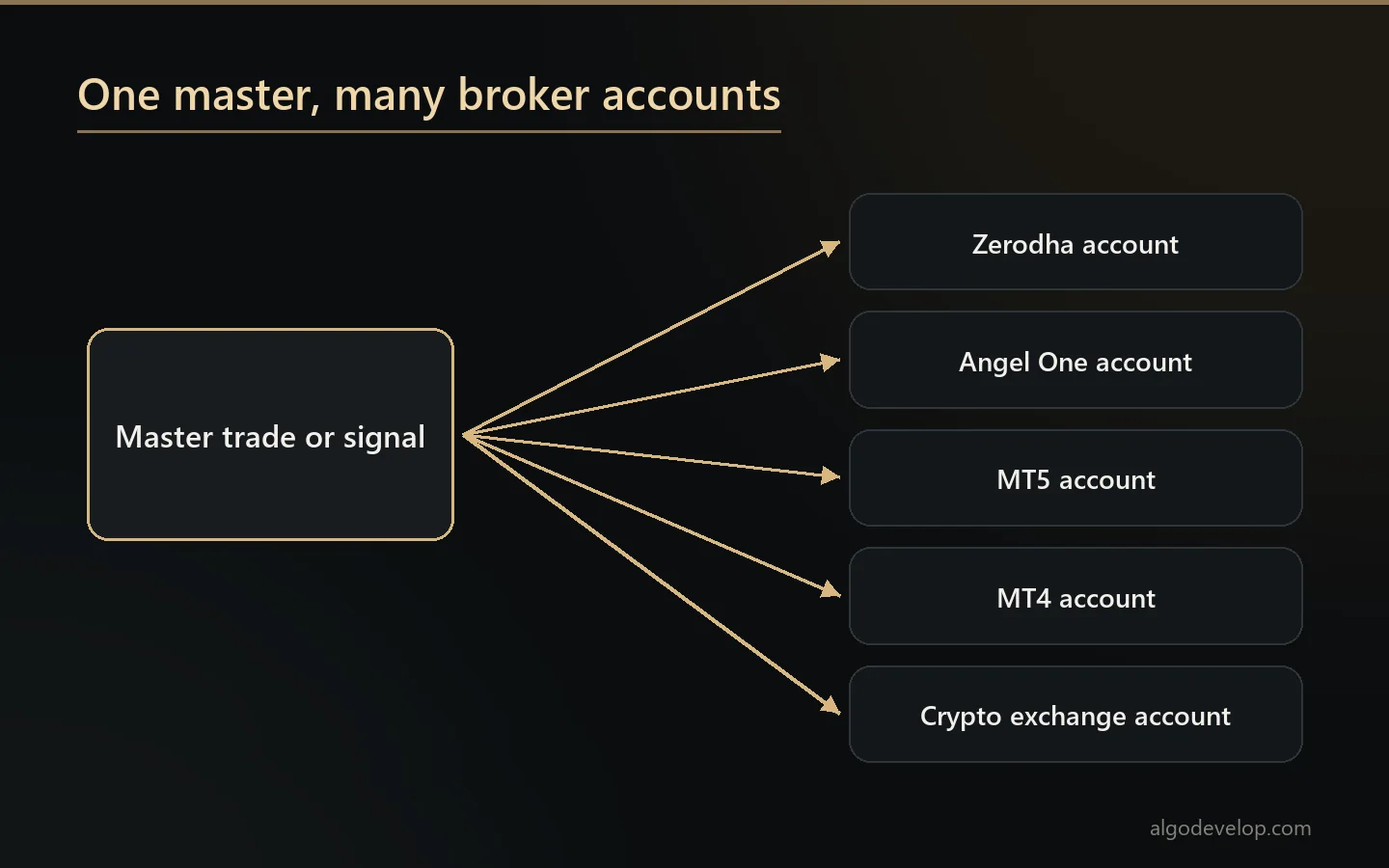
Multi-broker copy trading puts one master’s trades into every account that follows it, at the same moment. Those accounts can sit at different brokers, such as Zerodha, Angel One, MT5 or a crypto exchange. Each one then sizes the trade by its own rule.
On this page
- What multi-broker copy trading actually does
- How multi-broker copy trading works, step by step
- Which platforms can sit under one master
- What the master can be
- Per-account sizing and selective routing
- Risk controls, global and per account
- Every feature in the multi-broker copy trading platform
- Keys, ownership and who controls what
- Setting up multi-broker copy trading
- One platform, or many?
- Frequently asked questions
What multi-broker copy trading actually does
Ordinary copy trading moves a trade from one account to another on the same platform. Multi-broker copy trading, however, does something harder. It takes one master and repeats it across accounts that are not on the same platform at all. Think of an options trade at Zerodha, a forex trade on MT5 and a crypto trade on an exchange. All three come from one instruction.
The hard part is not the sending. Instead, one master trade means different things on different platforms: quantity here, lots there, contracts somewhere else. The symbol names differ too, and so do the order types. So the real job is translation: one decision has to land right in every account.
How multi-broker copy trading works, step by step
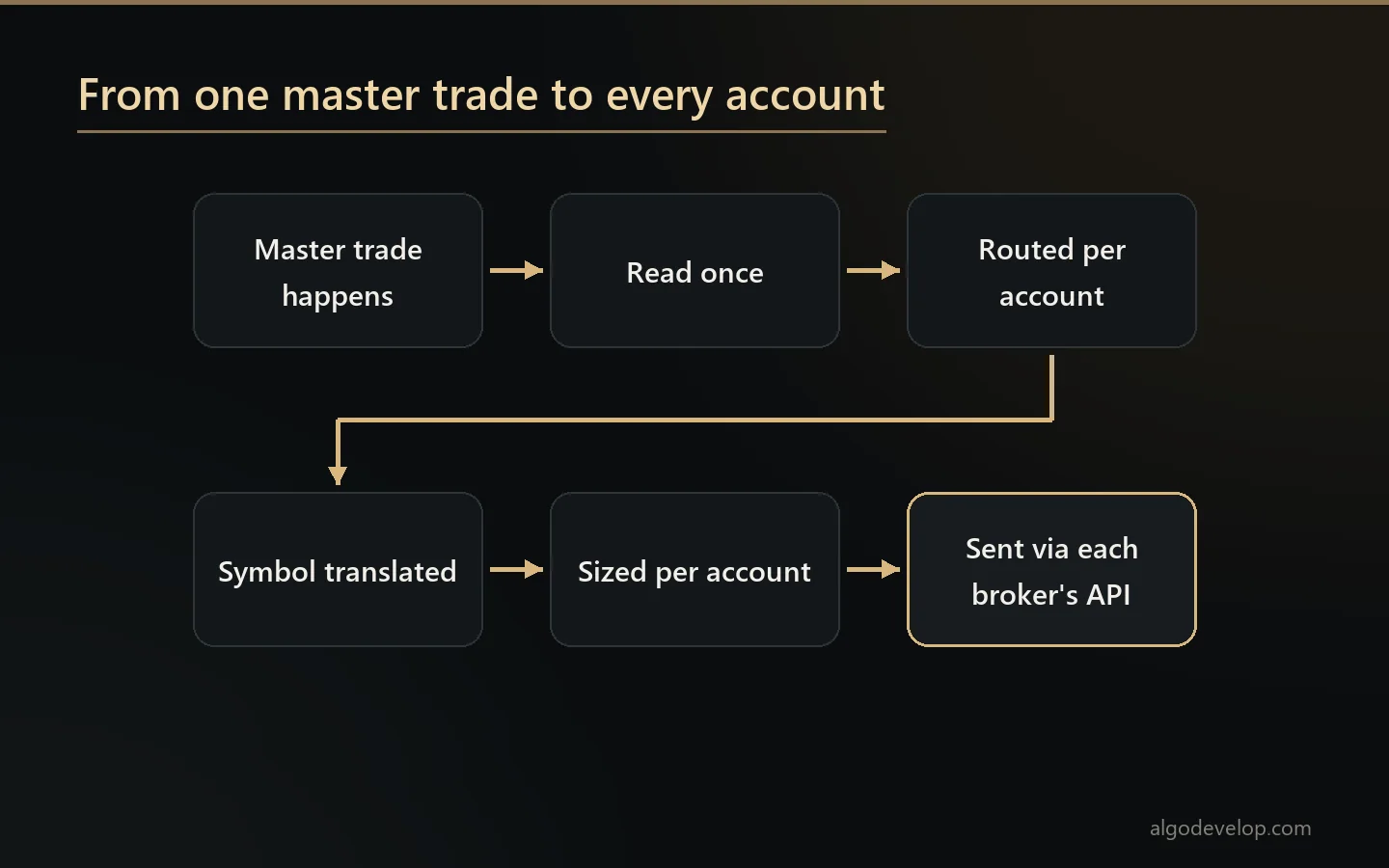
- A master trade happens. It can be your own manual trade, an EA, a TradingView alert or a Telegram channel, whichever you choose.
- The system reads the instruction once. It notes the symbol, side, size and any stop or target, in a form that suits every platform.
- Routing comes next. Each follower gets a check: does it take this symbol, this segment, at this hour?
- The symbol changes per platform. So the master’s symbol becomes the exact contract or pair that each account expects.
- Each account sizes the trade itself. That means lots on MetaTrader, quantity or F&O lots at an Indian broker, and size on a crypto exchange.
- Then the orders go out together through each broker’s own API. The system logs every reply against its account.
- The position stays in sync. After the entry, exits, changes and partial closes reach every account that took it.
Which platforms can sit under one master
Each platform connects through its own official API, wherever one exists:
- Indian brokers such as Zerodha, Angel One, Upstox, Fyers and Dhan. They cover equity and F&O, plus MCX where the API allows it.
- MetaTrader: MT4 and MT5 accounts at any broker, for forex, metals and CFDs.
- Crypto exchanges: spot and derivatives, where the exchange has a trading API.
The system can mix them under one master. So one call can open an F&O trade for one follower and a forex trade for another. That depends only on how you route it.
However, Indian accounts bring one extra rule. SEBI’s framework for retail algo trading has applied since 1 April 2026. Under it, a broker accepts API orders only from a static IP you have registered with it. So the machine that sends those orders needs a static IP, registered with each broker.
What the master can be
The source does not have to be a person clicking buy. Any of these can drive a multi-broker copy trading setup:
- Your own manual trades in one terminal or one broker account.
- An Expert Advisor (EA) that runs your own strategy.
- TradingView alerts from your own charts or Pine strategy.
- A Telegram channel, read the same way our signal copiers read one.
Whichever you choose, the followers below it stay the same. That way you can swap the master later without rebuilding the accounts underneath.
Per-account sizing and selective routing
Two accounts that follow the same master almost never want the same size. Often they do not want the same trades either, so the system has to handle both.
Per-account sizing. So every follower carries its own rule:
- Fixed: a set quantity or number of lots.
- Multiple: half the master’s size, double it, or any other step.
- Share of capital: the size grows as the account grows.
- Risk from the stop: a size worked back from the stop, so each account risks its own fixed amount.
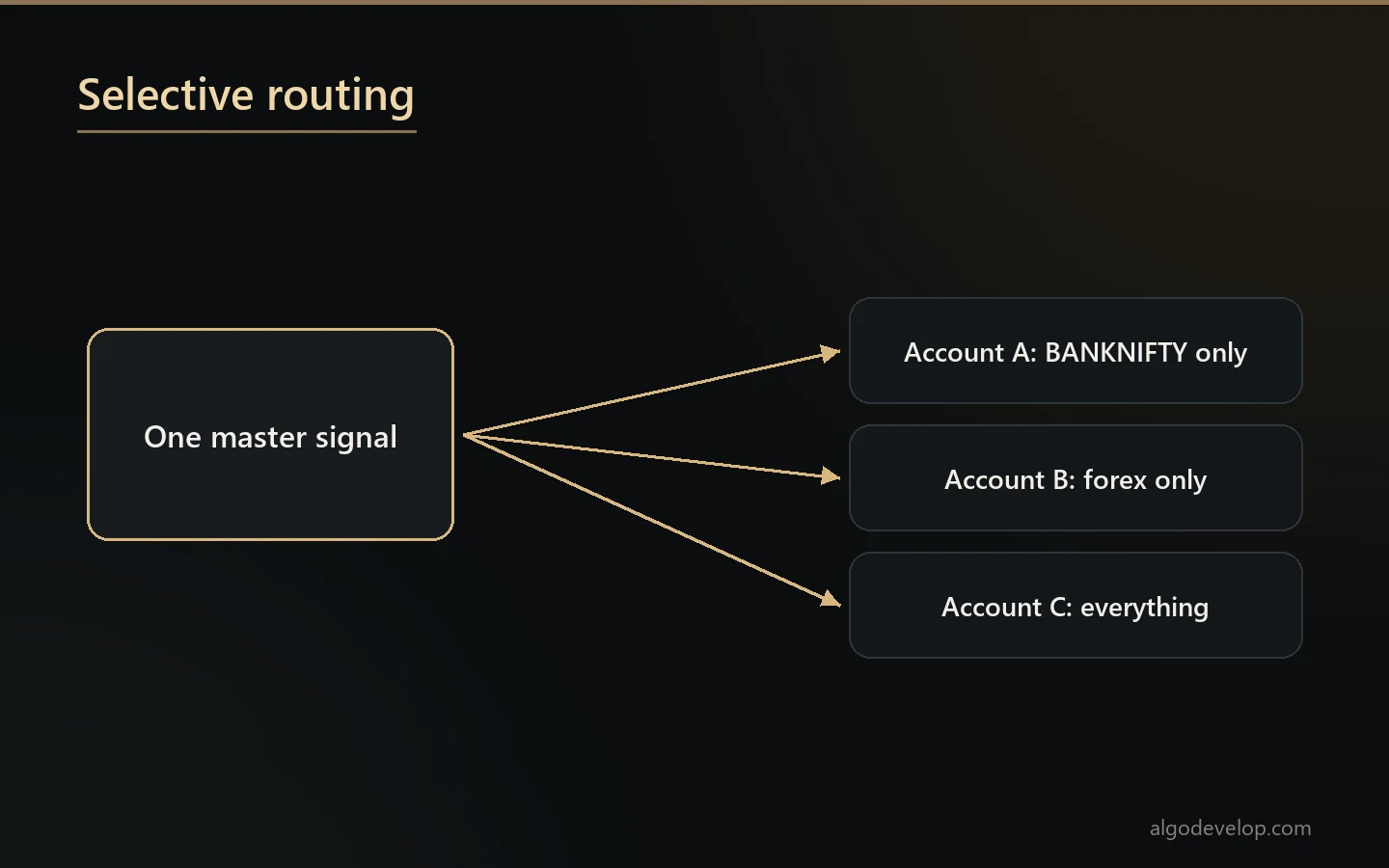
Selective routing: send only certain symbols or segments to certain accounts. For example, one follower takes only BANKNIFTY, another only forex, and a third takes everything. The master does not need to know or care.
Accounts come and go. You can add or remove a follower without rebuilding anything, while the rest keep running.
Risk controls, global and per account
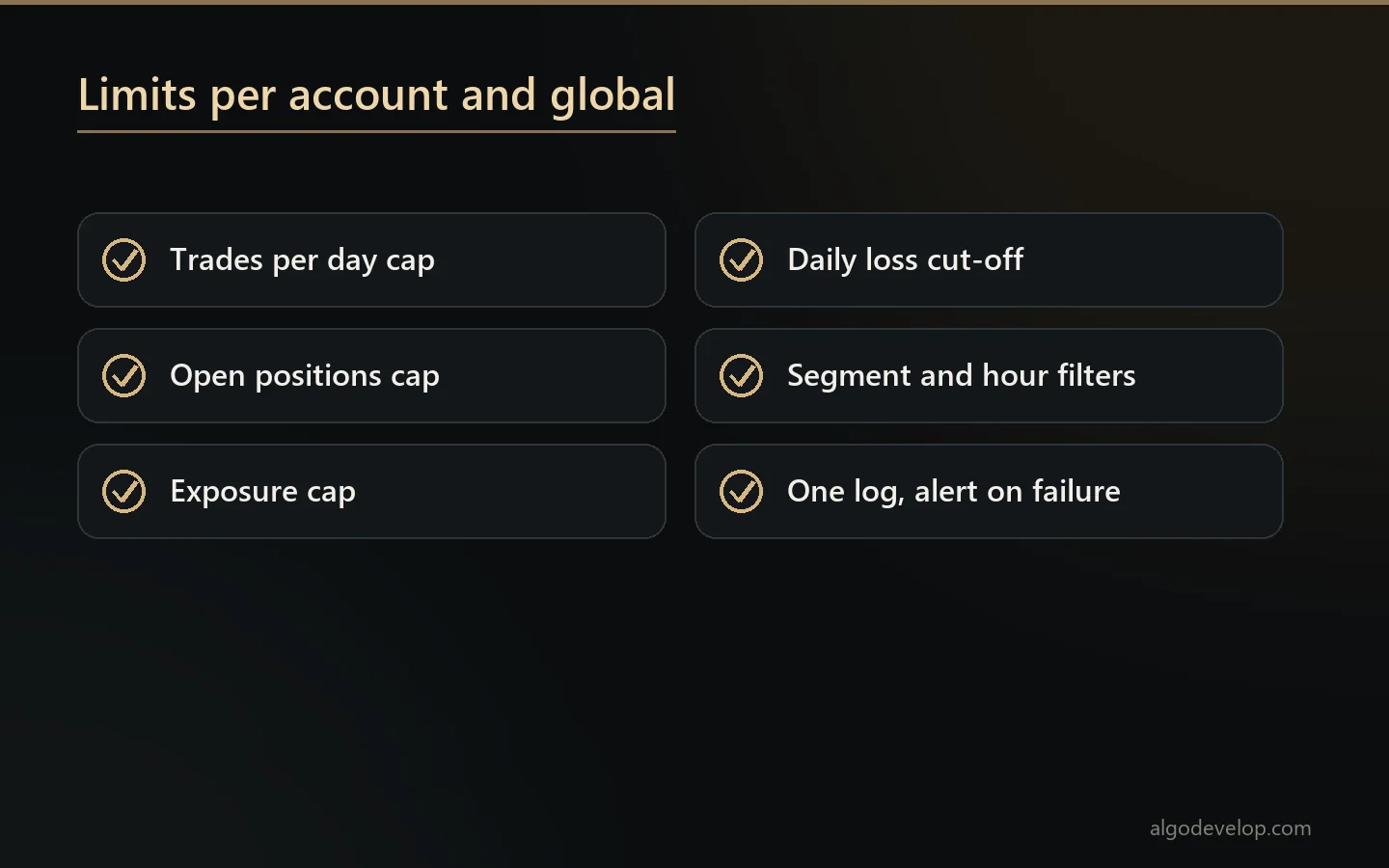
With many accounts under one master, a single bad order multiplies. That is why multi-broker copy trading applies limits at two levels:
- Per account: caps on daily trades, open positions and exposure, plus a daily loss cut-off for that account alone.
- Global: the same limits across the whole system, so one runaway master cannot flood every account.
- Filters: segment and trading-hour rules for each account.
- One log: every account, every order and every skip with its reason, plus an alert when something fails.
Every feature in the multi-broker copy trading platform
| Feature | What it does |
|---|---|
| One master, many brokers | Pushes a single set of trades to Zerodha, Angel One, MT4/MT5, crypto and more, together. |
| Mixed platforms at once | Indian equity and F&O, forex and crypto, all driven from one source. |
| Per-account sizing | Every account gets its own lot or quantity rule and its own risk rule. |
| Risk controls at two levels | Global and per-account limits on trades, exposure and daily loss. |
| Broker API bridges | Official APIs where they exist, with each account’s keys kept apart. |
| Symbol translation | Maps one master symbol to the right instrument on each broker. |
| Selective routing | Sends certain symbols or segments only to certain accounts. |
| Add or remove accounts | Scales followers up or down without rebuilding the system. |
| Full sync | Entries, exits, changes and partial closes across every account. |
| Logs and alerts | One place to see everything, with an alert when something fails. |
| Runs on your accounts | Every account stays under its owner’s own keys and control. |
| Built to your workflow | The master can be a Telegram channel, TradingView, an EA or your own manual trades. |
Keys, ownership and who controls what
Each follower account stays in its owner’s hands. The system keeps each account’s API keys apart, so no follower can see or affect another. It pools nothing, and no funds move between accounts. In addition, any owner can detach their account at any time.
Setting up multi-broker copy trading
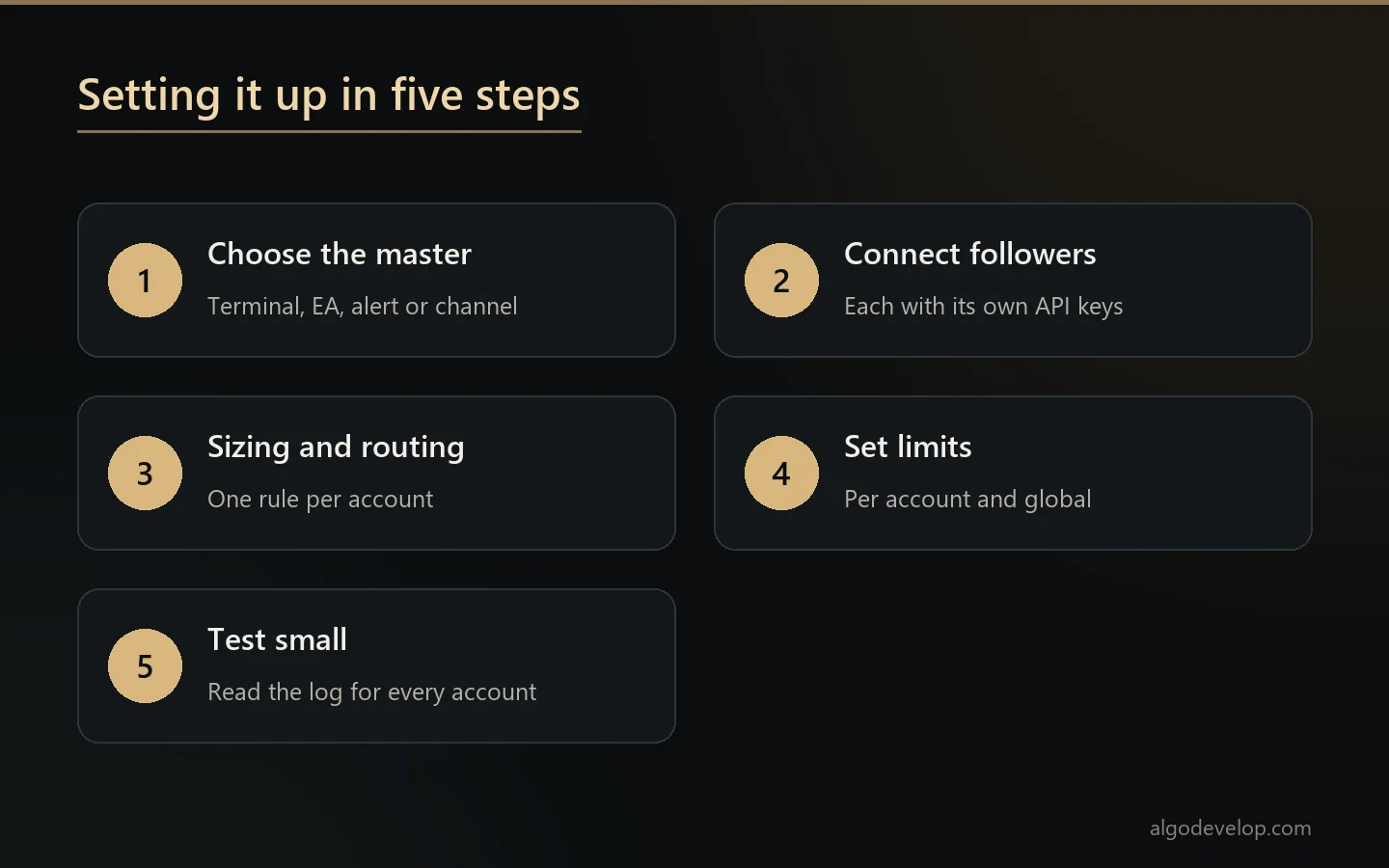
- First, decide what the master is: a terminal, an EA, a TradingView alert or a channel.
- Next, connect each follower account with its own API keys.
- Then set each account’s sizing rule and its routing.
- After that, set the per-account and global limits.
- Run one small trade through the whole chain, then read the log for every account before going live.
Indian brokers publish their own APIs, such as Zerodha’s Kite Connect and Angel One’s SmartAPI. The platform follows their rules rather than working around them.
The shape of the setup depends on how many accounts you run and on which platforms. So we build it to your setup, rather than ship it as one fixed product.
One platform, or many?
Multi-broker copy trading is worth its extra parts only when the followers sit on different platforms. If they are all in one place, something simpler fits better:
- MT4 to MT5 copier – when every account is on MetaTrader.
- Telegram to Indian broker copier – when your Indian broker accounts follow a channel. It already places one call at several accounts.
- TradingView to Indian broker copier – when those accounts follow your own TradingView alerts instead.
- Telegram to MT4/MT5 copier – when MetaTrader accounts follow a channel.
- Shark Exchange copier – for a single exchange account.
Not sure which fits? Tell us how many accounts and which brokers, and we will say plainly what you need. You can also compare every option on the copy trading page.
Multi-broker copy trading – frequently asked questions
Which brokers can follow one master?
Multi-broker copy trading can mix Indian brokers with MT4 and MT5 accounts. Zerodha, Angel One, Upstox, Fyers and Dhan all fit, and crypto exchanges with a trading API can join too.
Can Indian equity, forex and crypto really run from one source?
Yes, and that is the point of multi-broker copy trading. The system reads the instruction once, then translates it for each platform. That means F&O lots at an Indian broker, lots on MetaTrader and size on an exchange.
Does every account have to take the same size?
No. Each follower carries its own rule. It can be a fixed quantity or a multiple of the master. It can also be a share of its capital, or a size worked back from the stop.
Can I send some symbols to some accounts only?
Yes. Selective routing sends chosen symbols or whole segments to chosen accounts. For example, one follower can take only BANKNIFTY while another takes only forex.
What can act as the master?
Your own manual trades, an Expert Advisor, TradingView alerts or a Telegram channel. You can also change the master later without rebuilding the follower accounts.
Who holds the API keys?
Each account’s keys stay separate, under that owner’s control. Also, no funds move between accounts, and no follower can see another. Any owner can detach their account at any time.
What stops one bad instruction hitting every account?
Limits at two levels, per account and global. They cap daily trades, open positions and exposure, and they add a daily loss cut-off. So a runaway master cannot open fifty trades in every account at once.
Do Indian broker accounts need a static IP?
Yes. Since 1 April 2026, an Indian broker accepts API orders only from a static IP you have registered with it. So the computer or VPS that sends those orders needs one.
Am I allowed to trade other people’s accounts?
Running your own accounts this way is one thing. Managing someone else’s money is another matter, since India regulates it. We build the software, but we are not advisers and we do not sell signals. So take your own regulatory advice before you accept anyone else’s capital.
Can I add accounts later?
Yes. You can add or remove followers without rebuilding anything, and the rest keep running while you do it.
Do exits and partial closes reach every account?
Yes. Entries, exits, changes and partial closes reach every account that took the entry, each in proportion to its own position.
How much does multi-broker copy trading cost?
It depends on how many accounts, which platforms and how much routing and risk logic you need. That is why we build this one to your setup, rather than sell it as a fixed product. Tell us how many accounts and which brokers, and we will quote it plainly: ask for a quote.