Crypto Trading Automation
Crypto Trading Automation turns your trading rules into a fully automated system. The software finds the signals your rules describe, places the orders and manages the risk. So your strategy runs the same way every hour — without you watching the screen.
Crypto trading automation is what happens when a market that never closes meets a person who has to sleep. Your rules run on a server, on your own exchange keys.
On this page
- What crypto trading automation is for
- Which of these are you actually trying to do?
- DCA and rebalancing, the quiet ones
- Grid bots, and the part people leave out
- Automating someone else’s signals
- The guards, and why crypto needs more of them
- Keys, custody and what can go wrong
- Getting started
- Frequently asked questions
What crypto trading automation is for
Crypto trading automation exists because crypto runs all the time. Every other market gives you a close, a point where positions settle and you stop thinking about them. Crypto does not. That is the honest reason most people automate it: not because a bot trades better, but because a bot is awake at four in the morning and you are not.
This page is about deciding what to automate. If you already know exactly what your bot should do and just need it written, that is Python crypto trading bot development. For other markets, see trading strategy automation.
Which of these are you actually trying to do?
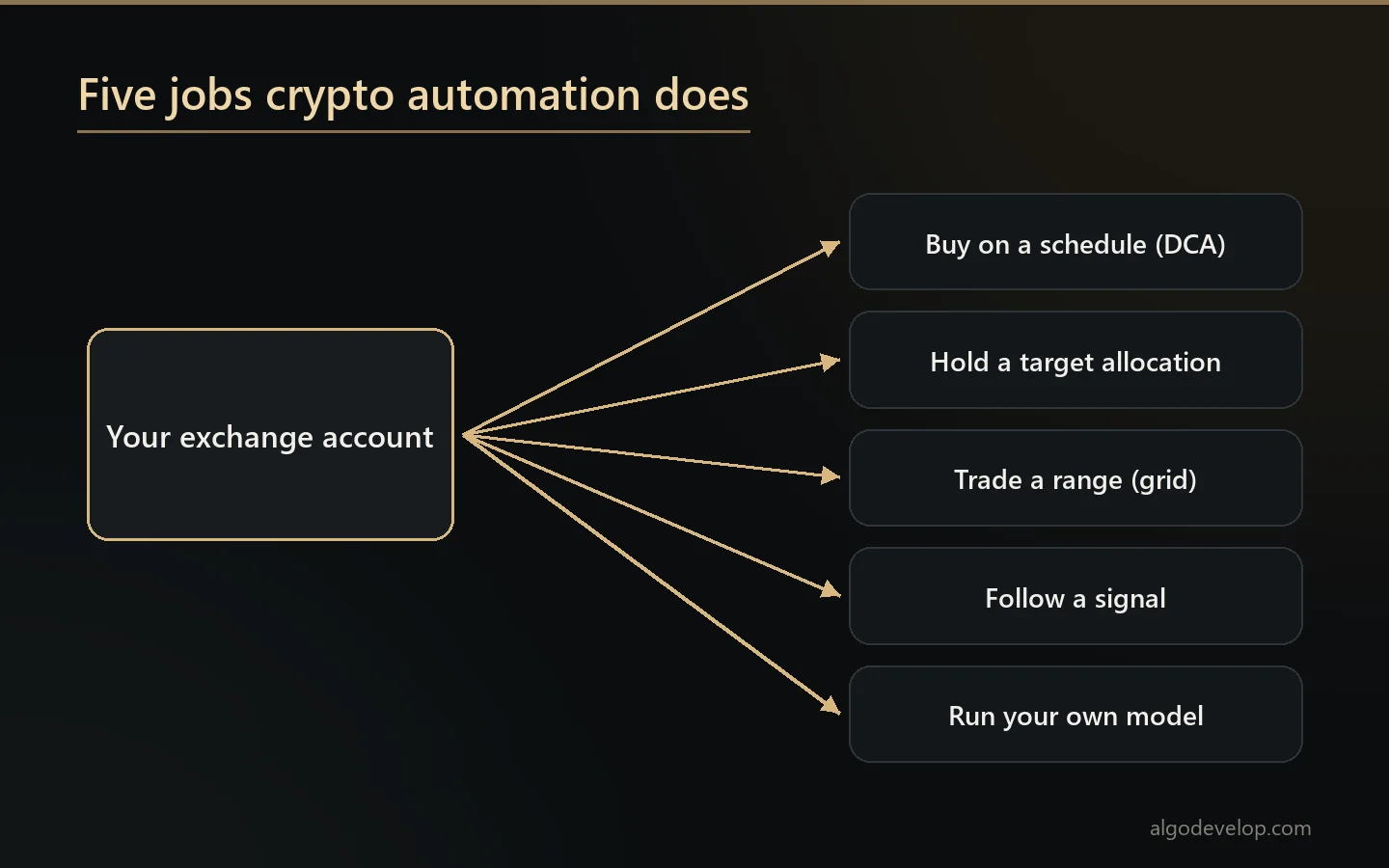
Most crypto trading automation requests turn out to be one of five jobs, and each has a very different risk shape:
- Accumulate – buy on a schedule, whatever the price.
- Hold a target allocation – rebalance back to your weights as they drift.
- Trade a range – a grid, laddered in and out.
- Follow a signal – your own indicator, a TradingView alert, or a channel.
- Run a model – something you have researched and tested yourself.
Name the job first, because it changes every decision that comes after it.
DCA and rebalancing, the quiet ones
The least exciting kind of crypto trading automation is often the most useful. A DCA bot buys a set amount on a schedule. A rebalancing bot, by contrast, sells what has grown and buys what has not, back to your target weights.
Neither one predicts anything, which is why they are the easiest to reason about. The work is in the details. Sizing has to allow for fees, so small buys do not vanish into minimums. Each pair’s minimum order value matters too. A drift threshold stops the bot from rebalancing every day for nothing, and a clean record helps when your accountant asks.
Grid bots, and the part people leave out
Grid is the kind of crypto trading automation people ask for most. A grid bot places buys below the price and sells above it, and it profits from movement inside a range. In a range it works well, and there are plenty of screenshots to prove it.
What the screenshots leave out is what happens when price leaves the range. On the way down, the bot keeps buying. Soon it holds a large position at an average well above the market, with no rule to stop. That is not the bot breaking down; it is exactly what a grid does.
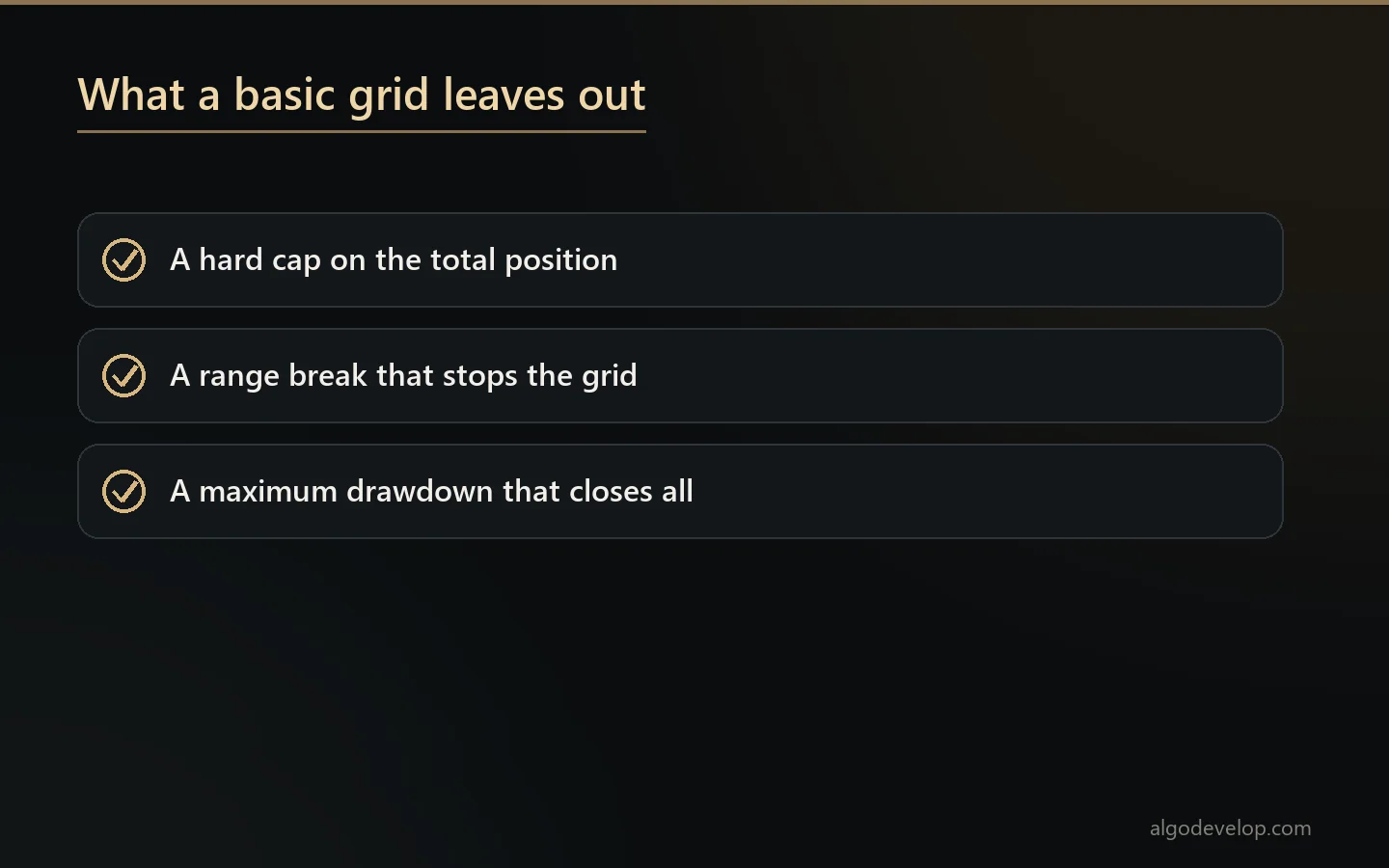
So building a grid is mostly building the parts a basic grid lacks. You need a hard cap on the total position, and a range break that stops the grid rather than widening it. You also need a maximum drawdown that closes everything. If you want a grid without those, the exchange’s own free grid tool will do it. We would rather tell you that than sell you the same thing.
Automating someone else’s signals
If the source is a channel rather than your own logic, the problem stays the same but the questions change. How should the software read the message? What happens to a signal that arrives while a position is already open? And how much should you size a source you did not write?
For two exchanges, ready-made bots already answer those questions. The Telegram to Binance bot and the Telegram to Delta Exchange bot trade a channel’s calls on your own account. For TradingView alerts, the TradingView to Binance bot and the TradingView to Delta Exchange bot do the same through a webhook.
In a custom build, the log keeps every skip with its reason, and it records results per source. So after a month you can see which channel is worth following, instead of guessing.
The guards, and why crypto needs more of them
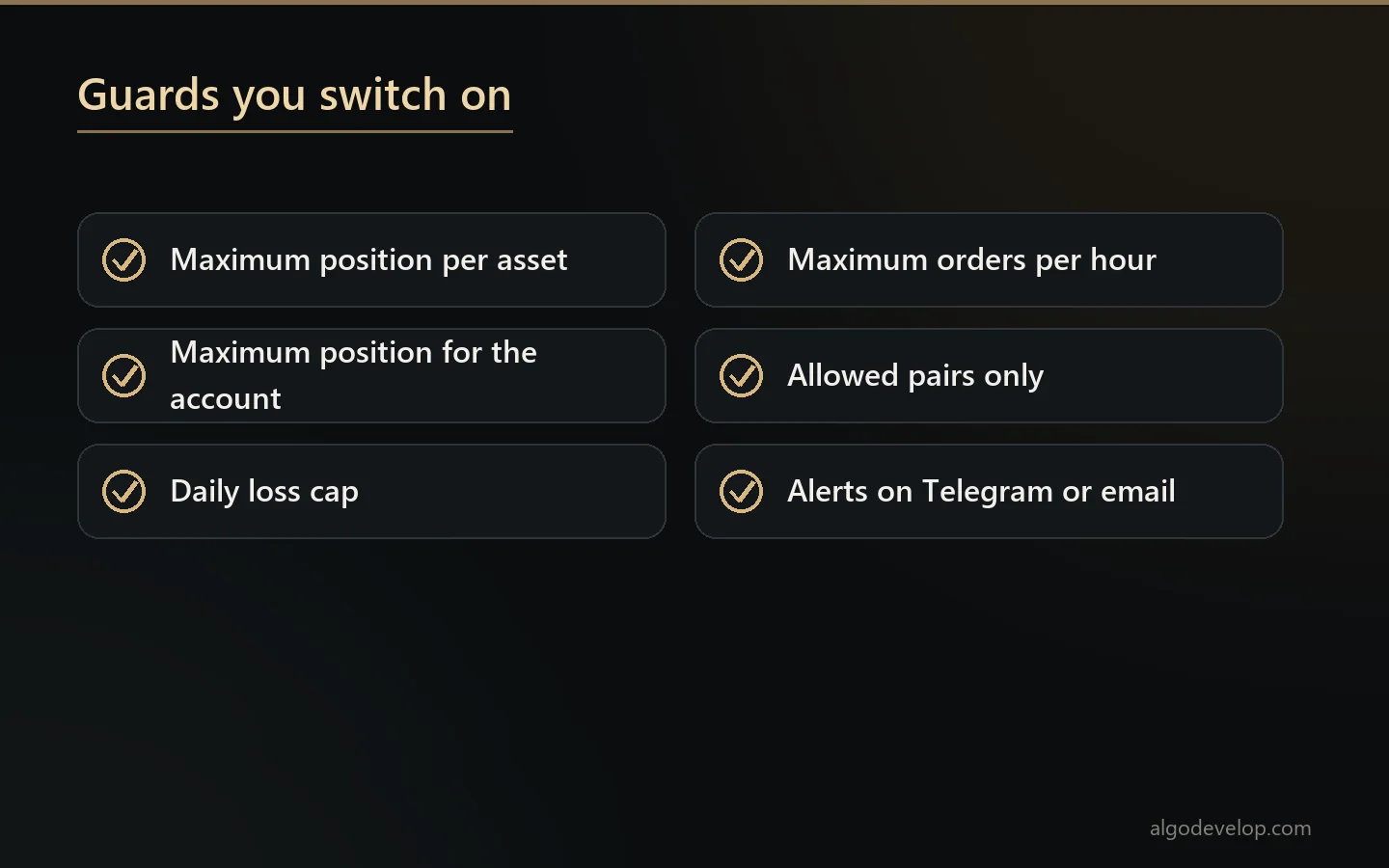
Crypto can move further in an hour than other markets move in a week, and no close interrupts it. So crypto trading automation needs more guards than most. Each of these stays off until you switch it on:
- Maximum position per asset and across the account.
- Daily loss cap that stops trading rather than letting a bad night compound.
- Maximum orders per hour, which also protects you from a bug in your own strategy.
- Allowed pairs only.
- Alerts to you on Telegram or email when it stops, errors, or hits a limit.
Two more should never be missing. The bot checks its positions with the exchange after a reconnect, rather than trusting its own memory. Also, it never treats a timed-out order as a failed one, because a timed-out order may well have filled.
Futures and options carry one more risk. Leverage is your own setting, and the exchange can liquidate a leveraged position. No guard removes that risk, so size for it.
Keys, custody and what can go wrong
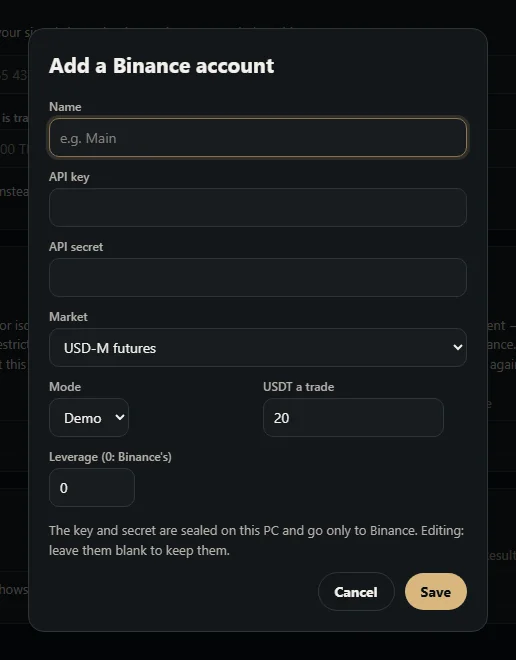
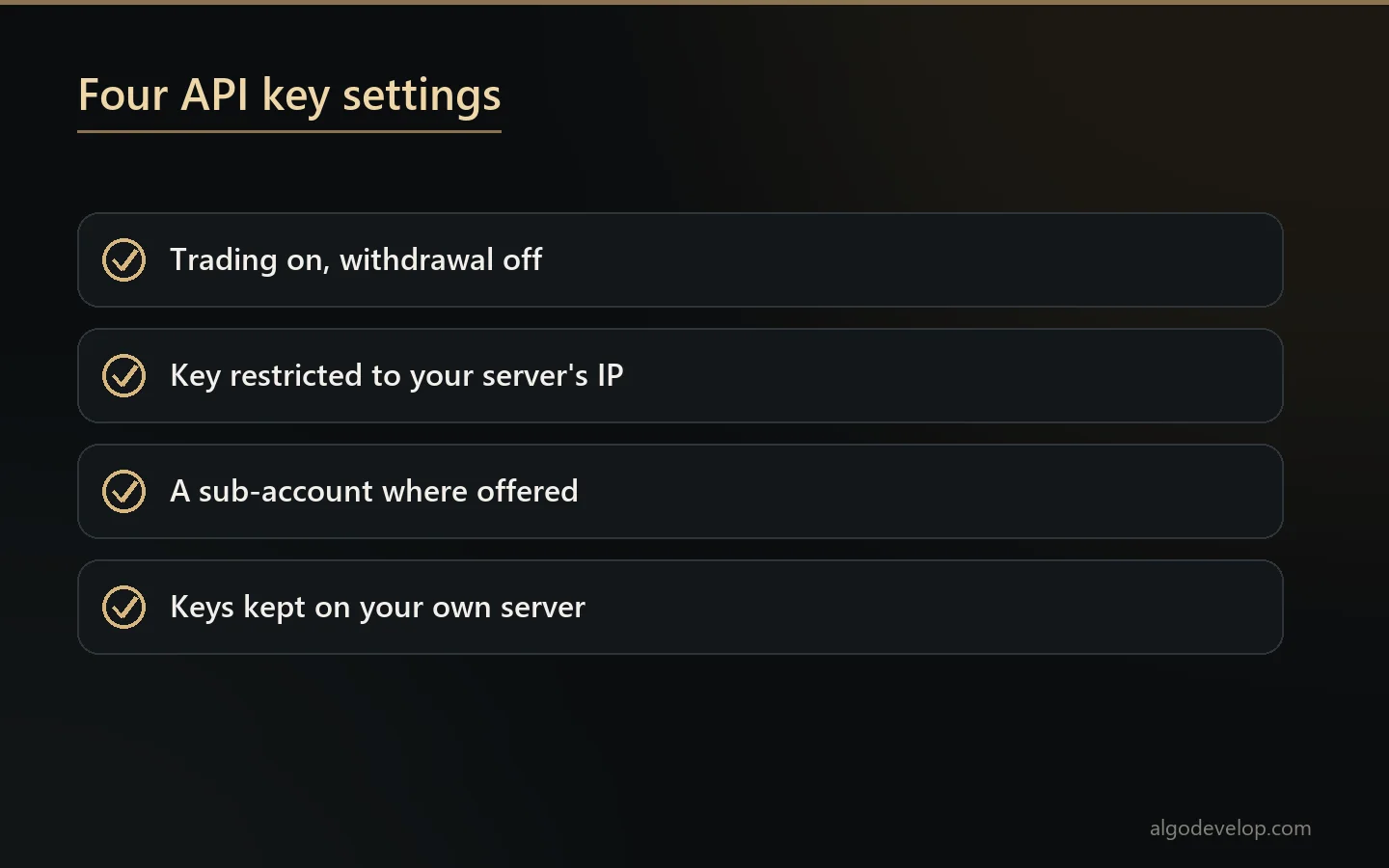
Your funds stay on your exchange throughout. The software signs in with API keys you create yourself, and four habits keep that safe:
- Enable trading, never withdrawal. The bot has no use for it.
- Restrict the key by IP to the server it runs on.
- Use a sub-account where the exchange offers one, so it can reach only the capital you put there.
- Keep the keys on your server. We never hold them.
Each exchange documents its own API and key settings. For example, see Binance’s API documentation or Delta Exchange’s API documentation.
Getting started
- Say which of the five jobs it is, and on which exchange. That one answer sets the scope of the whole project.
- We scope it and quote a fixed price, and tell you if the exchange’s own free tool already does it.
- We build and test it on testnet or at minimum size.
- You read the logs before it runs at size.
- It goes live, with alerts to you and every guard you asked for.
Crypto trading automation – frequently asked questions
Which exchanges can be automated?
Binance, Bybit, OKX, KuCoin, Kraken, Coinbase and others, through their official APIs, spot or derivatives. Binance and Delta Exchange also have ready-made bots. If yours is not listed, send the API documentation and we will tell you whether it is workable.
What is the difference between this and Python crypto bot development?
This page is about deciding what to automate, and why. Python crypto trading bot development is the build itself, for when you already know exactly what you want written.
Are grid bots safe?
A grid works in a range, but it keeps buying when price leaves the range on the way down. It then holds a large position at an average well above the market. That is what a grid does, so a custom grid adds a position cap, a range break and a maximum drawdown that closes everything.
Should I just use the exchange’s free bot?
Sometimes, and we would rather say so before you pay for crypto trading automation. If a plain DCA or a simple grid is all you need, the exchange’s own tool may do it for free. A custom build earns its cost when you need guards or logic the free tool does not have.
Do you ever hold my API keys or my funds?
No. Your funds stay on your exchange, and the keys stay on your own server. Enable trading only, never withdrawal, and restrict the key by IP to the machine it runs on.
What happens if the bot disconnects mid-order?
It checks with the exchange on reconnect, rather than trusting its own memory. It never treats a timed-out order as failed, because that order may have filled. Assuming otherwise is how accounts end up double-sized.
Can it follow a signal channel instead of my own strategy?
Yes. The Telegram to Binance and Telegram to Delta Exchange bots do it ready-made. A custom build logs every skip with its reason and records results per source, so you can see which channel is worth following.
Does it need to run all the time?
Crypto never closes, so crypto trading automation normally runs on a small VPS. It sends alerts to Telegram or email when it stops or hits a limit you set.
What stops a bad night compounding?
A daily loss cap, a maximum position per asset and across the account, and a cap on orders per hour. That cap also protects you from a bug in your own strategy. A list of allowed pairs adds one more limit.
How much does crypto trading automation cost?
The price depends on which of the five jobs it is, and on which exchange. Say what you are trying to do and we will quote a fixed price. We will also tell you honestly if the exchange’s own tool would do it: ask for a quote.
Ready to start?
Tell us your requirements and get a fixed quote — usually within a few hours.
Get a Free Quote on WhatsAppDisclaimer: AlgoDevelop is a software & automation development studio — not a SEBI-registered intermediary, broker, investment adviser, or research analyst. We do not provide trading signals, tips, or investment advice, do not execute trades as a service, and do not manage funds or accounts. Every tool is custom software that you operate on your own account, with your own credentials and API, under your own control. You alone make your trading decisions and are responsible for your results and for any registrations, approvals, or compliance your usage may require (including SEBI/exchange rules in India). Trading carries substantial risk of loss; past performance and backtests do not guarantee future results. No guarantee of profit.