Trading Strategy Automation
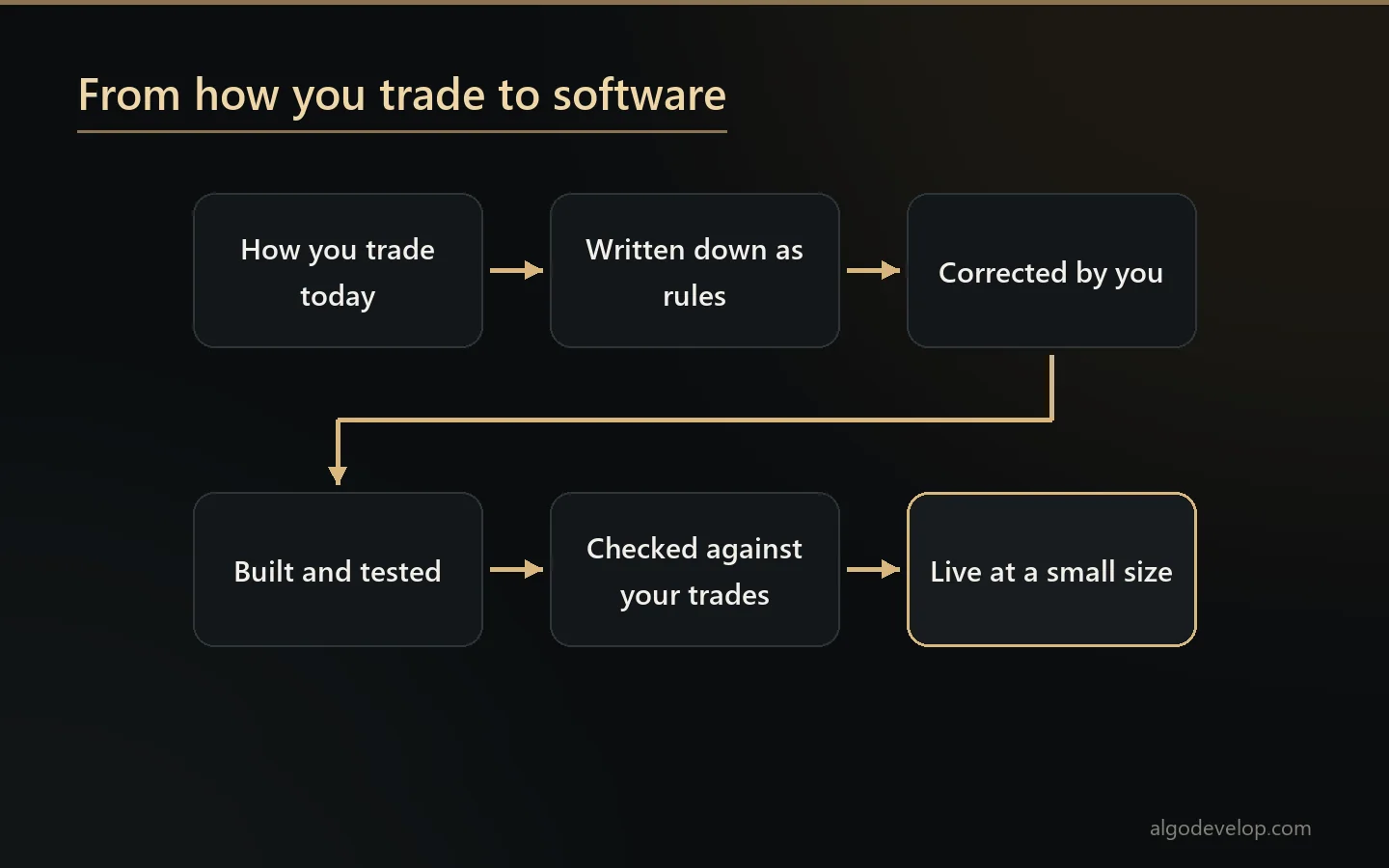
Trading strategy automation takes something you already trade by hand and turns it into rules a machine can follow. Then the machine follows them exactly, every time, whether or not you are watching.
On this page
What trading strategy automation is
Strategy automation starts from something you already do. You have a strategy in your head, on a chart, or in a routine you follow each morning. Now you want it to keep running while you sleep, work or simply rest.
That is a different starting point from ordering software. When somebody brings a written specification, the job is to build it. But when somebody brings a way of trading, most of the job is writing that specification first. This page is about that part.
The questions that decide whether it can be done
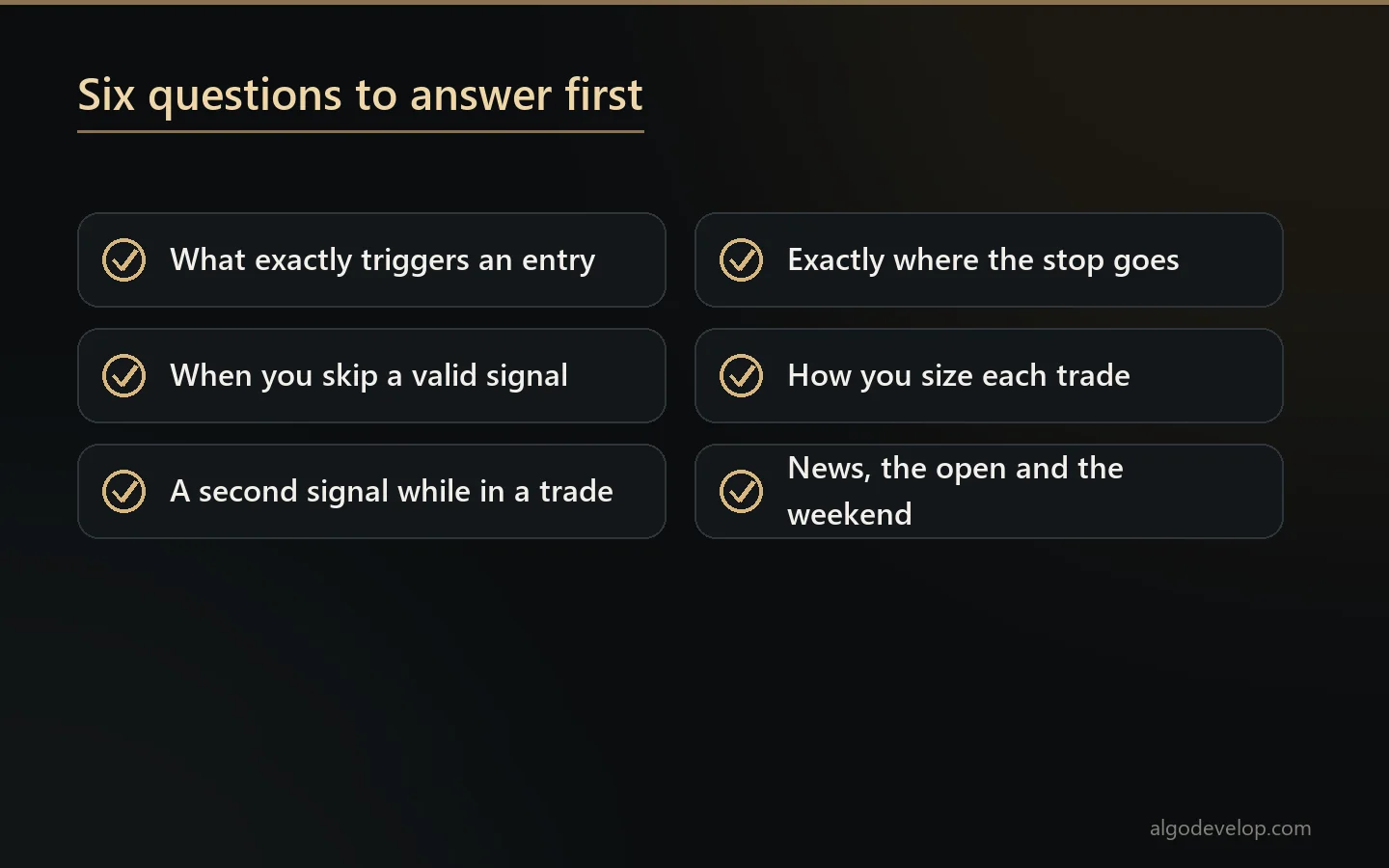
Every strategy automation project has to answer these questions. The answers often take longer than the coding, so think about them before you contact anyone:
- What exactly triggers an entry? Not “when the trend is clear”, but which value, on which timeframe.
- When do you skip a valid signal? Every discretionary trader does, and the reason is often a rule they never wrote down.
- What if a second signal arrives while you are in a trade? Add, ignore or replace.
- Where exactly does the stop go? A swing low is a rule. “Below the structure” is not one yet.
- How do you size, and does it vary?
- What do you do around news, the open and the weekend?
We ask these questions rather than guess the answers. A guess produces software that trades something close to your strategy, and close is worse than useless.
The part you cannot write down
Most strategies we see contain a piece that nobody has written down yet. It is the moment you look at the chart and decide the trade does not feel right. Pretending that piece does not exist is how automation projects disappoint.
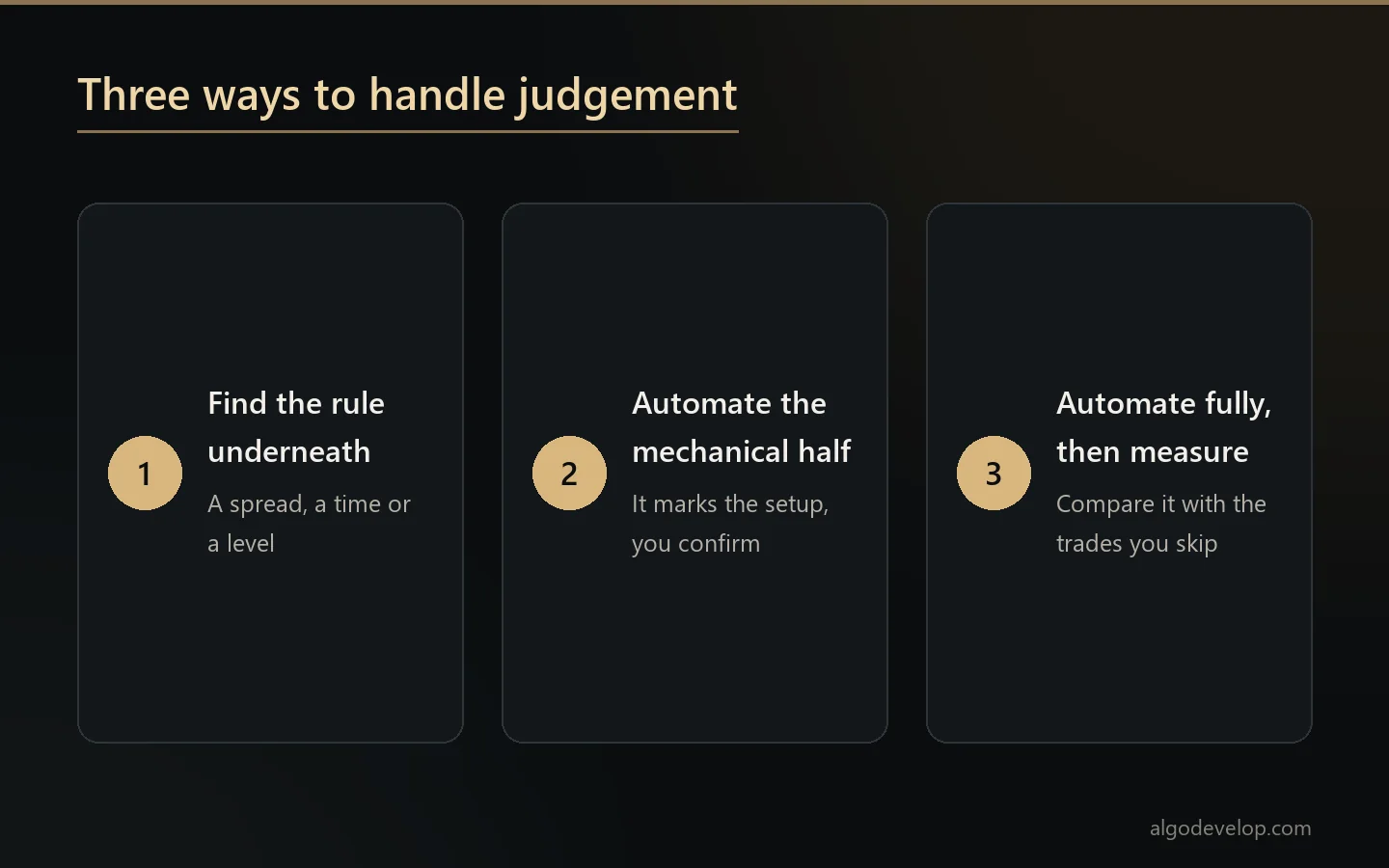
There are three honest ways to handle it:
- Find the rule underneath. There usually is one, such as a spread limit, a time of day or a distance from a level. Once you name it, the software can measure it.
- Automate the mechanical half. The software marks the setup and waits for you to confirm. After that, it manages everything that follows the entry.
- Automate fully and measure the difference. Sometimes the filter you apply by eye is worth less than the trades you miss while asleep. You can measure that before you decide.
Where strategy automation runs
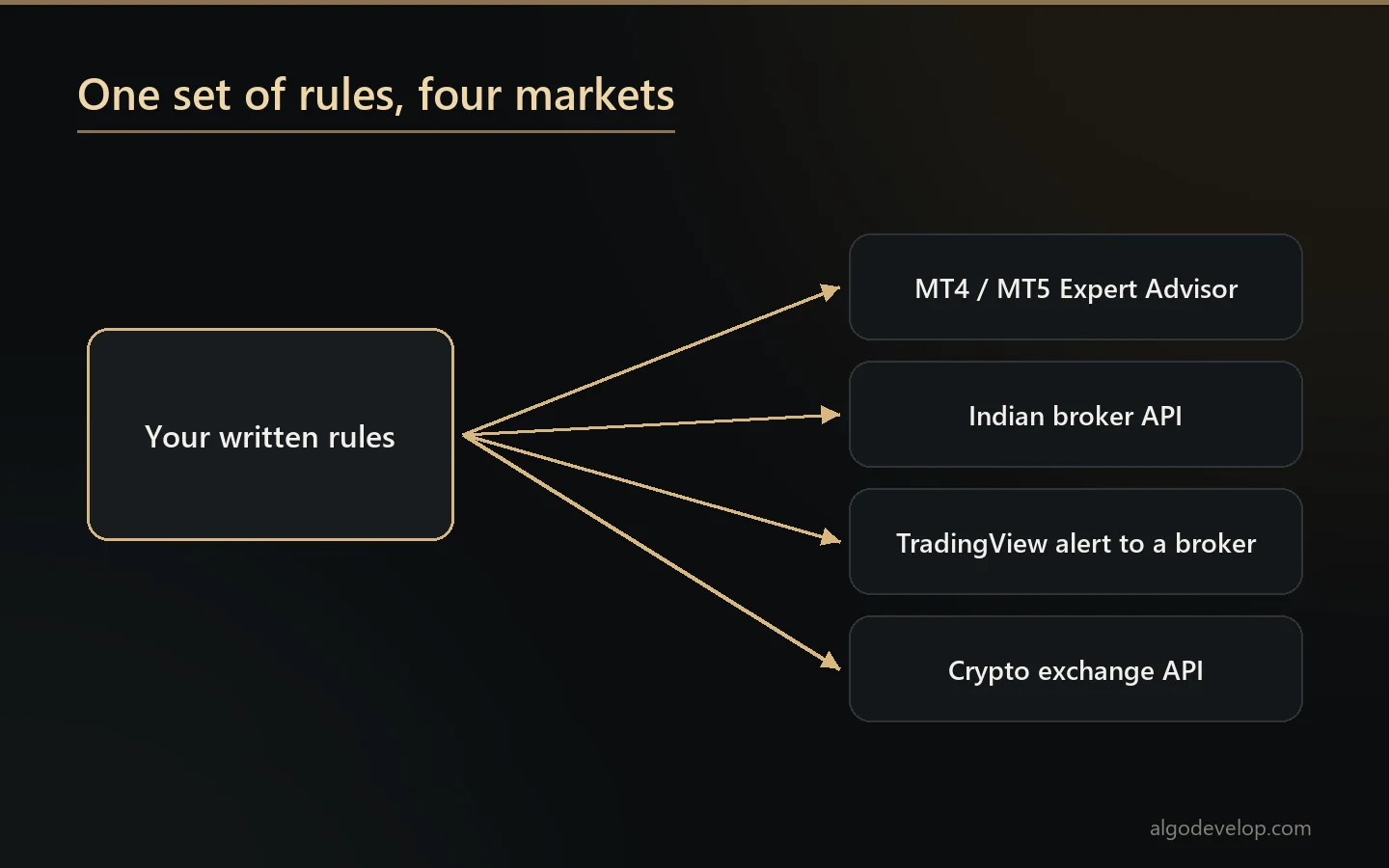
Strategy automation is the same discipline in every market. What changes is the platform underneath:
- MT4 and MT5 – forex, metals and indices, as an Expert Advisor in your own terminal.
- Indian markets – equity, F&O and MCX through your broker’s own API.
- TradingView – your Pine strategy fires a webhook that reaches a real account.
- Crypto – exchange APIs, in a market that never closes.
Would you rather follow a signal source than your own rules? Then there may be nothing to build. For example, the TradingView to MT4/MT5 copier and the Telegram to Indian broker copier are ready-made. Each one places those orders on your own account.
Proving it trades the way you do
A backtest tells you the code follows the rules. However, it does not tell you the rules are the ones you actually trade. Those are two different questions.
So, where you can share a period of your own trade history, we test against it. We run the software over the same dates and compare the two. Which trades did it take that you did not? Which did you take that it did not, and why?
That comparison is where the last few unwritten rules come out. They are the ones you did not know you had until you watched a machine break them. On MetaTrader, that test runs in the terminal’s own Strategy Tester. Also, MetaTrader 5’s own help on Expert Advisors explains what an EA is and how developers build one.
What automation changes, and what it does not
It changes the trades you miss while asleep and the entries you hesitate on. It also changes the stop you widen just this once, and the size you raise after two wins. Then there is the day you keep trading past your own limit because the loss feels recoverable.
It does not change whether the strategy has an edge. Strategy automation makes a losing strategy lose more consistently, because it removes the human errors that were sometimes saving you.
We will tell you if a strategy, as described, looks unlikely to survive costs. You may still want it, and then we will build it properly. But you will not hear that from us for the first time after delivery.
Living with it
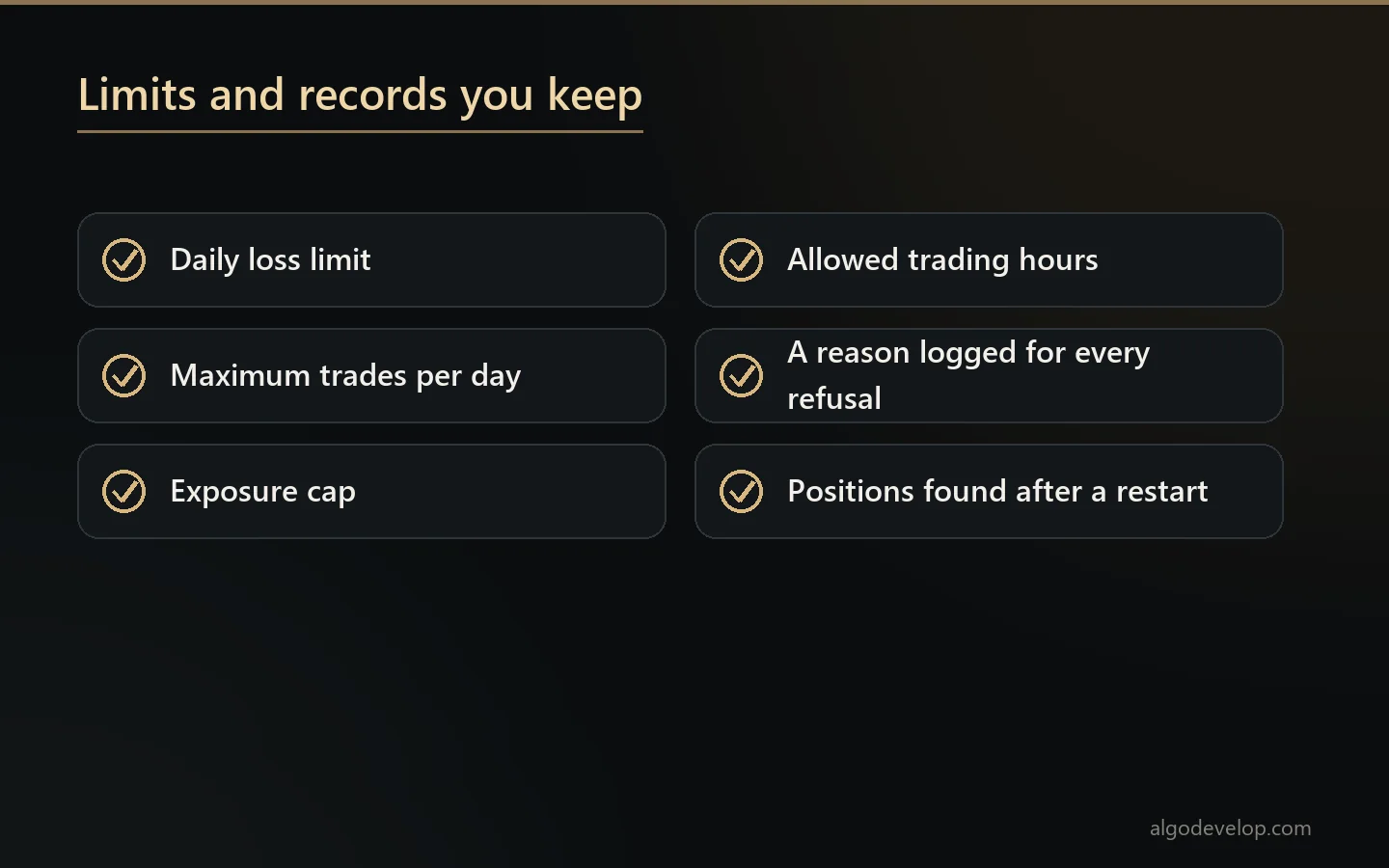
- A log that explains itself. It records every signal seen, every trade taken and every trade refused, with the reason.
- Limits you set. Daily loss, trade count, exposure and allowed hours stay off until you switch them on.
- It survives a restart. The software finds its own positions again rather than losing track of them.
- Adjustments afterwards. The first live month usually suggests two or three refinements, and that is normal rather than a failure.
Want the build rather than the specification work? That is trading bot development. Following somebody else’s calls rather than your own rules? That is copy trading software.
Trading strategy automation – frequently asked questions
What is trading strategy automation?
Trading strategy automation takes something you already trade by hand and turns it into rules that software can follow. Then the software follows them exactly, every time, without you.
How is this different from bot development?
Bot development builds from a specification you already have. Strategy automation is the step before that: it turns a way of trading into a specification.
My strategy is partly discretionary. Can it still work?
Yes, in one of three ways. Find the rule underneath the judgement, or automate the mechanical half and keep the decision. Otherwise, automate fully and measure what the discretion was worth.
What do I need to send you?
Written rules, a screen recording, or marked-up screenshots of your last twenty trades. Screenshots of real trades are often more useful than a document.
Will it trade exactly like me?
That is the target, and we test it. Given a period of your own trade history, we run the software over the same dates and show you every difference.
Will automating make my strategy profitable?
No. Strategy automation removes hesitation, missed trades and broken rules. It does not create an edge, so a losing strategy simply loses more consistently.
Which markets can it run in?
MT4 and MT5, Indian brokers, TradingView alerts sent to a broker, and crypto exchanges. The discipline stays the same, while the platform underneath changes.
Can it alert me instead of trading?
Yes. The software can mark the setup and wait for your confirmation. After that, it manages the stop, the targets and the exit by itself.
How long does it take?
It depends mostly on how clear your rules already are. The coding is usually the shorter half, and you get a timeline with a fixed quote.
What happens after delivery?
The first live month usually suggests two or three refinements. That is normal rather than a failure, and support covers it.
How much does strategy automation cost?
It depends on how many rules there are and how much of the strategy is still judgement. Describe it, even with screenshots, and we will quote a fixed price: ask for a quote.
Ready to start?
Tell us your requirements and get a fixed quote — usually within a few hours. Get a Free Quote on WhatsAppDisclaimer: AlgoDevelop is a software & automation development studio — not a SEBI-registered intermediary, broker, investment adviser, or research analyst. We do not provide trading signals, tips, or investment advice, do not execute trades as a service, and do not manage funds or accounts. Every tool is custom software that you operate on your own account, with your own credentials and API, under your own control. You alone make your trading decisions and are responsible for your results and for any registrations, approvals, or compliance your usage may require (including SEBI/exchange rules in India). Trading carries substantial risk of loss; past performance and backtests do not guarantee future results. No guarantee of profit.