Broker API & Bridge Development
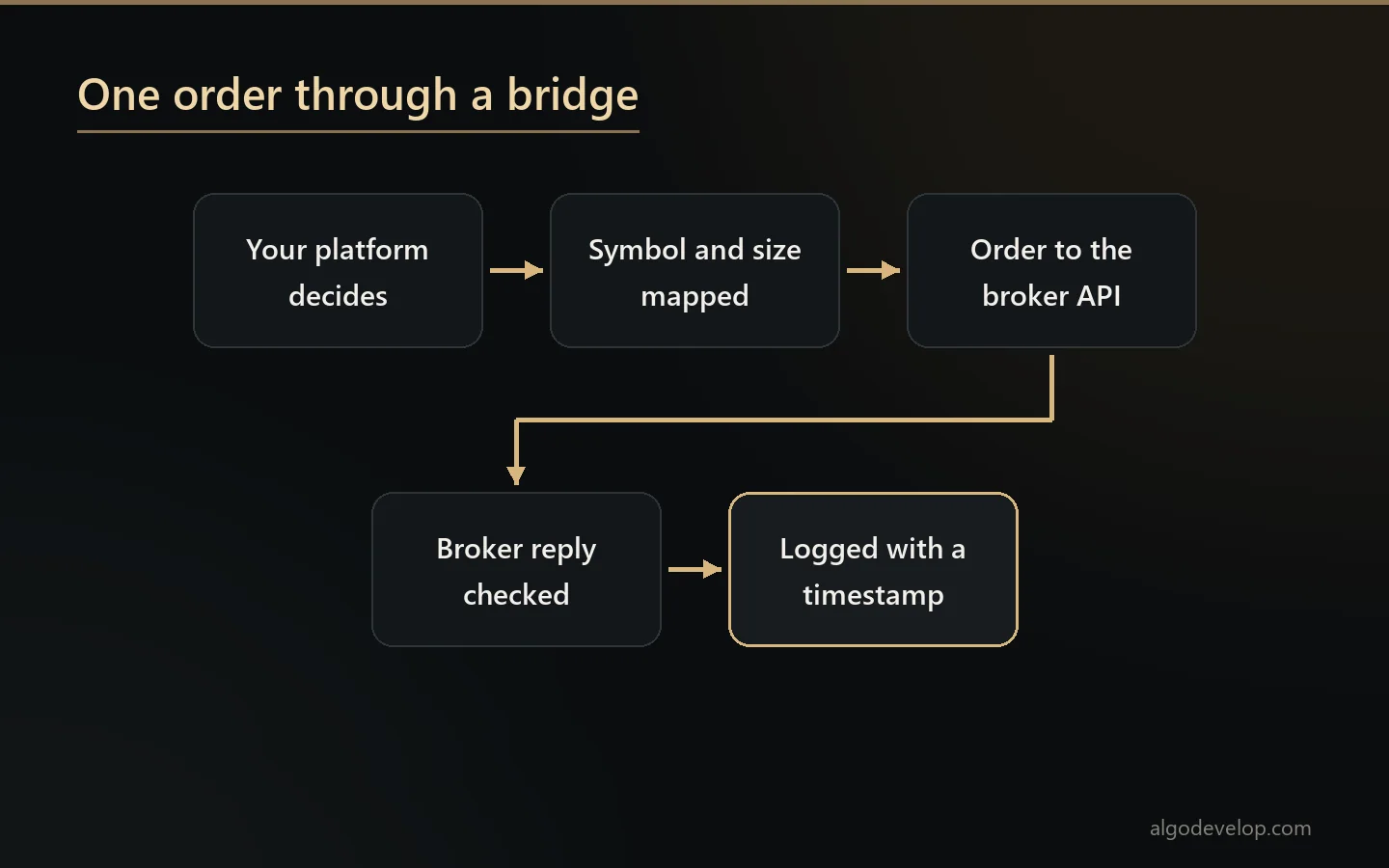
Broker API bridge development is the work of making one system place orders in another. Your platform, your strategy or your dashboard talks to a broker that was never designed with it in mind.
Bring a finished design or only a rough idea. Either way, we build exactly what you describe. You get it tested and documented, and you own it outright.
On this page
- What broker API bridge development actually means
- The shapes these projects take
- REST, WebSocket and FIX
- Symbols, sizes and the translation problem
- Sessions, tokens and staying connected
- Logging, and why it is not optional
- What we need before we can quote
- What you receive on delivery
- How a project runs
- Frequently asked questions
What broker API bridge development actually means
Broker API bridge development builds a layer between two systems that do not speak the same language. Then it makes them agree. On one side is whatever makes the trading decisions. That might be a MetaTrader terminal, a Python strategy, a web dashboard or a signal feed. On the other side, however, sits a broker or exchange with its own API. It also has its own names for things and its own idea of a valid order.
In fact, almost none of the difficulty lies in sending the order. Instead, broker API bridge development is mostly the translation and the failure handling on either side of that one line.
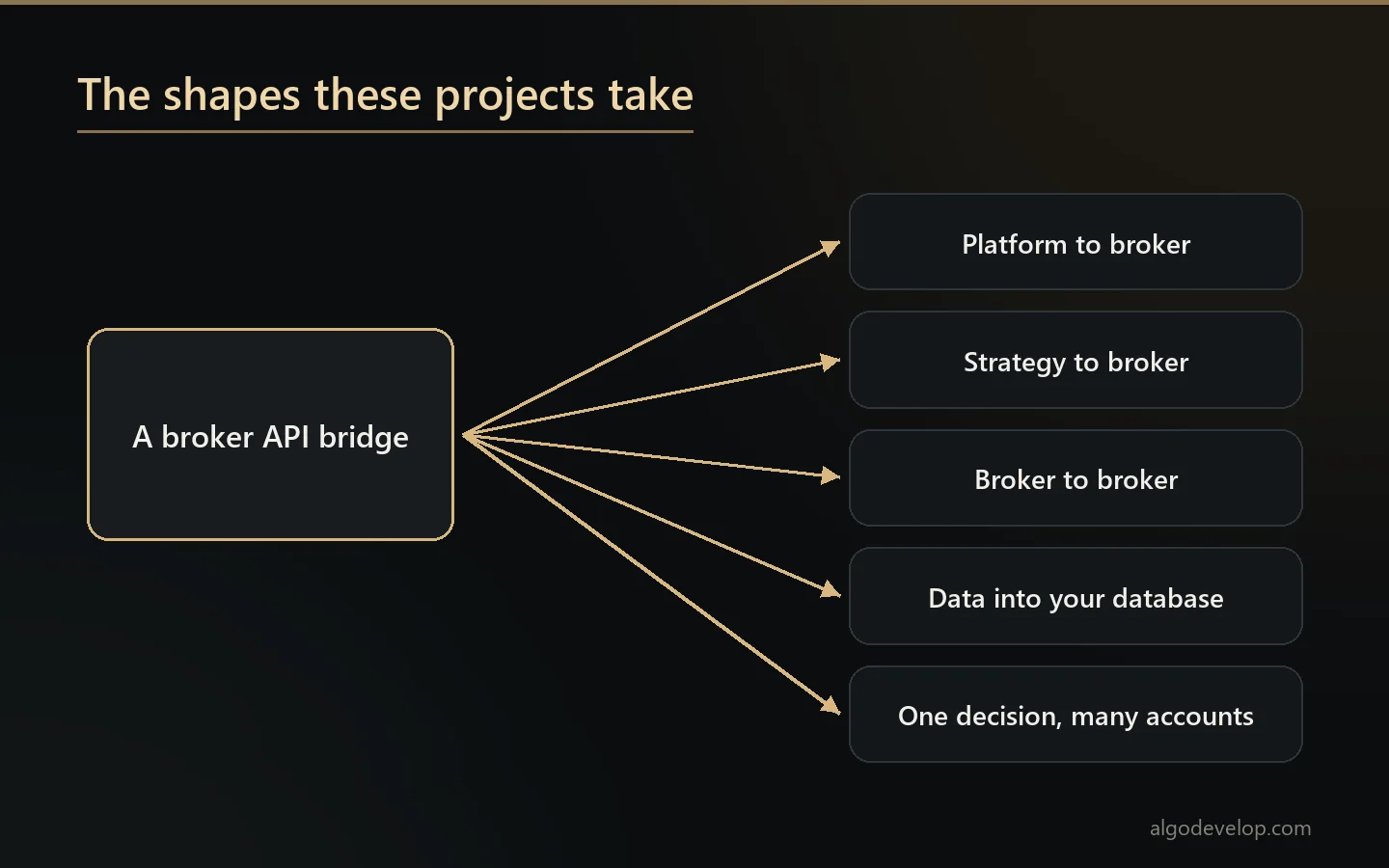
The shapes these projects take
- Platform to broker. MetaTrader, or your own app, placing orders at a broker that has an API but no native link to it.
- Strategy to broker. A Python or C# model that decides, and needs somewhere to send the result.
- Broker to broker. Mirroring positions between two accounts that are not on the same platform.
- Data bridges. Pulling prices, positions or history out of a broker into your own database or dashboard.
- Multi-account routing. One decision reaching several accounts, each with its own size. See multi-broker copy trading for that as a finished product.
Some shapes already exist as ready-made tools. For example, the MT4 to MT5 copier mirrors trades between MetaTrader accounts. Likewise, the TradingView to Indian broker copier turns TradingView alerts into orders at Indian brokers.
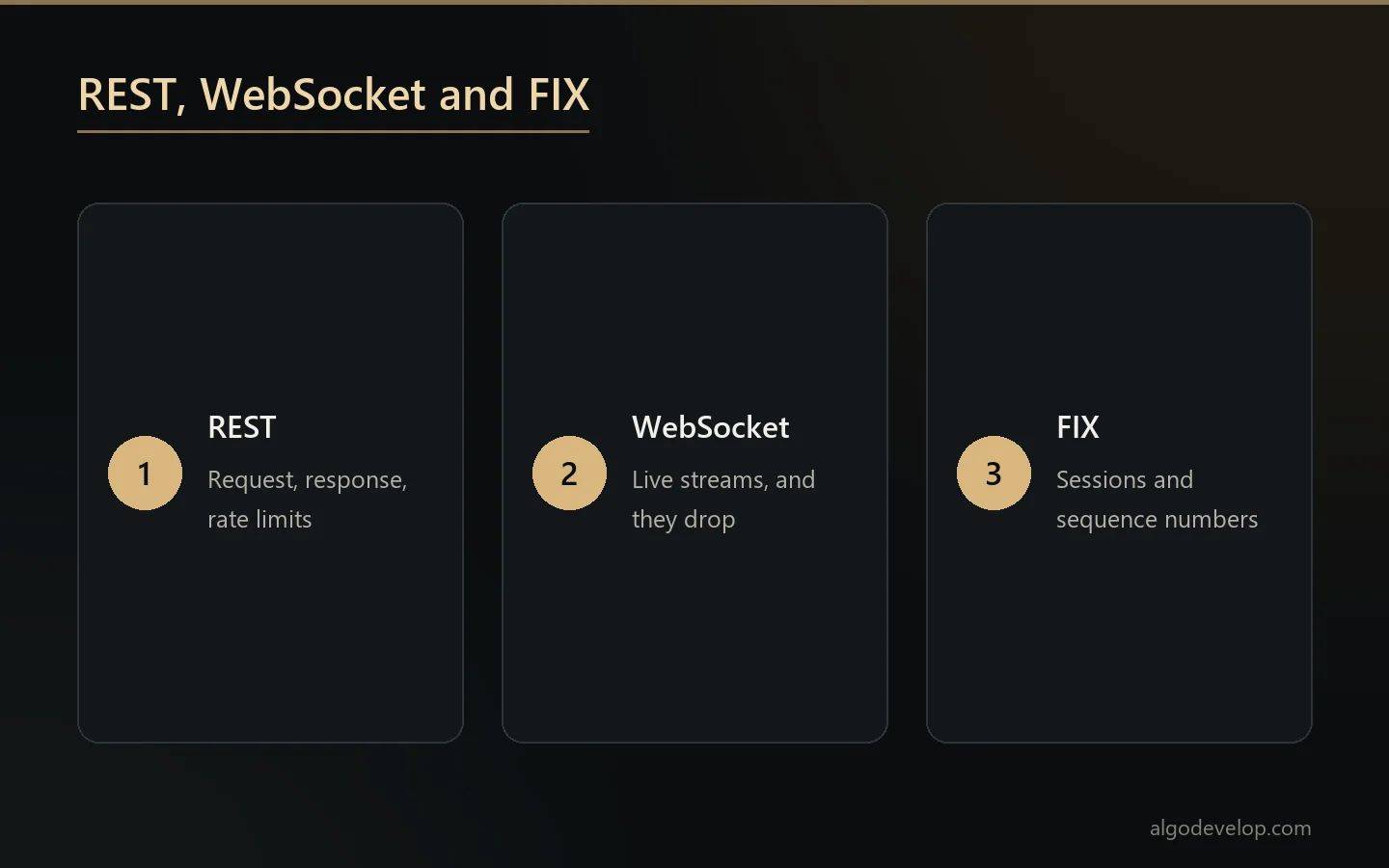
REST, WebSocket and FIX
In broker API bridge development, the broker decides the protocol, not our preference. Each one also brings its own work.
REST is the most common and the simplest to reason about: a request, then a response. The catches are rate limits, and the fact that a request that timed out may still have gone through.
WebSocket is what brokers offer for streaming prices and order updates. It is faster, but it drops. So a bridge that treats a disconnect as anything other than routine will fail on some Monday morning.
FIX is what big institutions expect, and it is a different kind of project. It means sessions, sequence numbers, heartbeats and resend requests. It also means a separate spec for each firm, because everyone’s FIX is slightly their own. The FIX Trading Community publishes the standard itself. We do FIX work, and we scope it separately, since it is not comparable to a REST integration.
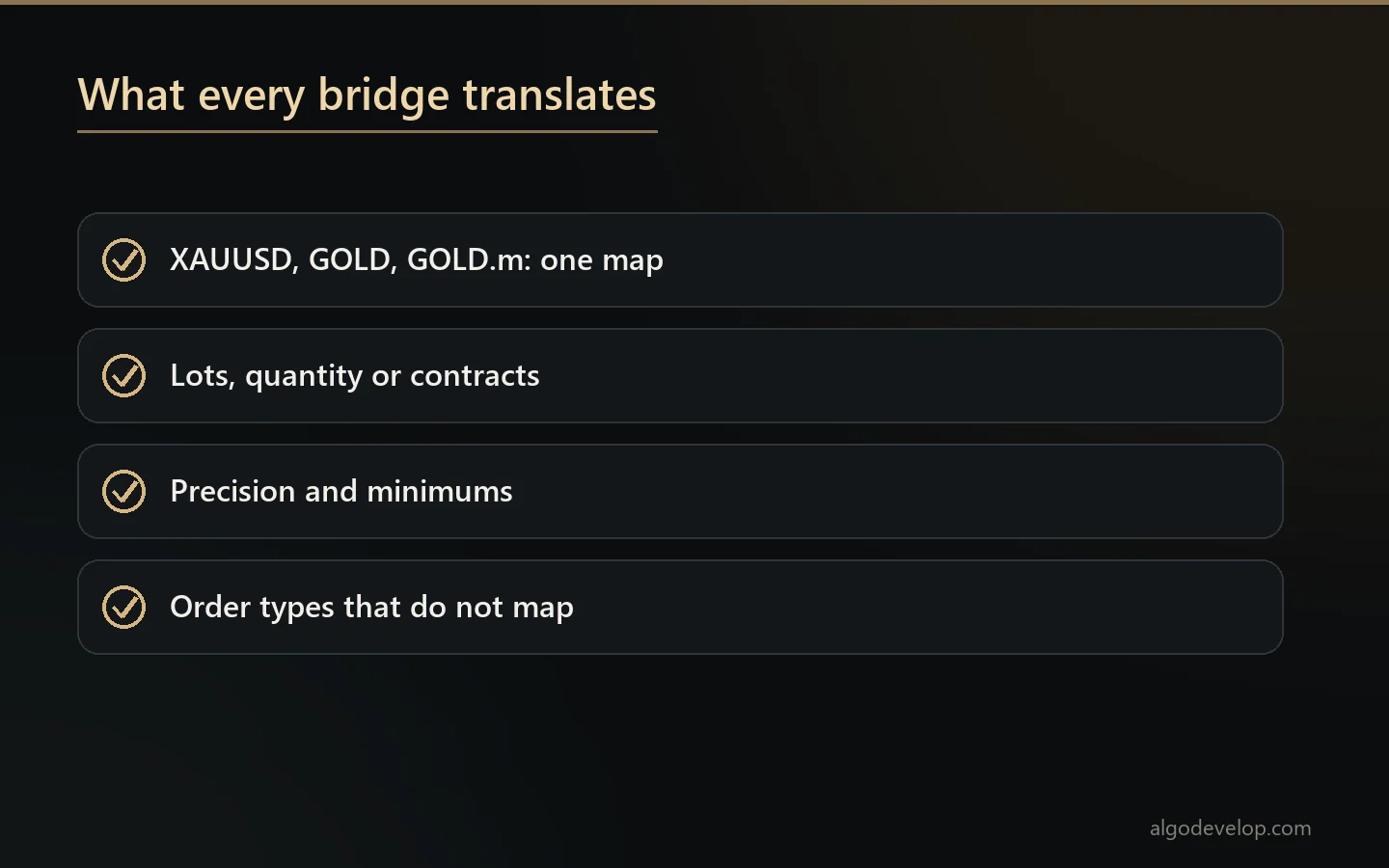
Symbols, sizes and the translation problem
This is where most broker API bridge development fails in production rather than in testing.
- Symbols do not match. XAUUSD, GOLD, GOLD.m and XAU/USD are the same instrument with four names. So the mapping has to be explicit, not guessed.
- Sizes are not the same unit. There are lots at one end, quantity at the other, and contracts somewhere else. An F&O lot can even change size by expiry.
- Precision and minimums differ. A quantity that one venue accepts, another may still reject. Rounding it the wrong way also changes your exposure.
- Order types do not map one to one. Stop, stop-limit, SL-M and market-if-touched are not the same set everywhere. An honest bridge tells you what it could not represent instead of quietly choosing something close.
Sessions, tokens and staying connected
Broker API sessions expire, and broker API bridge development lives or dies on handling that. For example, some expire daily, some hourly, and some on a schedule no document mentions.
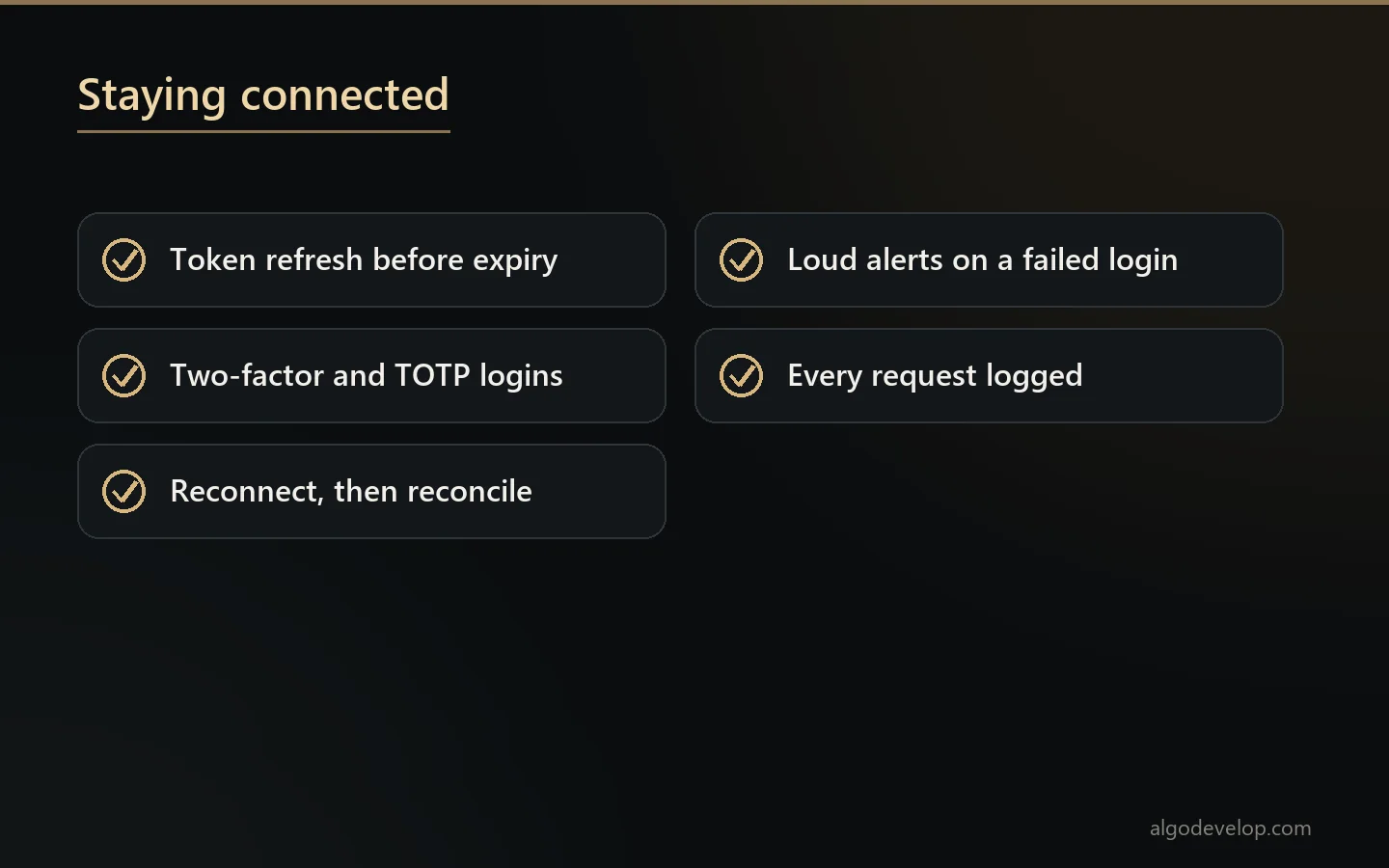
- Token refresh happens automatically, before expiry rather than after the first rejection.
- Two-factor and TOTP flows run where the broker requires them, so nobody logs in by hand each morning.
- Credentials stay on your own servers. We build the bridge; we do not hold your keys.
- Reconnect, then reconcile. When it comes back, the bridge asks the broker what is really open rather than trusting its own memory.
- Failures are loud. A login that stops working raises an alert, not a silence.
Indian brokers also add one more rule. Since 1 April 2026, SEBI’s retail algo framework applies. An Indian broker now accepts an API order only from a static IP registered to you. So the bridge must run on a machine with that IP. Our Indian broker automation pages cover each broker in turn.
Logging, and why it is not optional
When money moves through a bridge, “it should have worked” is not an answer. That is why logging is part of broker API bridge development rather than an extra. The bridge records every request and every response with a timestamp, including the broker’s own error text. As a result, you can rebuild a disputed order exactly as it happened. In short, that log is as much a deliverable as the code.
What we need before we can quote
- The broker’s API documentation. A public link is ideal, such as Zerodha’s Kite Connect docs, but a PDF is fine.
- What sits on the other side – the platform, the language, and whether we are writing that end too.
- A sandbox or demo account, if the broker provides one. If not, say so at the start, because it changes how we test the work.
- The instruments and order types you really need, which is usually far fewer than the API supports.
We read the documentation before quoting, not after. If something you want is not in the broker’s API, you will hear it from us before you commit.
What you receive on delivery
- Full source, with comments.
- Configuration for credentials, endpoints and mappings, kept apart from the code.
- The symbol map as a file you can edit yourself.
- A plain guide to every setting and every error the bridge can report.
- Deployment steps for your own server.
- Support after delivery, plus reasonable adjustments.
How a project runs
- Send the API documentation and describe both ends of the bridge you need.
- We read it and quote a fixed price, flagging anything the broker’s API cannot do.
- Building happens against the sandbox, or at minimum size if there is none.
- You review the logs before it carries real orders.
- We deliver, document and support it.
Every broker API bridge development project follows those five steps. The trading bot development page lists everything else we build, and platforms shows the platforms we work with.
Broker API bridge development – frequently asked questions
Which brokers can you integrate with?
Any broker or exchange that publishes an order-placement API, whether REST, WebSocket or FIX. Send us the documentation, and we will tell you what is possible before you commit to anything.
Can you do FIX API work?
Yes, and we scope FIX separately from REST broker API bridge development. Sessions, sequence numbers, heartbeats and resend requests make FIX a different kind of project. Also, every counterparty’s FIX is slightly its own.
Do you hold my broker credentials?
No. Credentials stay on your own servers. We build the bridge, but we do not run it for you. We also never keep or even see your keys.
What happens when the broker’s session expires?
The bridge refreshes tokens before they expire rather than after the first rejection. That also covers two-factor and TOTP flows where the broker requires them. If a login stops working, it raises an alert rather than going quiet.
My broker calls gold something different. Is that a problem?
No, but the mapping has to be explicit rather than guessed. You get the symbol map as a file you can edit yourself, not something buried in the code.
What if an order type does not exist at the other end?
The bridge reports what it could not represent instead of quietly swapping in something close. After all, choosing the nearest match is a decision that belongs to you, not to the code.
Do I need a sandbox or demo account?
Ideally yes, because it helps broker API bridge development a great deal. If the broker does not offer one, tell us at the start. It changes how we test the work, and so what it costs.
Can the bridge send one order to several accounts?
Yes. If that is the whole requirement, our multi-broker copy trading platform may already be what you need.
What do you need from me to quote?
Send the broker’s API documentation and describe what sits on the other side. Then list the instruments and order types you really need, which are usually far fewer than the API supports. We read the documentation before quoting, not after.
How much does broker API bridge development cost?
It depends on the protocol, how many order types matter, and whether we write both ends. Send the API docs, and we will quote a fixed price. Ask for a quote.